The UFO Library: Military encounter
Milton Torres RAF Manston UFO Intercept
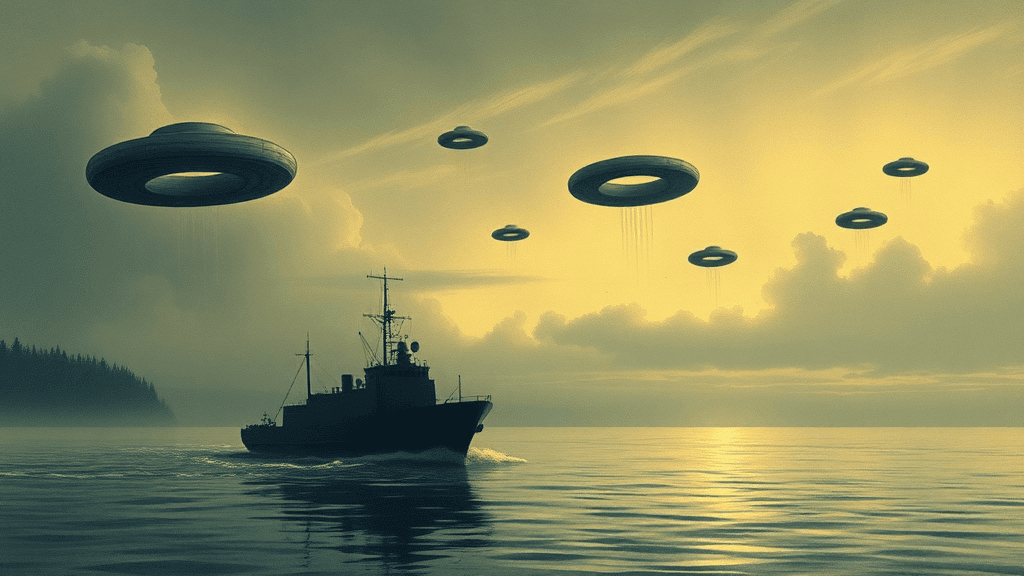
A USAF interceptor pilot was scrambled from RAF Manston and ordered to fire a full rocket salvo at a massive, radar-tracked object over the North Sea, only for it to vanish at an estimated Mach 10 before he could shoot.
Background
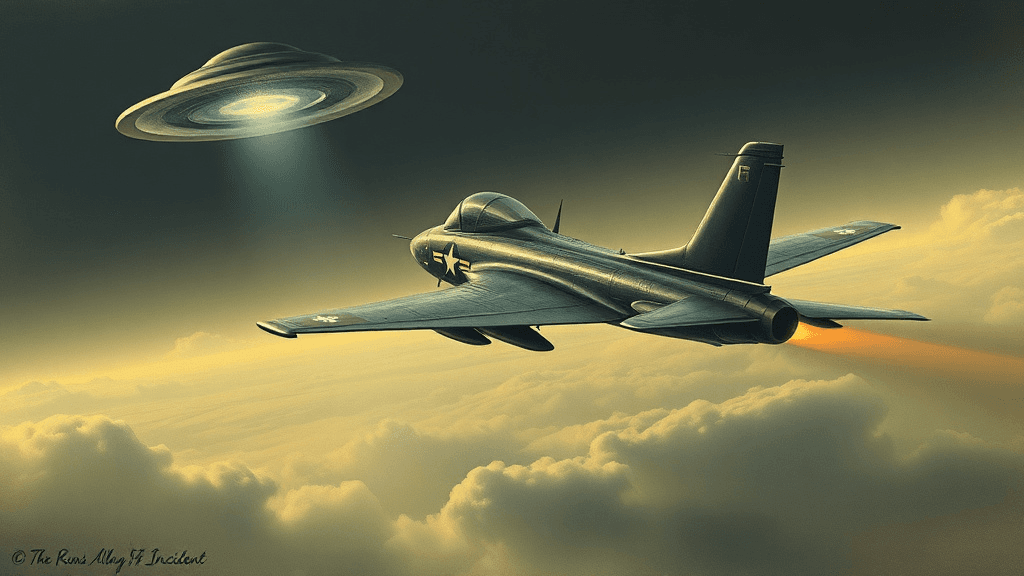
By May 1957 the air defense of the United Kingdom was a joint British-American enterprise. Under NATO arrangements, United States Air Force fighter-interceptor squadrons flew from RAF stations alongside RAF units, feeding into the same ground-controlled interception network that watched the skies for a Soviet bomber strike. RAF Manston, on the Kent coast, hosted the 406th Fighter Interceptor Wing, and its 514th Fighter Interceptor Squadron flew the North American F-86D Sabre — the radar-equipped, all-weather variant of the famous Korean War fighter, armed not with guns but with a retractable belly tray of 24 unguided 2.75-inch "Mighty Mouse" Folding Fin Aircraft Rockets, fired in a single devastating salvo.
First Lieutenant Milton John Torres, born July 28, 1931, was 25 years old and a junior member of the squadron. Like all interceptor pilots of the period, he and a wingman, Dave Roberson, spent portions of their duty cycle sitting in the cockpit at the end of the runway on five-minute alert, ready to be vectored by ground radar controllers onto anything that entered UK airspace unannounced. Their controller sat far from Manston itself, inside the Metropolitan Sector ("Met Sector") bunker, a hardened underground command post near Kelvedon Hatch in Essex built to survive a 20-kiloton nuclear detonation. On the night of May 20, 1957 — a pitch-black night with thick cloud cover over the Channel and North Sea — that routine alert became something else entirely.
The Scramble
Near midnight, the order came to launch. Torres and Roberson took their F-86Ds airborne and were vectored by Met Sector toward a contact roughly 15 miles out over the North Sea, east of the East Anglian coast. There would be no chance of a visual identification: the cloud deck and darkness meant the encounter, from Torres's cockpit, would be conducted entirely on instruments and on the small green scope of his onboard AN/APG-36 fire-control radar.
What he found there was not the modest return of a stray airliner or a misidentified weather balloon. The radar signature was enormous and rock-solid — Torres later compared its proportions on the scope to a B-52 Stratofortress, and in interviews decades afterward he reached for a still stranger image: something with "the proportions of a flying aircraft carrier." Ground control, watching the same picture from the Essex bunker, treated the contact as a live air-defense threat. Torres was ordered to close and, extraordinarily, to fire.
The Intercept
Because a shooting order over British soil aimed at an unidentified target was so far outside normal procedure, Torres said he refused to act on it until it was authenticated — a standard Cold War safeguard against a spoofed or mistaken command triggering an international incident. The authentication came back confirmed. Torres armed his full salvo of 24 rockets and closed the range, his radar tracking a closure rate later described as roughly 800 knots.
Then, in the last seconds before he would have fired, the picture on his scope broke apart. The closure rate reportedly reversed almost instantaneously to roughly negative 200 knots — meaning the target had not merely turned away but had accelerated past and away from Torres's own aircraft, itself moving at high subsonic speed, in a fraction of a second. Torres put the object's departure speed at somewhere around Mach 10, ten times the speed of sound, and described the turn that preceded it as one that "didn't follow classic Newtonian mechanics." Within moments the contact was gone from the scope entirely. Torres never fired a rocket, never saw the object with his own eyes, and returned to Manston with nothing but a radar trace, a fire-control tape, and an authenticated order to fire on something that no longer existed as far as any instrument could tell.
Silence and Disclosure
According to Torres, the aftermath was as strange as the intercept itself. He said he was met on the ground not by a routine flight surgeon or intelligence officer but by a civilian in a dark blue trench coat who identified himself as connected to national security — in some tellings a domestic "secret service" contact, in others someone claiming an NSA affiliation. Torres was informed the mission was Top Secret and warned that discussing it, even with fellow pilots, could cost him his wings.
He kept that silence for thirty-one years. It broke, almost by accident, at a 1988 reunion of 514th Squadron veterans held back at RAF Manston, where Torres crossed paths with his old wingman Dave Roberson and the two compared memories of the night for the first time since 1957. Around this period a written account of the incident — by some accounts drafted with the help of a UFO researcher who had heard Torres's story — was sent to the UK Ministry of Defence. It sat, like thousands of other UFO reports, in the department's classified files for two more decades.
The case only reached the public when Britain's MoD, compelled by the Freedom of Information Act, began releasing tranches of its UFO files to the National Archives starting in 2008. The Torres file was part of that October 2008 release, catalogued among files identified in later archive indexes as DEFE 24/1931/1 and DEFE 24/1942/1. Mainstream outlets, including NBC News, picked up the story under headlines describing an American pilot "ordered to shoot down" a UFO over Britain — the first time most of the public, on either side of the Atlantic, had heard Torres's name.
Investigation and the Palladium Hypothesis
When journalists and researchers, including the Sheffield Hallam University academic and MoD-files specialist Dr David Clarke, went looking for corroborating paperwork, both the Ministry of Defence and the USAF reported they held no records of the specific incident described by Torres and Roberson. That absence is not, on its own, damning: British officials have noted that MoD policy through 1967 was to destroy UFO-related files after five years, which — if applied here — would have erased any contemporaneous 1957 paperwork long before anyone thought to ask for it in the 1980s.
Lacking a document trail, investigators have instead reached for a Cold War explanation that fits the technology of the era: electronic deception. One theory floated in MoD correspondence held that the giant, fast-moving "target" Torres locked onto was not a physical object at all but a bogus radar pulse, deliberately transmitted to create the illusion of a solid contact on an interceptor's fire-control scope — precisely the kind of trick an adversary, or an allied service testing adversary countermeasures, might want to rehearse against NATO's air-defense radar network. Some writers have connected this to the CIA's real, declassified Operation PALLADIUM, a program built to inject false "ghost" targets onto Soviet radar. The connection is suggestive but imperfect: available declassified material indicates Palladium-style spoofing tests did not begin until the early 1960s, several years after the Manston intercept, which weakens rather than confirms the link. Clarke has suggested more broadly that a still-unacknowledged American electronic-warfare trial, rather than PALLADIUM specifically, may be the likelier candidate — though he stops short of calling it proven.
The case for and against
The case for taking Torres seriously rests substantially on Torres himself. He was not a fringe witness: he went on to a twenty-year Air Force career that included 276 combat missions over Vietnam and thirteen Air Medals, earned a doctorate in engineering, and became a university professor at Florida International University before retiring in the early 2000s — a biography that reads as unusually credentialed even by the standards of career-military UFO witnesses. His account is also, in its broad strokes, corroborated by a second named witness, wingman Dave Roberson, and it aligns with an authenticated file reference in the National Archives rather than resting on Torres's word alone.
Against that, the case is built entirely on radar returns interpreted by a single pilot at night through heavy cloud — there was no visual sighting, no photograph, no independent ground-radar confirmation released alongside the file, and no physical trace. The thirty-one-year gap between event and disclosure, however plausibly explained by an intimidating debrief, means the earliest surviving account is a decades-old recollection rather than a contemporaneous report. And a mundane, historically grounded alternative — a classified electronic-warfare exercise producing a phantom radar target — remains available and arguably more parsimonious than a physical craft capable of reversing from an 800-knot closure to a Mach-10 departure in seconds, which would imply structural and propulsion physics with no known analog. Torres himself never wavered from the extraordinary reading: "I think it was an alien spacecraft," he told interviewers in later years. "What I saw on my radar screen was an actual object. It was nothing made on Earth."
Cultural impact
The Torres case entered wider UFO culture relatively late, only after the 2008 file release, but it quickly became a fixture of British "MoD files" UFO discourse alongside cases like the Lakenheath-Bentwaters incident of August 1956 — another radar-visual military encounter involving USAF assets stationed in England just nine months earlier. Former MoD UFO desk officer Nick Pope discussed the incident publicly, and it was dramatized as part of the 2015 documentary series UFOs Declassified, which aired on History/Yesterday and the Smithsonian Channel and drew heavily on the same MoD FOIA releases. The case is frequently cited by UAP researchers as a rare instance where a named, decorated, and independently verifiable military officer went on the record describing both an authenticated fire order and his own conviction that the object was non-human in origin.
Current status
More than sixty-five years on, the Torres intercept remains formally unresolved. The MoD and USAF have never produced files that confirm the encounter as Torres and Roberson described it, and no alternative explanation — electronic-warfare spoofing, a misidentified aircraft, an instrumentation fault, or a genuine anomalous craft — has been established to the satisfaction of researchers on any side of the question. Torres continued, into his later years, to describe the object as extraterrestrial and the encounter as the defining event of his flying career. Absent the release of further primary documentation from either government, the case sits where much of Cold War-era radar-visual ufology sits: a credentialed witness, a corroborating file reference, a plausible mundane theory, and no way to close the loop.
Witnesses
Lt. Milton J. Torres (F-86D pilot, 514th Fighter Interceptor Squadron); Dave Roberson (wingman, second F-86D pilot); Met Sector ground radar controllers (Kelvedon Hatch bunker, Essex) - names not released in declassified files
Evidence
Torres's onboard fire-control radar contact and authenticated fire order (recalled testimony, no surviving contemporaneous transcript); UK National Archives files DEFE 24/1931/1 and DEFE 24/1942/1, released under FOIA in 2008-2013; corroborating account from wingman Dave Roberson given at the 1988 squadron reunion; no visual, photographic, or independent ground-radar confirmation has been released
Filed under
Watch
US Pilot Ordered To Shoot Down UFO Sky News
Where this entry came from
ProvenanceAgent indexedUpdated 2mo ago7 sources
Drafted by the archive's AI research agent from the sources below; corrections from readers are reviewed and folded in.
- First indexed
- 24 AUG 26 // 03:19Z
- Last updated
- 31 AUG 26 // 16:46Z
- Intercept UFO: RAF Manston 1956-57, David Clarke, Dr David Clarke
- USAF F-86D from Manston ordered to fire on UFO - May 20th 1957, Manston Airfield Archive, History of Manston Airfield
- U.S. pilot was ordered to shoot down UFO, NBC News, NBC News
- The Milton Torres UFO Incident, David Cayton, Colin Andrews UFO Research
- Milton Torres 1957 UFO Encounter, Creative Spirits, Creative Spirits
- US Pilot Told to Shoot Down UFO - Milton Torres, May 20, 1957, The Living Moon Archive, The Living Moon
- UFOs Declassified, Wikipedia contributors, Wikipedia
Notes
- Intercept UFO: RAF Manston 1956-57, David Clarke, Dr David Clarke
- USAF F-86D from Manston ordered to fire on UFO - May 20th 1957, Manston Airfield Archive, History of Manston Airfield
- U.S. pilot was ordered to shoot down UFO, NBC News, NBC News
- The Milton Torres UFO Incident, David Cayton, Colin Andrews UFO Research
- Milton Torres 1957 UFO Encounter, Creative Spirits, Creative Spirits
- US Pilot Told to Shoot Down UFO - Milton Torres, May 20, 1957, The Living Moon Archive, The Living Moon
- UFOs Declassified, Wikipedia contributors, Wikipedia
Also available

UFOs Declassified
Canadian documentary series that uncovers the world's most amazing UFO stories. The episode 'Shoot 'em Down' features declassified Ministry of Defence files about the 1957 Milton Torres incident, when a USAF F-86D pilot based at RAF Manston was ordered to fire 24 rockets at a UFO over East Anglia. Series covering declassified CIA and US Air Force documents.

The Pentagon UFO Files
Documentary examining newly revealed Pentagon UFO files with analysis from scientific and military experts. Features British UFO incidents and RAF cases, including 1950s military encounters with unidentified objects tracked on radar and aircraft intercept attempts.

The Phenomenon
Documentary covering post-WWII UFO sightings and the recently released Pentagon UFO videos. Features testimony from government and military officials about UAP incidents. Examines declassified documents and makes the case for greater scientific study of UFO phenomena.

Close Encounters of the Fifth Kind
Documentary presented by ufologist Dr. Steven Greer examining evidence of extraterrestrial contact and government knowledge of UFO phenomena. Explores declassified government documents, military witness testimony, and physical evidence related to unidentified flying objects.
Buying through these links supports the library. We may earn a commission.