The UFO Library: Military encounter
Rendlesham Forest Incident
Over three nights in late December 1980, U.S. Air Force personnel stationed at twin NATO bases in Suffolk reported encounters with an unidentified craft in Rendlesham Forest; the case produced an official military memo, real-time audio recordings, triangular ground impressions, and elevated radiation readings, earning it the epithet 'Britain's Roswell.'
Background
By 1980, the twin bases of RAF Bentwaters and RAF Woodbridge in Suffolk, England, hosted the 81st Tactical Fighter Wing of the United States Air Force — one of the largest USAF deployments in Europe at the height of the Cold War. The bases sat on the edge of Rendlesham Forest, a dense Forestry Commission pine plantation, and together formed a sensitive NATO installation handling nuclear-capable A-10 Thunderbolt aircraft. The surrounding Suffolk countryside was quiet, rural, and almost entirely dark at night — ideal conditions for misidentifying distant lights, but also for genuinely unusual observations to be made by trained military observers.
To the southeast, roughly five miles from the forest's eastern edge, stood the Orford Ness lighthouse, a coastal beacon that rotated with a characteristic double flash every five seconds. This lighthouse would later become central to the most prominent skeptical explanation. A decade before the incident, the Project Blue Book investigation programme had been shuttered in the United States (1969), leaving no formal government machinery to investigate UFO reports on American soil — or, it would turn out, at American bases abroad.
Events
Night One: 26 December 1980
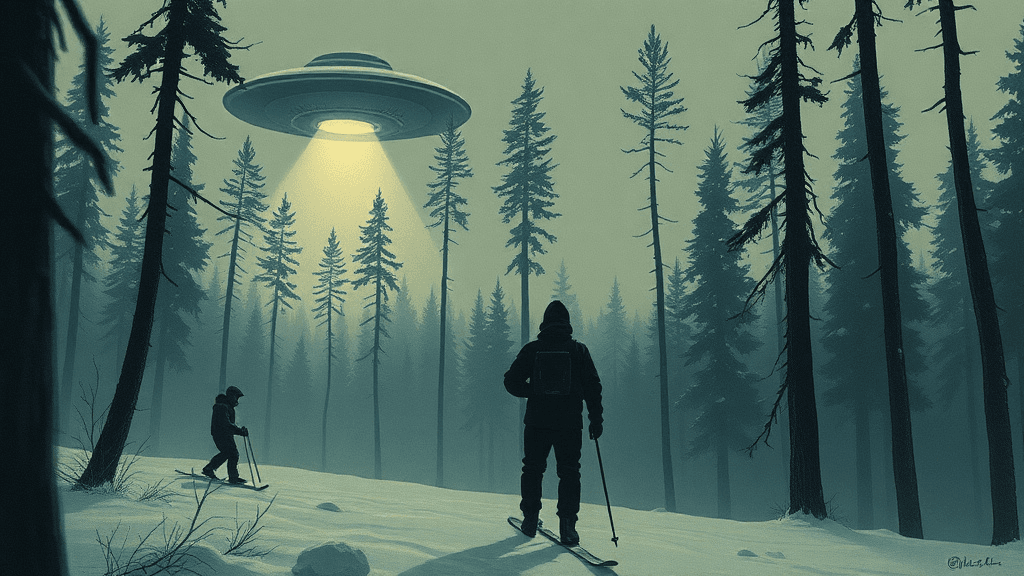
At approximately 3:00 a.m. on 26 December 1980, a security patrol near the eastern gate of RAF Woodbridge observed unusual lights descending into the trees of Rendlesham Forest. Believing they were looking at a downed aircraft, the duty controller authorized a small team to investigate. Sergeant Jim Penniston, Airman First Class John Burroughs, and Airman Ed Cabansag entered the forest on foot.
According to their contemporaneous accounts, Burroughs and Penniston moved closer to a glowing object while Cabansag maintained a position further back. Penniston would later describe a triangular craft roughly three meters tall and three meters wide at the base, with a smooth surface he compared to black opaque glass. He reported touching the craft and feeling symbols or pictorial engravings on its surface. After several minutes, the object allegedly maneuvered silently through the trees and vanished. Farm animals in a nearby field reportedly became extremely agitated during the encounter.
The following morning, investigators returned to the site in daylight. They found three small depressions in the ground arranged in a triangular pattern, as well as damage to trees — broken branches overhead and what appeared to be burn or scorch marks on the trunks at head height. Plaster casts were made of the depressions. Local Suffolk Police were also called to the site; their officers suggested the ground marks might have been caused by burrowing animals, and initially attributed lights in the forest to the Orford Ness lighthouse.
Night Two: 27–28 December 1980
Two nights later, with reports of lights in the forest persisting, Lieutenant Colonel Charles Halt — Deputy Base Commander at RAF Bentwaters — led an investigation team into the forest in the early hours of 28 December. Crucially, Halt brought a portable cassette recorder and narrated his observations in real time, creating what would become one of the most discussed pieces of evidence in UFO history: the Halt tape.
On the recording, Halt and his team can be heard taking radiation readings using an AN/PDR-27 survey meter near the triangular depressions from the first night. Readings of 0.07 milliroentgens per hour were recorded at the depressions — roughly twice the background level measured in surrounding areas (0.03–0.04 mR/h). Although this elevation was small in absolute terms and well within safe levels, it was statistically notable that the highest readings clustered at the alleged landing points.
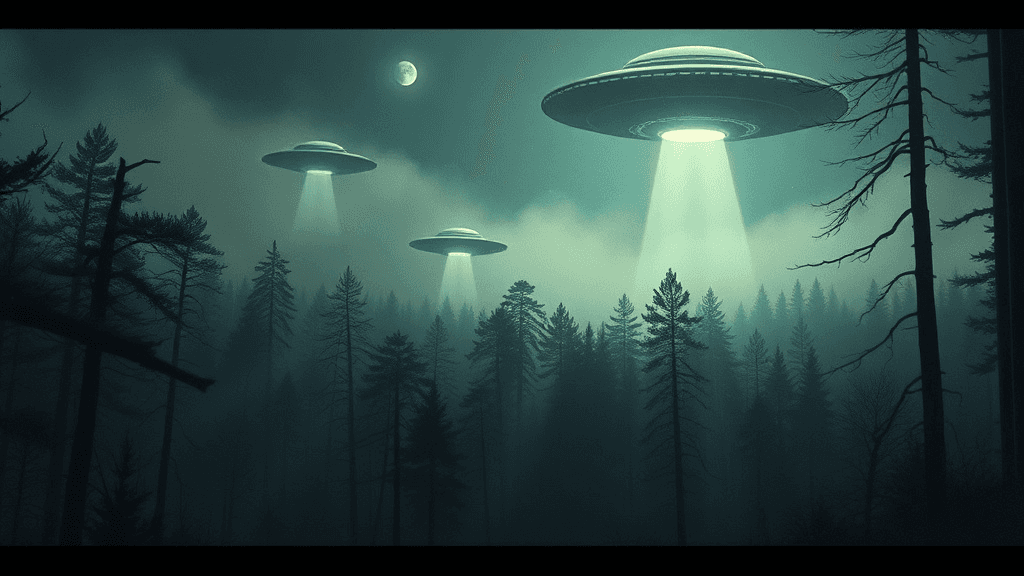
Halt then observed a bright pulsing light to the east. His tape captures the moment: "It looks like an eye winking at you... it's still hovering over the forest. Now it's moved further to the south... it's definitely moving to the south." Over the following two to three hours, Halt and his team observed aerial lights that he described as red, sun-like objects that pulsed, shed glowing particles, and broke into smaller pieces. Three star-like objects appeared at high altitude, making sharp angular movements and projecting beams of light downward toward the forest floor. One object, visible to the south for over two hours, appeared at times to beam a bright column of light directly down.
Halt was adamant in his recording at one point: "I see it too... it's coming this way... definitely seeing it and it is not the lighthouse." This comment — acknowledging that witnesses were aware of the lighthouse and distinguishing what they were seeing from it — became a recurring touchstone in later debates.
Investigation
The Halt Memo
On 13 January 1981, Lieutenant Colonel Halt submitted a single-page memorandum to the UK Ministry of Defence headed simply "Unexplained Lights." Written on official USAF letterhead and unclassified, the memo described the events of 26–29 December (the dates in the memo are offset from those given by other witnesses by one day, a discrepancy that has never been fully resolved). It documented the metallic, glowing object seen by the initial patrol, the ground traces, the radiation readings, and the aerial lights observed during Halt's own investigation.
The memo was released publicly under the U.S. Freedom of Information Act in June 1983, following a request from researcher Robert Todd. Its existence transformed the Rendlesham case from base rumour into documented historical record. The original is held at The National Archives in Kew, London.
UK Ministry of Defence Response
The MoD's official position — maintained for decades — was that the incident had been assessed and found to pose "no threat to national security." Officials stated that it was therefore never formally investigated as a security matter. However, later releases of documents under the Freedom of Information Act 2000 revealed that the MoD had maintained a substantial file on the case, and that senior officials had privately exchanged correspondence about it. Campaigners, including journalist and researcher Nick Pope, argued this constituted a de facto cover-up, or at minimum a failure of institutional transparency.
The Suffolk Constabulary's own file on the case was released in 2005 under the Freedom of Information Act, corroborating that local police had responded to calls from the base and had visited the site.
Subsequent Witness Accounts and Controversies
In the decades following the incident, the testimony of some witnesses expanded significantly — and in ways that created credibility problems. Sergeant Penniston, who had made no mention of touching the craft in his original security log, began in the 1990s and 2000s to elaborate his account substantially. By 2010 he claimed the craft had transmitted binary code telepathically into his mind, which he had transcribed in a notebook over the following 45 minutes, and which supposedly encoded geographic coordinates pointing to ancient sacred sites around the world. Fellow witness John Burroughs has disputed key elements of this account, stating that "Penniston was not keeping a notebook as it went down" and that Penniston "did not have time to make any sketches in a notebook while this was going on."
Airman Larry Warren, who claimed to have witnessed a separate encounter at a field called Capel Green — featuring a triangular craft and small humanoid entities — similarly saw his account contested by other witnesses who disputed his presence at the alleged event.
Halt himself, however, has remained a consistent and credible voice. In later interviews and public statements he stated he believed the objects he saw were extraterrestrial in origin, and claimed in 2015 that radar operators from both the base and a civilian facility had provided him with written statements confirming that an unidentified object had been tracked moving at extraordinary speeds that night.
The Case For and Against
Arguments for an anomalous event
The core of the case for something genuinely unusual rests on several pillars. First, the primary witnesses — particularly Halt — were trained military officers with security clearances and professional reputations at stake; Halt narrated events in real time on audio tape, reducing the likelihood of post-hoc confabulation. Second, physical traces were documented by multiple investigators, including local police, the morning after the first night. Third, the radiation readings, while modest, were spatially consistent with the claimed landing site rather than scattered randomly. Fourth, Halt explicitly acknowledged the Orford Ness lighthouse on tape and stated that what he was seeing was distinct from it.
Skeptical explanations
The most thorough skeptical treatment of the case has been provided by science writer Ian Ridpath, who visited the site shortly after the story became public. Ridpath's analysis assigns each element a mundane explanation. The initial sighting on 26 December coincided with a bright fireball — a meteor — reported by the British Astronomical Association over southern England at approximately the same time. The flashing object that witnesses described subsequently, and which appears to be the main focus of Penniston and Burroughs's observation, lay in precisely the same compass direction as the Orford Ness lighthouse. Ridpath conducted on-site tests demonstrating that the lighthouse beam was visible through gaps in the pine trees at the relevant points, appearing to flash and move as observers moved between the trees — even though its actual position was static.
For the second night's observations, the brightest of the hovering star-like lights was in the direction of Sirius, the brightest star in the winter sky, which was low on the horizon and subject to dramatic atmospheric scintillation — the twinkling that causes bright stars near the horizon to appear to pulse and change color. The timing of the flashes that Halt recorded as coming from the object also matched the five-second cycle of the Orford Ness lighthouse with notable consistency. As for the ground traces, local police attributed the depressions to animal burrowing, and the tree damage was consistent with ordinary forestry activity.
None of these explanations individually satisfies every witness or every detail, and no single explanation has been officially accepted. The case remains, in the language of investigators, genuinely unexplained rather than explained.
Cultural Impact
Rendlesham Forest rapidly became what British tabloids dubbed "Britain's Roswell" — the domestic equivalent of the American case that launched modern UFO mythology. The case entered public consciousness in 1983 when the Halt memo was released, and was further amplified by a 1984 broadcast of the Halt tape on a British radio programme. Journalist Georgina Bruni's 2000 book You Can't Tell the People brought new research and additional witness testimonies to a wide audience, and claimed — controversially — that Prime Minister Margaret Thatcher had been briefed on the incident.
Nick Pope, who managed the UK government's UFO desk at the MoD from 1991 to 1994, became one of the case's foremost champions after leaving government service. His 2014 book Encounter in Rendlesham Forest, co-authored with John Burroughs and Jim Penniston, combined first-person testimony with analysis of the official documents and became a bestseller.
In 2005, the Forestry Commission installed a formal UFO Trail at Rendlesham Forest, funded partly by the National Lottery, guiding visitors past the key sites of the alleged encounter. In 2014 a permanent sculpture was installed based on eyewitness sketches of the craft. The forest now draws tens of thousands of visitors annually, and the case features prominently in virtually every major survey of UFO history.
The incident has also had a subtler influence on how governments handle UFO reports. The MoD's eventual release of its files — accumulated over years of stonewalling — is frequently cited in arguments for greater official transparency, and fed directly into the culture of disclosure advocacy that eventually produced, decades later, the U.S. government's own reluctant acknowledgements under the UAP Task Force framework.
Current Status
The Rendlesham Forest Incident remains officially unexplained. No government — British or American — has issued any finding that identifies the objects described by Halt and his colleagues. The MoD closed its UFO desk in 2009, stating that no UFO report had ever been shown to pose a threat to national security, but without resolving any of the classic cases including Rendlesham.
Charles Halt, now retired, continues to maintain that what he witnessed was not of terrestrial origin and that both U.S. and UK security services have sought to minimize the case's significance. John Burroughs has pursued a separate and remarkable avenue: a years-long campaign to obtain VA medical benefits for injuries he believes were caused by radiation during his close encounter, which eventually resulted in the U.S. Senate passing the Unidentified Aerial Phenomena Disclosure Act provision supporting his claim — an extraordinary implicit acknowledgement by the U.S. government that something unusual may have harmed him.
The forest itself remains a working Forestry Commission site and one of England's most unusual tourist destinations. The UFO Trail is well-maintained, and the triangular indentation site, though long since grown over, is marked. Whether the lights over Rendlesham in December 1980 were lighthouse beams refracted through pine needles, a twinkling winter star, an extraordinary performance of Cold War psychology under stress — or something else entirely — the case has permanently marked the landscape, the witnesses, and the long, unresolved argument about what, if anything, visits us from beyond.
Witnesses
Sgt. Jim Penniston (USAF Security Police, Night 1) — reported close approach to a triangular craft with smooth black glass-like surface and engraved symbols; his account expanded significantly over subsequent decades, culminating in disputed claims of binary code transmission.
Airman First Class John Burroughs (USAF Security Police, Night 1) — reported pulsing lights and a glowing object moving through the trees; corroborated Penniston's account in its broad outlines but disputed specific later elaborations.
Airman Ed Cabansag (USAF Security Police, Night 1) — maintained a position further back in the forest; his account was more ambiguous and has been cited by skeptics as consistent with the lighthouse explanation.
Lt. Col. Charles Halt (Deputy Base Commander, RAF Bentwaters, Night 2) — the most senior and credible witness; narrated observations in real time on audio tape; submitted the official memo to the UK Ministry of Defence. Has publicly stated his belief that the objects were extraterrestrial and that a cover-up occurred.
Sgt. Adrian Bustinza (USAF Security Police, Night 2) — reported the object moving in and out through the trees during Halt's investigation.
Airman Larry Warren (disputed, Capel Green) — claimed a third separate encounter featuring humanoid entities; his account has been heavily disputed by other witnesses.
Evidence
Halt memo (13 January 1981) — single-page unclassified memorandum from Lt. Col. Halt to UK Ministry of Defence, describing both nights' events; released under FOIA in 1983; original held at The National Archives, Kew.
Halt tape — approximately 18 minutes of audio recorded in real time during the second night investigation; captures Halt and team observing and narrating moving lights, radiation readings, and aerial phenomena.
Ground traces — three small depressions in a triangular pattern discovered the morning after Night 1; plaster casts made; confirmed by Suffolk Police who visited the site.
Radiation readings — AN/PDR-27 survey meter readings of 0.05–0.1 milliroentgens per hour at the depressions, approximately twice background levels recorded in surrounding areas.
Tree damage — broken branches overhead and apparent scorch or burn marks on tree trunks at the alleged encounter site, documented by USAF investigators.
Suffolk Constabulary file — released under FOI in 2005; confirms police response and site visit.
People involved
Filed under
Watch
The Rendlesham UFO Encounter and the Alien Message from the Future
Ep. 6 | PART 2: Rendlesham Forest UFO encounter | Binary Code & Jim Penniston | The Basement Office
Propulsion Expert Discusses UFO's and the Rendlesham Forest Incident
Rendlesham Forest UFO sighting: Eyewitness Colonel Charles Halt
Investigating the US Military Tapes of the Rendlesham UFO
Where this entry came from
ProvenanceAgent indexedUpdated 6mo ago10 sources
Drafted by the archive's AI research agent from the sources below; corrections from readers are reviewed and folded in.
- First indexed
- 24 APR 26 // 22:45Z
- Last updated
- 24 APR 26 // 23:11Z
- Rendlesham Forest incident, Wikipedia
- The Rendlesham Forest UFO case, Ian Ridpath, Ian Ridpath (personal site)
- Rendlesham Forest UFO Incident: A Comprehensive Report, Lightnet
- 21 Facts About The Unresolved UFO Incident at Rendlesham Forest, Interesting Engineering
- The Halt Memo and Tapes, Enigma Labs
- The Rendlesham Forest Incident: Elaborate UFO Hoax Or Government Cover-Up?, All That's Interesting
- Rendlesham Forest Incident: Britain's Roswell, Hangar 1 Publishing
- Encounter in Rendlesham Forest: The Inside Story of the World's Best-Documented UFO Incident, Nick Pope, John Burroughs, Jim Penniston, Macmillan
- National Archives UFO Files Podcast Transcript (August 2009), The National Archives (UK)
- New Witnesses, Old Mystery: Revisiting the Rendlesham Forest UFO Incident, UAP Files (Substack)
Notes
- Rendlesham Forest incident, Wikipedia
- The Rendlesham Forest UFO case, Ian Ridpath, Ian Ridpath (personal site)
- Rendlesham Forest UFO Incident: A Comprehensive Report, Lightnet
- 21 Facts About The Unresolved UFO Incident at Rendlesham Forest, Interesting Engineering
- The Halt Memo and Tapes, Enigma Labs
- The Rendlesham Forest Incident: Elaborate UFO Hoax Or Government Cover-Up?, All That's Interesting
- Rendlesham Forest Incident: Britain's Roswell, Hangar 1 Publishing
- Encounter in Rendlesham Forest: The Inside Story of the World's Best-Documented UFO Incident, Nick Pope, John Burroughs, Jim Penniston, Macmillan
- National Archives UFO Files Podcast Transcript (August 2009), The National Archives (UK)
- New Witnesses, Old Mystery: Revisiting the Rendlesham Forest UFO Incident, UAP Files (Substack)
Also available
The Rendlesham UFO: The British Roswell
Award-winning documentary examining the mysterious events that unfolded in Rendlesham Forest, Suffolk, during December 1980—Britain's most significant military-UFO incident. Features testimony from witnesses and investigative analysis of this enigmatic encounter.
Capel Green
Ambitious 4-hour feature-length documentary focusing on Larry Warren, original witness and whistle-blower of the Rendlesham Forest Incidents, alongside testimony from military and civilian witnesses. Includes dramatizations and rare archival material about the mysterious December 1980 events.
Codename Rendlesham
Concise documentary that retraces the 40-year evolution of the Rendlesham Forest UFO incident story, examining how military accounts and witness testimonies have developed since the December 1980 encounter near RAF Woodbridge and Bentwaters.
Witnesses of the Rendlesham Forest Incident
45th Anniversary documentary special featuring sixteen first-hand witnesses of the Rendlesham Forest Incident recounting their accounts of what they observed over three nights in December 1980. Includes rare and previously controversial testimony from military and civilian eyewitnesses.
Buying through these links supports the library. We may earn a commission.