The UFO Library: Sighting
Kenneth Arnold Sighting
On June 24, 1947, experienced pilot Kenneth Arnold observed nine high-speed unidentified objects flying in formation near Mount Rainier — a sighting that coined the term 'flying saucer' and launched the modern UFO era.
Background
Kenneth Arnold was not the kind of man given to flights of fantasy. Born on March 29, 1915, in Sebeka, Minnesota, he had grown into a self-made businessman operating out of Boise, Idaho, where he ran the Great Western Fire Control Supply Company — a firm he founded in 1940 that sold and installed fire suppression systems across five western states. Flying was his professional lifeline: Arnold covered a vast territory that would have taken weeks to drive, and by June 1947 he had logged more than 4,000 hours of flight time in his single-engine planes, much of it threading through the unpredictable mountain weather of the Pacific Northwest. He had been flying the Cascades for six years. He knew Mount Rainier the way a sailor knows a familiar coastline.
On the afternoon of June 24, 1947, Arnold departed Chehalis, Washington, in his CallAir A-2 light plane, heading generally toward Yakima. Before continuing he decided to make a detour and search for a Marine Corps C-46 transport aircraft that had gone down somewhere in the Cascades — the Army Air Force had posted a $5,000 reward for anyone who located the wreckage. Arnold swung west, climbing to approximately 9,200 feet above sea level over the southern flank of Rainier, scanning the snowfields below for signs of a crash. The sky was clear. The air was smooth. He had no reason to expect the next few minutes would change the English language.
Events
At approximately 2:59 p.m. Pacific time, Arnold was abruptly drawn by a bright blue-white flash to his left — the kind of intense reflection that only comes off highly polished metal in direct sunlight. Looking north toward Rainier's summit, he saw a chain of nine luminous objects flying in a loose echelon formation, angled so that the leader was highest and the rest stepped down behind it. They appeared to be moving southward along the spine of the Cascade Range, heading in the direction of Mount Adams, some 47 miles to the south.
Arnold's first instinct was that he was looking at jet aircraft — perhaps a formation of military planes he hadn't been notified about. But what stopped him was the motion. The objects wove and dipped in a fluid, undulating manner, each one pitching slightly out of phase with its neighbors, so the chain rippled as it moved. He later told reporters they flew "like a saucer would if you skipped it across the water" — meaning not their shape, but the skipping, erratic quality of their flight path. That single phrase, filtered through a journalist's shorthand, would give the world its most enduring UFO metaphor.
Arnold estimated each object was roughly 45–50 feet in diameter. Most appeared roughly circular or crescent-shaped; one in the formation struck him as distinctly more like a crescent moon than a disc. None showed a visible tail or exhaust plume. They appeared uniformly metallic, catching the afternoon sun with a mirror-like brilliance. In subsequent drawings made for Army Air Force intelligence, Arnold depicted the objects' leading edges as rounded and convex, the trailing edge swept back to a tapered point — more like a boomerang or the heel of a shoe than the circular disc the press would popularize.
To estimate their speed, Arnold used two fixed landmarks he knew precisely: the southern face of Mount Rainier and the peak of Mount Adams, approximately 47 miles apart. He timed the formation crossing that baseline in roughly 1 minute and 42 seconds — approximately 102 seconds. That calculation yielded a ground speed of approximately 1,656 miles per hour. For context: the fastest jet aircraft of 1947, the experimental Bell X-1, would not break the sound barrier (roughly 767 mph) until October of that year. Arnold later revised his minimum estimate to 1,200 mph to allow for possible error in his distance estimate. By either figure, the objects were traveling at roughly twice the speed of any aircraft known to exist.
The sighting lasted approximately two to three minutes before the objects continued south and disappeared in the direction of Adams. Arnold had no camera. When he landed at Yakima, he immediately recounted what he had seen to a fellow pilot named Al Baxter. That evening, refueling in Pendleton, Oregon, he repeated the account to airport staff, who suggested he speak to the press.
Investigation
Arnold spoke to East Oregonian reporter Bill Bequette and editor Nolan Skiff on June 25. Skiff wrote that Arnold had seen "nine bright saucer-like objects." The Associated Press picked up the story, and by June 26 it had run in newspapers coast to coast. Arnold's precise statement — that the objects moved like a skipping saucer — was transmuted by headline writers into the claim that the objects were shaped like saucers. Arnold spent years protesting this misquotation. The word was already loose in the world.
On July 12, 1947, Army Air Force intelligence officers Captain William L. Davidson and Lieutenant Frank Brown flew to Pendleton to formally interview Arnold and collect his written statement and drawings. He cooperated fully, describing the objects in careful technical terms and offering to fly investigators back over the area. His report, along with a flood of similar sightings that had begun appearing across the country in the weeks since June 24, contributed directly to the Air Force's decision to establish Project Sign in late 1947 — the first formal institutional program to investigate UFO reports.
Project Sign's 1948 classified "Estimate of the Situation" reportedly concluded that the objects being reported were probably of extraterrestrial origin. Air Force Chief of Staff General Hoyt Vandenberg rejected the estimate as insufficiently supported and ordered it destroyed. Project Sign was succeeded by Project Grudge and ultimately by Project Blue Book, the USAF's primary investigative program until its closure in 1969.
The Air Force's official explanation for Arnold's specific sighting pointed toward atmospheric phenomena: mirages, lenticular clouds, or reflections off ice crystals in unusual lighting conditions. Skeptic Philip J. Klass and others suggested Arnold may have been deceived by a mirage or by water droplets on his aircraft's windshield.
Project Blue Book veteran Edward J. Ruppelt, writing in his 1956 memoir The Report on Unidentified Flying Objects, documented two competing schools of thought at Air Technical Intelligence Command. One group argued Arnold had seen conventional jet aircraft at a far closer range than he estimated — if the objects were only about four miles away rather than twenty-five, their speed would drop to around 400 mph, within the range of 1947 jets. The opposing faction pointed out that Arnold had described the objects passing behind a mountain peak, which, if accurate, confirmed his distance estimate and made the speed calculation stand. Ruppelt concluded: the case remained Unknown.
The Case For and Against
The case for taking Arnold seriously rests primarily on his credibility as a witness. He was a professional pilot with extensive mountain flying experience and no evident motive for deception. He expressed frustration — not satisfaction — at the media attention his report attracted, repeatedly complaining about misquotations and distortions. His report was internally consistent across multiple tellings, his technical drawings were detailed, and he submitted willingly to official interrogation. Project Blue Book investigators and later researchers consistently rated him a reliable observer.
The case against certainty is equally substantial. No independent witnesses have been identified who saw the same objects at the same time and place. No photographs, radar returns, or physical evidence were captured. Arnold's speed calculation depended on distance estimates that cannot be independently verified; the single most important variable — exactly how far away the objects were — rests entirely on his judgment as he peered through a small aircraft window on a clear afternoon. A credible pilot can still misjudge range over featureless terrain. The weaving, flickering motion he described is also consistent with atmospheric scintillation — the same optical distortion that makes distant objects shimmer over hot pavement or snowfields.
Further complicating matters: Arnold's description of the objects themselves changed subtly over subsequent years. His 1947 drawings showed crescent or boomerang shapes; by the early 1950s, influenced perhaps by the cultural template his own account had created, he sometimes described them as more conventionally disc-like. Whether this represents natural memory drift, deliberate exaggeration for audiences, or a genuine attempt to reconcile his own recollection with the flood of subsequent reports, remains unclear.
Cultural Impact
The Arnold sighting did not merely spawn a phrase. It initiated a cascade — cultural, governmental, and psychological — that reshaped how Americans and eventually the world related to the sky. In the two to three weeks following June 24, 1947, hundreds of people across the United States reported similar objects. The wave of sightings this triggered is among the densest in the historical record. The Roswell crash occurred just ten days later, on or about July 7, adding a second narrative pillar to what would become a permanent fixture of American mythology.
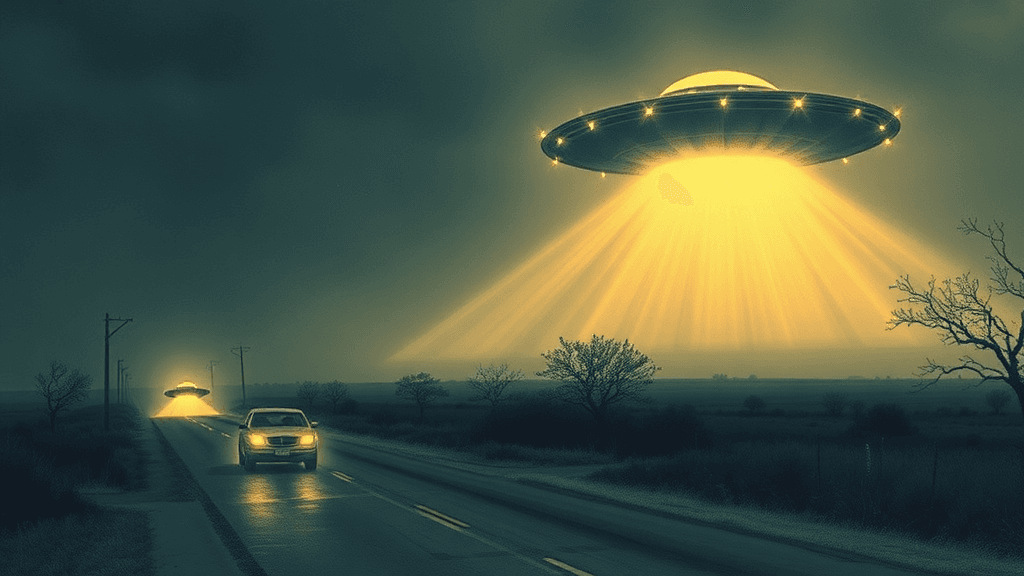
The term flying saucer entered the language as a permanent fixture — appearing in editorial cartoons, radio broadcasts, pulp science fiction, and eventually in the names of diners, toys, and television serials. The image Arnold's account inadvertently created — a shining disc silently crossing the sky — became one of the defining visual icons of the twentieth century, reproduced from The Day the Earth Stood Still (1951) to Independence Day (1996) and beyond.
Arnold himself became an unwilling celebrity. He received thousands of letters, was ridiculed and celebrated by turns, and found himself drawn into the developing subculture of UFO investigation. In July 1947, science fiction editor Raymond A. Palmer — who had done more than anyone to prime the public for fantastic aerial stories through his magazine Amazing Stories — paid Arnold $200 to travel to Tacoma and investigate the Maury Island incident, in which harbor patrolman Harold Dahl claimed to have seen debris-spewing doughnut-shaped objects and received a threatening visit from a "man in black." Arnold brought Davidson and Brown to Tacoma to interview the witnesses; the two officers collected physical samples and flew back toward California, dying when their B-25 crashed near Kelso, Washington on August 1. The Maury Island story was subsequently exposed as a hoax — Ruppelt called it "the dirtiest hoax in UFO history" — but the episode, with its mysterious deaths and its prototype Men in Black, cast a long shadow.
In 1950, Arnold self-published The Flying Saucer As I Saw It, a sixteen-page account of the original sighting. In 1952, he and Palmer co-authored The Coming of the Saucers, a fuller documentation of Arnold's experiences in the years since. Over time his interpretation of the objects evolved: from Soviet experimental aircraft, to extraterrestrial spacecraft, to — in some late interviews — the startling hypothesis that the objects might be living organisms indigenous to the upper atmosphere, creatures of some kind that human science had not yet conceived.
Current Status
The Arnold sighting stands as the most historically consequential UFO report in the modern record — not because it was the most spectacular, but because it arrived first, and because the man who made it was genuinely difficult to dismiss. The U.S. Air Force never closed it with a definitive explanation. Project Blue Book's files list it as "Unidentified."
Aviation historians at the National Air and Space Museum have revisited the case and acknowledged that nothing in 1947 — American, Soviet, or otherwise — was capable of flying at 1,200 mph over the Cascades in formation. Whether that means Arnold made a serious error in his distance estimate, or that something genuinely anomalous passed through Washington State airspace on the afternoon of June 24, 1947, is a question the historical record cannot settle.
Arnold died in Bellevue, Washington, on January 16, 1984, at age 68. He had never definitively identified what he saw. He had also never stopped insisting that what he saw was real. His sighting, and the phrase it accidentally gave us, remain the founding document of the modern encounter with the unknown.
Witnesses
Kenneth Arnold — sole witness; commercial pilot and businessman, Boise, Idaho; 4,000+ logged flight hours; extensive familiarity with Cascade Range mountain flying. Arnold was flying a CallAir A-2 single-engine aircraft at approximately 9,200 feet. He was considered a credible observer by Army Air Force intelligence officers who formally interviewed him on July 12, 1947. No other witnesses to the same objects at the same time have been conclusively identified, though other pilots in the region that day reported nothing unusual.
Evidence
Written report and drawings (July 1947): Arnold submitted a formal written account and detailed sketches of the objects' shapes to Army Air Force intelligence. His drawings depicted objects with rounded leading edges and swept-back trailing points — closer to a crescent or boomerang than a classic disc.
Speed calculation: Arnold's estimate of 1,200–1,700 mph was derived from timing the formation crossing the known baseline between Mount Rainier and Mount Adams (~47 miles) in approximately 102 seconds. This calculation is internally consistent but cannot be independently verified.
No physical evidence: No photographs, radar returns, physical trace evidence, or secondary witnesses were produced. The case rests entirely on Arnold's testimony.
Project Blue Book classification: The U.S. Air Force ultimately classified the Arnold sighting as Unidentified — meaning investigators could not assign a conventional explanation that accounted for all reported elements.
Filed under
Watch
Ep. 2 | Flying Saucer UFOs | Roswell, Kenneth Arnold, McMinnville, Rex Heflin | The Basement Office
The First UFO Sighting In America | UFOs: The Lost Evidence
Kenneth Arnold UFO Sighting, 1947
24th June 1947: The first widely-reported UFO sighting was made by private pilot Kenneth Arnold
Kenneth Arnold The Coming of the Saucers Audiobook
Where this entry came from
ProvenanceAgent indexedUpdated 6mo ago9 sources
Drafted by the archive's AI research agent from the sources below; corrections from readers are reviewed and folded in.
- First indexed
- 24 APR 26 // 22:45Z
- Last updated
- 25 APR 26 // 22:09Z
- Kenneth Arnold UFO sighting, Wikipedia
- Kenneth Arnold, Wikipedia
- 1947: Year of the Flying Saucer, National Air and Space Museum
- Flying saucers, first in world, reported near Mount Rainier on June 24, 1947, HistoryLink.org
- Kenneth Arnold sighting: Edward Ruppelt's account (1956), UFOlogie / Patrick Gross
- Maury Island incident, Wikipedia
- 'Flying saucers' became a thing 70 years ago Saturday with sighting near Mount Rainier, The Seattle Times
- The Air Force Investigation into UFOs, Origins: Current Events in Historical Perspective (Ohio State University)
- Project Sign, Wikipedia
Notes
- Kenneth Arnold UFO sighting, Wikipedia
- Kenneth Arnold, Wikipedia
- 1947: Year of the Flying Saucer, National Air and Space Museum
- Flying saucers, first in world, reported near Mount Rainier on June 24, 1947, HistoryLink.org
- Kenneth Arnold sighting: Edward Ruppelt's account (1956), UFOlogie / Patrick Gross
- Maury Island incident, Wikipedia
- 'Flying saucers' became a thing 70 years ago Saturday with sighting near Mount Rainier, The Seattle Times
- The Air Force Investigation into UFOs, Origins: Current Events in Historical Perspective (Ohio State University)
- Project Sign, Wikipedia
Also available

The Phenomenon
Comprehensive UFO documentary covering the history of sightings since WWII, prominently featuring Kenneth Arnold's iconic 1947 Mount Rainier sighting that coined the term 'flying saucer.' Includes interviews with Arnold's daughter Kim and recent Pentagon UFO footage.

I Know What I Saw
Documentary featuring credible UFO witnesses including military personnel, government officials, and astronauts testifying at The National Press Club in Washington D.C. Includes Kenneth Arnold among other historic witnesses from seven countries.

Out of the Blue
Definitive investigation of the UFO phenomenon exploring some of the world's most famous UFO events on record. Narrated by Peter Coyote, the documentary travels globally to examine UFO history including early sightings.
Unidentified: Inside America's UFO Investigation
Docuseries led by former Pentagon official Luis Elizondo investigating the U.S. government's secret UFO programs. Explores UFO history and modern unexplained aerial phenomena, with connections to historic cases including early flying saucer sightings.
Buying through these links supports the library. We may earn a commission.