The UFO Library: Military encounter
Kinross AFB Incident
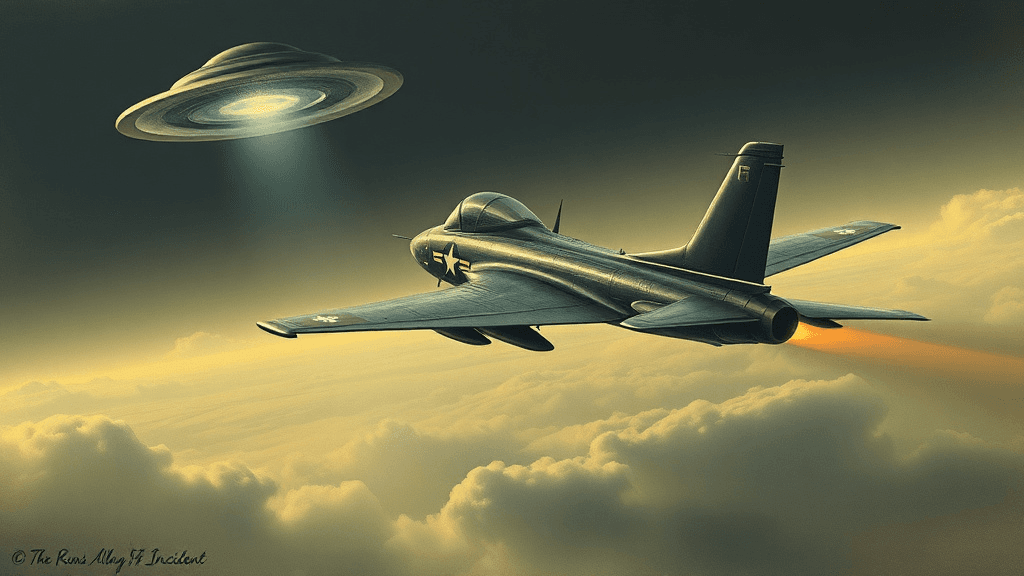
On November 23, 1953, an F-89C Scorpion interceptor scrambled from Kinross AFB vanished over Lake Superior after radar operators watched it close on an unidentified target — the two blips merging into one before disappearing entirely. Neither the aircraft nor its crew were ever found.
Background
By the autumn of 1953, the United States Air Defense Command was operating in a state of heightened vigilance. The Soviet Union had detonated its first thermonuclear device just weeks earlier, in August, and American radar networks along the Canadian border were on hair-trigger alert for any airborne intrusion. Kinross Air Force Base, situated near Sault Ste. Marie in Michigan's Upper Peninsula, housed the 433rd Fighter-Interceptor Squadron, flying the Northrop F-89 Scorpion — a twin-engine all-weather jet specifically designed to hunt enemy bombers at high altitude and in darkness.
The Soo Locks, just south of Kinross, represented one of the most strategically sensitive installations in North America. The locks connect Lake Superior to the lower Great Lakes, and the vast majority of iron ore moving from Minnesota's Iron Range to the steel mills of Pittsburgh and Chicago passed through them. A determined adversary striking the Soo Locks could, in theory, cripple American industrial output. Air Defense Command treated any unidentified track in that corridor with the utmost seriousness.
First Lieutenant Felix Eugene Moncla Jr. was 27 years old, a Louisiana native from Moreauville with a reputation as a capable if somewhat impulsive pilot. Colleagues would later recall that he had experienced some difficulties with instrument flying and disorientation at altitude — details the Air Force would lean on in its post-incident explanation. His radar operator that evening was Second Lieutenant Robert Lindsay Wilson, 22 years old, seated in the rear cockpit of the two-seat Scorpion. Both men were experienced enough for an intercept mission, though Moncla had reportedly been grounded briefly earlier in the year for undisclosed reasons before being reinstated to flight status.
Events
At approximately 6:00 PM local time on Monday, November 23, 1953, Ground Control Intercept (GCI) radar operators at Sault Ste. Marie detected an unidentified blip moving over Lake Superior near the Soo Locks. The contact was flying at an altitude and speed that did not match any filed flight plan, and it did not respond to radio calls. Standard procedure dictated a scramble.
Moncla and Wilson lifted off from Kinross AFB and were vectored toward the target by ground controllers. The intercept geometry was complicated from the start: the unknown object appeared to be altering course, moving away as the F-89 closed in. Ground radar showed the target maneuvering — not violently, but enough to keep the Scorpion from achieving a clear identification pass. Moncla pushed his aircraft to over 500 miles per hour, consuming fuel at a demanding rate.
For approximately 30 minutes the chase continued across the dark waters of Lake Superior. Wilson attempted to acquire the target on the F-89's own airborne radar but reportedly struggled as the contact shifted heading. GCI controllers, watching both blips on their scopes, provided continuous steering cues to Moncla. At an altitude of roughly 8,000 feet and some 70 miles north of Keweenaw Point — deep over open water — the situation changed dramatically.
On the GCI scope, ground controllers watched the two radar returns draw together. The gap narrowed, narrowed further — and then the two blips merged into a single return. Moments later, that single blip faded from the screen entirely. All radio contact with the aircraft had already ceased. No distress call, no final transmission. The F-89C and the unidentified object had simply vanished together from radar coverage, leaving nothing behind.
A GCI radar operator present that night would later be quoted in a leaked Air Force document obtained by UFO investigator Major Donald Keyhoe: "It seems incredible, but the blip apparently just swallowed our F-89."
Investigation
The search that followed was one of the most extensive in Great Lakes history. Aircraft and surface vessels from both the U.S. Air Force and the Royal Canadian Air Force (RCAF) combed more than 29,000 square miles of Lake Superior over five days. The lake in November is brutally cold; survival in those waters without immersion suits would be measured in minutes. No wreckage was found. No oil slick, no seat cushions, no parachutes — nothing that could confirm the fate of the two men or the aircraft.
The Air Force's initial public statement, released to the Associated Press, was startlingly candid. It stated that the F-89 had been "followed by radar until it merged with an object 70 miles off Keweenaw Point in upper Michigan." The Chicago Tribune ran the story under the headline: JET, TWO ABOARD, VANISHES OVER LAKE SUPERIOR. Within days, however, the Air Force retracted the statement and substituted a more mundane explanation.
The revised official account held that the unidentified radar contact had been a Royal Canadian Air Force C-47 Dakota transport that had inadvertently strayed into U.S. airspace. Under this scenario, Moncla — perhaps suffering from vertigo in the darkness over featureless water — had misjudged his altitude and collided with the lake's surface while attempting to identify the Canadian plane.
This explanation collapsed almost immediately on contact with the Canadian government. In a 1961 letter, the Chief of the Air Staff at Canada's Department of National Defence stated flatly: "A check of Royal Canadian Air Force files has revealed no report of an incident involving an RCAF aircraft in the Lake Superior area on the above date." The Canadians had no C-47 in that airspace that night. The cornerstone of the official explanation had been disavowed by the very nation whose aircraft it named.
Project Blue Book — the Air Force's official UFO investigation program — retained the case in its files. An officer associated with the project, identified in documents as O.D. Hill, reportedly confided to civilian investigators that the Kinross incident was not unique; there had been other cases of radar-confirmed mergers between Air Force interceptors and unidentified targets. The implication was that officials were quietly alarmed by a pattern they could neither explain nor publicly acknowledge.
The families of both men received no satisfactory answers. According to Keyhoe, Air Force representatives visited Moncla's widow and offered two different, mutually contradictory accounts of her husband's death. In one version, the pilot had crashed into the lake because he was flying too low. In another, the jet had exploded at high altitude. The inconsistency — unacceptable in any competent accident investigation — pointed either to genuine confusion within the Air Force or to a deliberate effort to deflect inquiry.
The Case For / Against
The Kinross incident occupies a position of unusual credibility within the catalogue of Cold War UFO encounters, primarily because its core evidence consists of official military radar records observed by multiple trained operators rather than civilian eyewitness testimony.
The case for anomalous causation rests on several pillars. First, the target's behavior: it changed course repeatedly as the interceptor approached, a pattern more consistent with an object reacting to pursuit than with a passive aircraft on a fixed heading. Second, the radar convergence: both blips merged simultaneously and then vanished — a signature difficult to explain as a simple crash into the lake, which would typically leave the other target (the alleged C-47) continuing on its course. Third, the Canadian denial: if there was no RCAF C-47, what exactly did ground controllers watch merge with the F-89? Fourth, the Air Force's own initial press statement acknowledged the merger, suggesting the radar operators themselves did not initially consider a mundane explanation plausible. Fifth, the complete absence of wreckage: a steel jet aircraft crashing into the lake should have left a debris field, yet extensive searching recovered absolutely nothing.
The skeptical interpretation is also coherent. The waters of Lake Superior are notoriously deep in some sections and the November storms churn the surface constantly — wreckage can sink without trace. Moncla's prior difficulty with instrument flight raises the possibility of spatial disorientation and controlled flight into water. GCI radar of the period was not infallible; target merging at range could reflect radar resolution limits rather than physical contact. The unidentified contact might have been a civilian or military aircraft operating without a filed plan, not unknown in 1953. And the contradictory explanations given to Mrs. Moncla may reflect bureaucratic incompetence rather than cover-up.
What cannot be dismissed is the documented contradiction between the official U.S. explanation and the categorical Canadian denial. That gap has never been filled by any subsequent declassification.
Cultural Impact
The Kinross incident became a touchstone of early UFO literature precisely because its central mystery is so cleanly stated: two men went up, two radar blips became one, and then there was nothing. Major Donald Keyhoe featured it prominently in his 1955 book The Flying Saucer Conspiracy and returned to it in subsequent writings, treating the leaked radar operator quote — "the blip apparently just swallowed our F-89" — as emblematic of what he argued was deliberate government suppression of UFO evidence.
The case energized the nascent civilian UFO research community. The National Investigations Committee on Aerial Phenomena (NICAP), which Keyhoe led for years, used Kinross as a prime example of military radar confirmation of anomalous phenomena. The incident also fed a broader cultural anxiety about disappearances in the Great Lakes region, connecting in the popular imagination to the mythology of the "Lake Superior Triangle" — a regional counterpart to the Bermuda Triangle narrative.
In the ufological canon, Kinross achieved near-legendary status as a case in which the government's own radar operators described, in their own words, something beyond their ability to explain — and in which the official substituted narrative was exposed as false by a foreign government.
In 2006, an organization calling itself the Great Lakes Dive Company announced it had located the wreck of Moncla's F-89 on the lake floor, complete with sonar images suggesting a large metallic object. The claim generated significant media attention and raised hopes among the families of the missing men. Investigation by the Mutual UFO Network (MUFON) and local diving communities determined that the "Great Lakes Dive Company" had no registered existence, was unknown to established Great Lakes divers, and could not produce verifiable sonar data or dive logs. The Director of MUFON concluded that the organization had never existed and that its claims were fabricated. The 2006 episode is now universally regarded as a deliberate hoax, though it briefly succeeded in reigniting public interest in the case.
Current Status
As of 2026, neither the aircraft nor the remains of Felix Moncla Jr. or Robert Wilson have been recovered. The official U.S. Air Force position remains that the men died in a crash, cause undetermined. No amended explanation has addressed the RCAF denial or the radar convergence.
Project Blue Book, declassified in the 1970s and now largely accessible through the National Archives, contains records pertaining to the Kinross incident, though researchers note that portions remain difficult to locate in the released files. Freedom of Information Act requests filed over the decades have yielded inconsistent results.
The 70th anniversary of the incident in November 2023 was marked by renewed attention from researchers affiliated with the Open Skies Project, a civilian initiative working to declassify remaining government documents and conduct fresh sonar surveys of the relevant area of Lake Superior. The project has coordinated with local diving experts and historians in Michigan's Upper Peninsula to reframe the search using modern side-scan sonar technology.
In the broader context of UAP disclosure that began gaining momentum after the 2017 New York Times reporting on the Advanced Aerospace Threat Identification Program (AATIP), retired military officials and legislators have called for systematic review of Cold War-era radar cases. Whether the Kinross files contain additional classified material that might reframe the incident remains an open question. What is certain is that the case remains the single most dramatic radar-confirmed military encounter in American UFO history — a chase that ended in silence, a merger of blips, and an absence that has endured for more than seven decades.
Witnesses
- Multiple GCI radar operators at Sault Ste. Marie Ground Control Intercept station observed the entire pursuit sequence and the convergence of the two radar blips
- 1st Lieutenant Felix Moncla Jr. (pilot) — missing, presumed dead
- 2nd Lieutenant Robert Lindsay Wilson (radar operator) — missing, presumed dead
- Unnamed GCI radar operator quoted in leaked Air Force document: "It seems incredible, but the blip apparently just swallowed our F-89"
- Air Defense Command personnel who directed the intercept via radio
Evidence
- GCI radar records from Sault Ste. Marie station documenting the pursuit and convergence of two radar returns before simultaneous disappearance
- Air Force press statement to the Associated Press acknowledging the jet "merged with an object 70 miles off Keweenaw Point" (subsequently retracted)
- 1961 letter from Chief of the Air Staff, Royal Canadian Air Force, stating no RCAF aircraft was in the Lake Superior area on November 23, 1953
- Leaked Air Force document obtained by Donald Keyhoe (1958) containing radar operator quote and characterizing the incident as unexplained
- Project Blue Book case file (partially declassified via National Archives)
- Extensive 5-day air and sea search covering 29,000+ square miles: no wreckage, oil slick, debris, or human remains recovered
- Contradictory explanations provided to Mrs. Moncla by Air Force representatives
Filed under
Watch
The Creepy Missing F-89 Pilot - The Kinross UFO Incident
Unsolved Mysteries - The Kinross Incident 1953
History of the Calumet Air Force Station and the Kinross Incident
Project Blue Book UFO Files: 10 True Declassified Cases | Fall Asleep to UFO Stories (Episode 3)
Fall Asleep to UFO & Alien Stories: USA Edition — America’s UFO Legacy From Coast to Coast
Where this entry came from
ProvenanceAgent indexedUpdated 5mo ago10 sources
Drafted by the archive's AI research agent from the sources below; corrections from readers are reviewed and folded in.
- First indexed
- 30 MAY 26 // 02:18Z
- Last updated
- 08 JUN 26 // 04:48Z
- This Air Force Jet Was Scrambled to Intercept a UFO — Then Disappeared, Becky Little, HISTORY
- Kinross AFB Radar Case Files, NICAP
- Project Blue Book Declassified: The Kinross UFO Incident, Quantum Origin
- The Kinross Incident, Open Skies Project
- 70-year Anniversary of Kinross Incident: Researchers Talk Incident Research and Progress of Open Skies Project, Upper Michigan's Source
- Disappearance of Two Pilots, 1953, UFO Casebook
- Did a UFO Cause the Disappearance of a Jet from Kinross Air Force Base?, AiPT
- Great Lakes Dive Company Hoax — Kinross Investigation, UFO*BC
- The Mystery of the Kinross Incident Deepens, The UFO Chronicles
- Missing in the Keweenaw: The Kinross Incident, Visit Keweenaw
Notes
- This Air Force Jet Was Scrambled to Intercept a UFO — Then Disappeared, Becky Little, HISTORY
- Kinross AFB Radar Case Files, NICAP
- Project Blue Book Declassified: The Kinross UFO Incident, Quantum Origin
- The Kinross Incident, Open Skies Project
- 70-year Anniversary of Kinross Incident: Researchers Talk Incident Research and Progress of Open Skies Project, Upper Michigan's Source
- Disappearance of Two Pilots, 1953, UFO Casebook
- Did a UFO Cause the Disappearance of a Jet from Kinross Air Force Base?, AiPT
- Great Lakes Dive Company Hoax — Kinross Investigation, UFO*BC
- The Mystery of the Kinross Incident Deepens, The UFO Chronicles
- Missing in the Keweenaw: The Kinross Incident, Visit Keweenaw
Also available

The Phenomenon
Comprehensive documentary covering UFO history from WWII onward, featuring declassified Pentagon footage, testimony from military officials, and analysis of landmark cases including the Kinross incident. Narrated by Peter Coyote.
Project Blue Book
Historical docudrama series recreating U.S. Air Force UFO investigations. Season 2 features an episode directly inspired by the 1953 Kinross AFB incident, exploring the F-89 Scorpion's disappearance over Lake Superior. Series runtime per episode approximately 45 minutes.
The Moncla Memories
Documentary produced for VisionTV's Enigma series, dedicated to the 1953 Kinross incident and pilot Felix Moncla. Explores the mysterious disappearance of the F-89 Scorpion and its two-man crew over Lake Superior.
Buying through these links supports the library. We may earn a commission.