The UFO Library: Abduction
Stanford, Kentucky Abduction (1976)
Three women reported a close encounter with a disc-shaped object and a period of missing time on a rural Kentucky road, then recalled a medical-style examination under hypnosis; the case is among the best-known early 1970s-era abduction reports in the US.
The Night of January 6, 1976
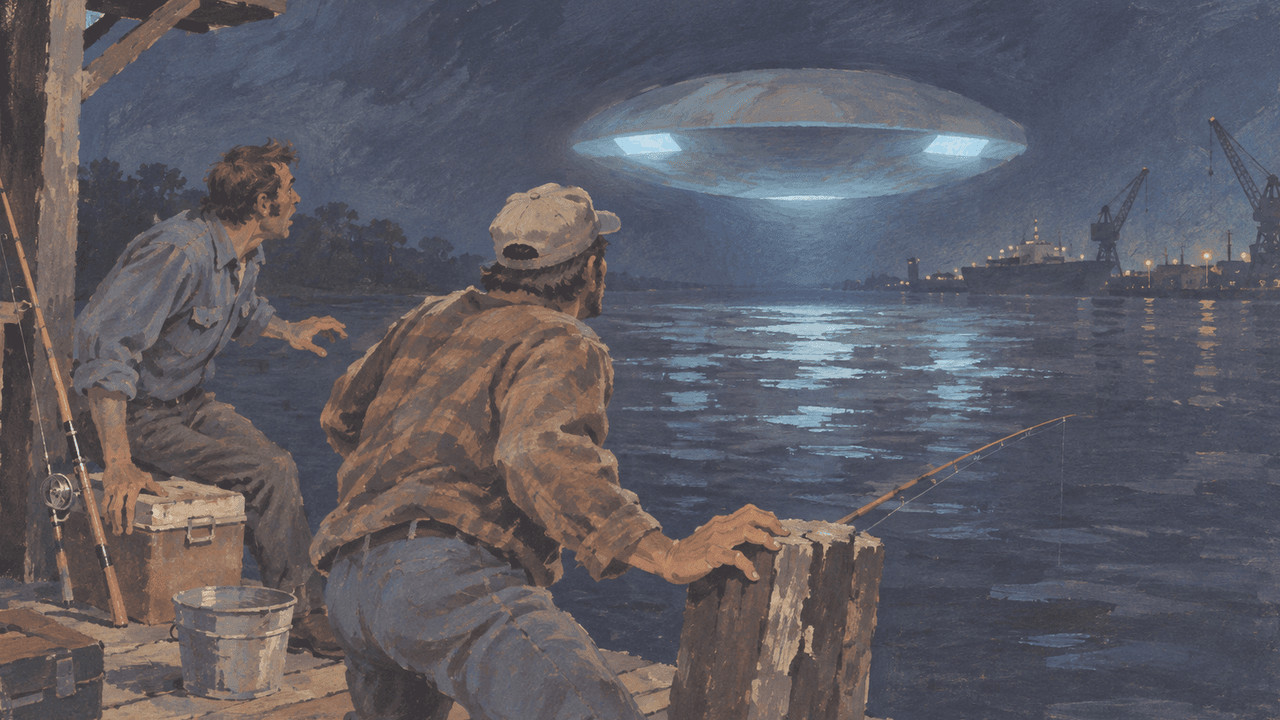
On the evening of January 6, 1976, Mona Stafford, Louise Smith and Elaine Thomas were driving home from a birthday dinner in Lincoln County, Kentucky, near the town of Stanford. Smith was at the wheel of her 1967 Chevrolet Nova. According to the women's accounts, as recorded by BJ Booth's UFO Casebook and summarized by The Black Vault, they saw a large disc with red lights, a dome and a bluish beam. The car reportedly accelerated to about 85 mph without the driver touching the pedal. Afterward the women reported burn-like marks on their necks, skin irritation when in water, and eye irritation, along with a loss of roughly 80 to 85 minutes. Neighbors and the car's own malfunctions (a watch running fast, an alarm clock failing) were cited as corroboration, though these claims come mainly from the witnesses and their investigators.
The exact restaurant, arrival times and even the women's ages differ between the main sources, which is typical of cases reconstructed years later from interviews.
Investigation and Hypnosis
The case drew several UFO organizations. Jerry Black of MUFON interviewed the women first and arranged further meetings. J. Allen Hynek of CUFOS was informed of the case, and Jim and Coral Lorenzen of APRO were consulted about the press attention. Bob Pratt of the National Enquirer attended later sessions, and the tabloid's involvement became a point of contention among the groups.
The women were given polygraph tests administered by Detective James C. Young of the Lexington Police Department. According to the APRO account, all three passed; Young believed they were telling the truth as they understood it, but warned that earlier interviews, including sketches of aliens shown to the witnesses, could have shaped their memories.
Dr. R. Leo Sprinkle then conducted regressive hypnosis. Sprinkle reportedly concluded that the women were describing real experiences and that abduction and examination was the "best hypothesis," while acknowledging uncertainty. Recollections under hypnosis included small humanoids, a brightly lit examination room, and a neck device that tightened when Thomas tried to speak. The sources give conflicting dates for these sessions.
Case For and Against
Supporters point to the polygraph results, the consistency of the three accounts, the physical symptoms, and the fact that investigators interviewed the women separately. Hynek's engagement and the involvement of multiple groups have also made the case a reference point in abduction literature.
The skeptical objections are substantial. Hypnosis is widely regarded as capable of producing confabulated detail, and the case had been discussed among the women and with investigators, including leading questions that APRO itself acknowledged. The organizations disagreed about control of the case and the release of information, which delayed reporting. No government documents, FBI involvement or police report on the incident have been identified, and the polygraph result is reported second-hand. Because the case rests on recollection and few physical records, it is hard to test whether the shared account reflects a real event, a misidentified object, or memories shaped by the interviews themselves.
Legacy
The case is a recurring entry in popular lists of US abduction reports from the mid-1970s, and details such as the parakeet that reportedly died after the event have circulated widely in those accounts. Accounts such as the Ace Weekly feature on Central Kentucky sightings show that the case remains a local touchstone. Its credibility rests on witness testimony and the work of hypnotic investigators, which mainstream researchers have generally regarded as insufficient to establish that an abduction occurred. Credibility is therefore recorded as contested: the events are documented as witness reports, but their objective reality has not been established.
Witnesses
Three women were involved: Mona Stafford (celebrating her birthday; the first to undergo hypnosis), Louise Smith (driver of the Nova), and Elaine Thomas. Neighbor Lowell Lee was reported to have confirmed time loss. Sources say other people reported a UFO in Casey and Lincoln counties that same night, though those accounts are second-hand.
Evidence
Polygraph examinations (reported as passed, by Lexington police Detective James C. Young), regressive hypnosis sessions led by Dr. R. Leo Sprinkle, and investigator interviews documented in the APRO Bulletin (October 1976). No physical evidence has been independently verified.
Filed under
Watch
The Stanford, Kentucky alien abductions, January 6, 1976
Unsolved Mysteries: The 1976 Alien Abduction in Stanford, KY
The Stanford, Kentucky UFO & alien abduction mystery, Jan 6 1976 (updated with interview & hypnosis)
The Traumatic ALIEN ABDUCTION from Kentucky in 1976
Terrifying Alien Attack: 1955 Kentucky UFO Encounter Unearthed | UFO Witness | Discovery Channel
Where this entry came from
ProvenanceAgent indexedUpdated 2w ago4 sources
Drafted by the archive's AI research agent from the sources below; corrections from readers are reviewed and folded in.
- First indexed
- 24 OCT 26 // 08:19Z
- Last updated
- 24 OCT 26 // 08:19Z
- The 1976 Stanford, Kentucky Abductions, The Black Vault
- The 1976 Stanford, Kentucky Abductions, Part 1, B.J. Booth, UFO Casebook
- There's something out there... UFO sightings in Central Kentucky, Ace Weekly
- Marc Hoover: Three women abducted by aliens, The Clermont Sun
Notes
- The 1976 Stanford, Kentucky Abductions, The Black Vault
- The 1976 Stanford, Kentucky Abductions, Part 1, B.J. Booth, UFO Casebook
- There's something out there... UFO sightings in Central Kentucky, Ace Weekly
- Marc Hoover: Three women abducted by aliens, The Clermont Sun