The UFO Library: Abduction
Travis Walton Abduction
On November 5, 1975, a seven-man logging crew in the Apache-Sitgreaves National Forest witnessed a luminous disc; Travis Walton approached the craft, was knocked down by a beam of light, and vanished for five days before reappearing disoriented near Heber, Arizona, claiming to have been taken aboard the craft by small humanoid beings.
Background
In the autumn of 1975, a team of contract loggers employed by crew chief Mike Rogers was thinning timber in a remote section of the Apache-Sitgreaves National Forests known as Turkey Springs, located roughly twelve miles south of Heber in Navajo County, Arizona. The seven-man crew — Rogers (28), Travis Walton (22), Allen Dallis, Ken Peterson, John Goulette, Steve Pierce, and Dwayne Smith — had been working since summer under a US Forest Service contract to clear brush and thin overstocked ponderosa pine. The contract had fallen behind schedule, and Rogers faced a November 10 deadline with financial penalties for non-completion, a detail that would later become central to skeptical analysis of the case.
The area was sparsely populated high-country pine forest, well over a mile in elevation, and darkness came early in early November. The crew's routine that Wednesday evening was mundane: finish the workday at dusk, pile into Rogers' truck, and drive the long dirt road back toward Snowflake and Taylor, the small towns where most of the men lived.
Events
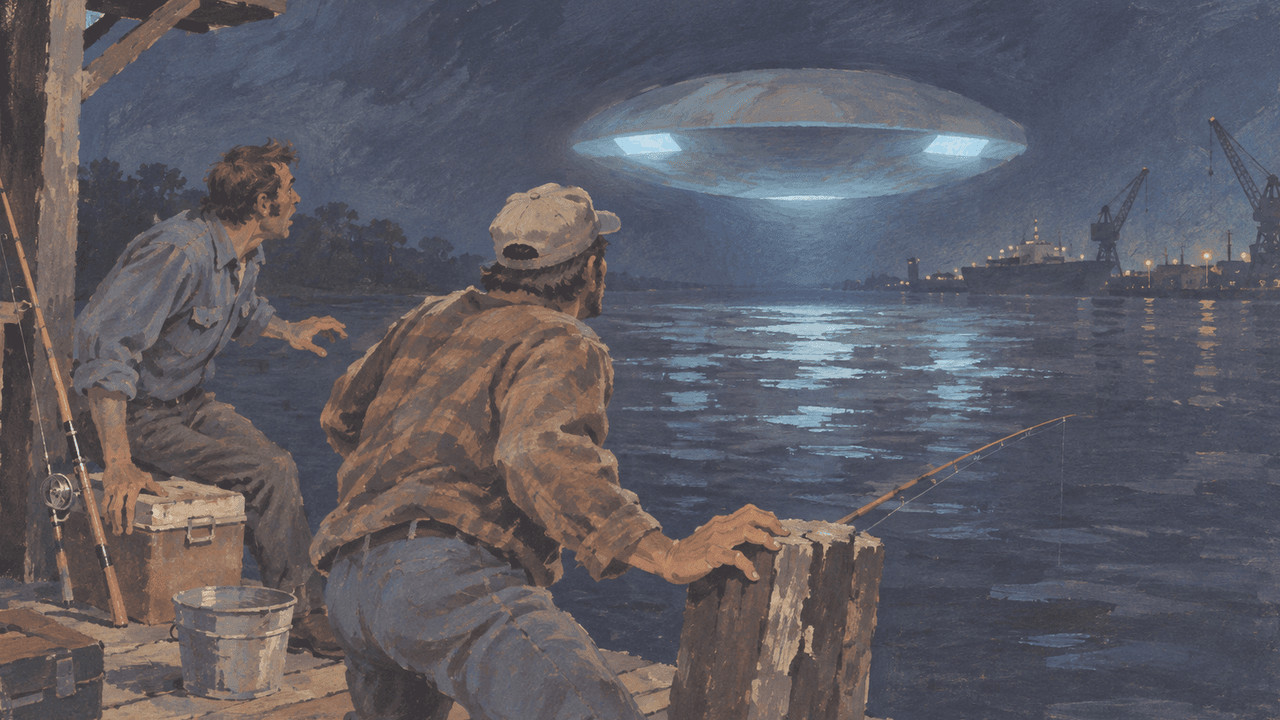
At approximately 6:00 p.m. on November 5, 1975, as Rogers drove the crew out along the forest track, someone in the truck spotted a bright, yellowish glow through the treeline roughly 100 yards ahead. As the truck rounded a curve and entered a clearing, the source became unmistakable: a luminous, disc-shaped object hovering approximately 15 to 20 feet above a pile of slash timber. Witnesses later described it as roughly 20 feet in diameter, emitting a steady golden-white radiance, and making a low humming sound. The craft appeared entirely solid — not a light in the sky, but a structured, three-dimensional object at treetop height.
The crew members in the truck reacted with a mixture of awe and fear. Most stayed inside the vehicle. Travis Walton, by his own account impulsive and fascinated, opened the door and jogged toward the object before anyone could stop him. He moved to within approximately fifteen feet of the craft and looked up at it. In that moment a bright blue-green beam of light shot downward from the object. Witnesses said it struck Walton and he was flung backward through the air, landing heavily on the ground. Panicked, Rogers gunned the truck engine and the crew fled down the road.
Within a few hundred yards, remorse and fear of what they'd abandoned overcame the crew. Rogers turned the truck around and drove back to the clearing. The craft was gone. Walton was gone. The crew conducted a brief, frightened search of the immediate area — calling his name, sweeping the ground with headlights — and found nothing. They drove to Heber and reported to the Navajo County Sheriff's Office at approximately 7:30 p.m.
The five-day disappearance. Sheriff Marlin Gillespie, Deputy Kenneth Coplan, and Officer L.C. Ellison interviewed the distraught crew and drove with Rogers and two of the men back to Turkey Springs that same night. They searched the site until after midnight and found no sign of Walton or anything anomalous on the ground. Over the following days, the search widened: on November 7, nearly fifty volunteers combed the area; a helicopter was added the next day at the urging of Walton's brother Duane. The FBI was notified. Local media descended on the story, and it quickly attracted national attention. Many investigators and law enforcement officials, noting that the crew might have killed Walton in a brawl or accident, treated the men as potential murder suspects.
Walton's return. Shortly after midnight on November 11, Travis Walton called his sister from a payphone outside a gas station in Heber. His brother Duane picked him up. Walton was gaunt, disoriented, unshaven, and reportedly trembling. He had lost approximately 10 pounds over the five days. Medical examination at a hospital noted a small puncture wound at his right elbow; a urinalysis showed no ketone bodies, suggesting he had been nourished during the interval — a detail Walton's supporters found significant, since a person deprived of food for five days would typically show high ketone levels.
What Walton reported. Walton's account, given in detail in his 1978 book The Walton Experience (later reissued as Fire in the Sky in 1996), described the following sequence: He remembered the beam of light, then nothing — a gap — then waking on a table in a low-ceilinged room, in considerable pain, with something heavy on his chest. Three beings stood around him. They were slightly under five feet tall, with oversized, bald, pale heads; large, amber-brown eyes; vestigial noses and mouths; and skin that Walton described as whitish and almost hairless. They wore matching burnt-orange jumpsuits. Walton, terrified, swung his arms at them and stumbled off the table; the beings retreated from the room.
Disoriented, Walton explored a corridor and found a domed chamber containing a reclining chair facing a curved view-screen filled with stars. He sat in the chair and found that touching controls caused the star-field to shift — as if changing orientation. A figure appeared in the doorway: a human-looking man in a helmet and tight blue uniform, with smooth, golden-tinted skin and eyes that were noticeably larger than a normal human's. This figure did not speak. He led Walton down a ramp out of the craft — Walton briefly saw the exterior of the ship in what appeared to be a hangar bay, alongside other craft — and into an adjoining room where three more human-looking beings waited: two men and a woman, all with blond hair and athletic builds, also silent. They laid Walton back on a table and placed a clear oxygen mask over his face. He lost consciousness again. He next remembered lying face-up on a paved road outside Heber, watching the craft recede into the night sky, and then staggering to the payphone.
Investigation
Law enforcement. The Navajo County Sheriff's Office, while unable to disprove the crew's account, could not verify it either. Sheriff Gillespie's official position was that Walton had either been injured by a lightning-like atmospheric event and wandered confused in the forest, or that the entire incident was a fabrication. No physical evidence — scorched ground, depressed vegetation, unusual soil readings — was recovered from the Turkey Springs site that conclusively supported the crew's description.
The polygraph tests. On November 10, 1975 — while Walton was still missing — state-licensed polygraph examiner Cy Gilson administered tests to the six remaining crew members. His report concluded that five of the six were truthful in denying any harm to Walton and in affirming they had witnessed an anomalous aerial object; Allen Dallis's results were scored as inconclusive. Gilson's official statement read: "These five men did see some object they believe to be a UFO, and that Travis Walton was not injured or murdered by any of these men."
The more complicated test was Travis Walton's own examination. On November 15, just days after his return, APRO (the Aerial Phenomena Research Organization, then the leading civilian UFO-investigation group in the US) and the National Enquirer — which had taken an early interest in the case and would eventually award the crew its annual $5,000 prize for the "best UFO case of the year" — jointly arranged a polygraph examination administered by John J. McCarthy, director of the Arizona Polygraph Laboratory, at the Scottsdale Sheraton Hotel. McCarthy concluded that Walton was attempting deception and that his responses indicated the incident was fabricated. This result was not publicly disclosed for several months. APRO's November 1975 newsletter covered the case in detail but omitted any mention of the McCarthy test.
When the failed test was leaked (eventually by Philip Klass, who obtained the documentation), APRO disputed the methodology and noted that Walton had been extremely emotional and unwell at the time. A subsequent polygraph administered in 1993, ahead of the film release, was evaluated as indicating truthfulness. The back-and-forth over polygraph results has become emblematic of the entire case's contested evidentiary status — lie-detector tests are not admissible in most courts and are subject to significant operator and subject variability.
APRO and Ground Saucer Watch. APRO sent investigators to Snowflake, conducted extensive witness interviews, arranged the medical examination, and published the first systematic account. Ground Saucer Watch (GSW), a competing civilian group, also sent a team and became embroiled in a methodological dispute with APRO over how the evidence should be handled. NICAP reviewed the case at a distance and concluded that either a hoax or a psychological episode was the most plausible explanation, declining to commit further resources.
The Case For / Against
Arguments supporting the account. The most compelling feature of the Walton case, from a credibility standpoint, is the presence of six independent eyewitnesses to the initial sighting. These were working-class men who stood to gain very little from public ridicule and who initially appeared genuinely afraid. Cy Gilson's polygraph results for the crew are often cited as supporting their core claim of having seen an anomalous object. The medical details — puncture wound, absence of ketones after five days — are harder to dismiss than a mere verbal account. Walton's own description of the beings and the craft's interior predates the cultural standardization of "gray alien" imagery by several years; his small beings with large eyes and the human-looking "Nordic" figures were not yet clichés in 1975.
Arguments against. Skeptic Philip J. Klass, writing in UFOs: The Public Deceived (1983) and in his newsletter Skeptics UFO Newsletter, developed the most detailed debunking case. His central argument was motive: Rogers's logging contract carried financial penalties for late completion, with the government inspection scheduled for November 10 — the same day Walton reappeared. Klass argued the disappearance was staged to trigger a force-majeure clause and get the contract extended without penalty. Rogers disputed the significance of the penalty, and supporters note that deliberately involving law enforcement, the FBI, and national media would be an extraordinarily risky and elaborate strategy for avoiding a modest fine.
Klass also pointed to the failed McCarthy polygraph and to inconsistencies between early accounts given by different crew members. He noted that Walton had expressed fascination with UFOs before the incident — his family had a documented interest in the subject — which some read as motivation to manufacture an experience rather than simply as background that made him willing to approach the craft. Michael Shermer, writing for the Skeptics Society, examined the polygraph record in detail and concluded the evidence for deception was strong. Neither Klass nor Shermer could, however, explain away the crew's five-man polygraph results or the consistent core of their account across forty-plus years of questioning.
Cultural Impact
The Travis Walton case became, alongside the Betty and Barney Hill abduction of 1961, one of the two foundational texts of the American alien-abduction narrative. Where the Hills provided the first widely-publicized, medically-investigated abduction case and introduced hypnotic regression as an investigative tool, Walton provided something different: a case with multiple sober witnesses to the triggering event, a physical disappearance documented by law enforcement from the first night, and a claimant who, by most accounts, showed no interest in becoming a celebrity and resisted sensationalism for years.
His 1978 book The Walton Experience, published by Berkley Medallion, was notable for its restrained tone. It reads more like a working man's bewildered account than the breathless contactee narratives of the previous generation. The 1996 revised edition, Fire in the Sky, added reflection accumulated over nearly two decades.
The 1993 Paramount film Fire in the Sky, directed by Robert Lieberman and starring D.B. Sweeney as Travis and Robert Patrick as Rogers, dramatized the case for a mainstream audience but substantially altered the aboard-ship sequences. Screenwriter Tracy Tormé, working with studio executives who found Walton's actual description insufficiently dramatic, replaced the relatively calm interior environments Walton described with a nightmarish sequence involving organic cocoon chambers and graphic medical procedures. Walton has consistently objected to these scenes as misrepresenting his experience. Despite the distortion, the film reached millions of viewers who had never heard of the case and cemented it as a popular-culture touchstone.
The incident has featured in documentaries including The Unexplained Files (Science Channel), Top Secret UFO Projects: Declassified (Netflix, 2021), and dozens of podcast series. Walton himself remains active on the lecture circuit and at UFO conventions, consistently telling the same core story with minimal variation — a consistency that his supporters read as evidence of truth and his critics read as the sign of a well-rehearsed narrative.
Current Status
As of 2025, all of the surviving crew members — several of whom spent decades avoiding public attention — have reiterated the core elements of their original account. In interviews marking the fiftieth anniversary of the incident, Walton stated he remained frustrated by attempts to reduce the case to a question of polygraphs and financial motives, arguing that fifty years of scrutiny had not produced a credible prosaic explanation for his five-day disappearance.
The case has no official resolution. It remains classified, in NICAP's database and in various government records, as unexplained. No charges were ever filed against any member of the crew. No evidence of a conventional fraud was ever documented. Soil samples collected from the Turkey Springs site decades after the event by private researchers have been analyzed without producing definitive results. The physical evidence record is, in the end, thin: a puncture wound, a medical note about ketones, and the memories of seven men.
What the case undeniably established — regardless of what one concludes about the abduction claim — is a template. The structure of the Walton incident: the group sighting, the isolated individual drawn toward the craft, the beam, the disappearance, the medical examination by small beings with large eyes, the encounter with taller human-like figures, and the confused return — recurred in dozens of abduction narratives reported across subsequent decades. Whether those later reports were influenced by the Walton case itself, or whether they reflect a genuinely recurring phenomenon, remains one of the central unsettled questions in the study of UAP.
Witnesses
- Mike Rogers (crew chief, 28) — drove the truck, primary witness to the beam event, reported the disappearance to police
- Allen Dallis — crew member; polygraph results inconclusive
- Ken Peterson — crew member; passed polygraph
- John Goulette — crew member; passed polygraph
- Steve Pierce — crew member; passed polygraph
- Dwayne Smith — crew member; passed polygraph
- Travis Walton (22, subject of abduction claim) — passed a 1993 polygraph; failed/inconclusive on a November 15, 1975 examination administered by John J. McCarthy
Evidence
- Polygraph results (crew, Nov 10, 1975): Cy Gilson examined six crew members; five returned results indicating truthfulness in affirming they saw an anomalous object and did not harm Walton; Allen Dallis was inconclusive.
- Polygraph result (Walton, Nov 15, 1975): John J. McCarthy (Arizona Polygraph Laboratory) concluded Walton showed deceptive responses; this result was suppressed for months by APRO and the National Enquirer.
- Polygraph result (Walton, 1993): A re-examination ahead of the film's release was scored as indicating truthfulness.
- Medical examination: Small puncture wound at right elbow; urinalysis negative for ketone bodies despite five days missing, suggesting Walton was nourished during the interval.
- Physical search: Law enforcement, volunteers, and a helicopter search of Turkey Springs found no physical trace of Walton, no blood, no signs of struggle.
- Soil analysis: Private researchers subsequently collected soil samples from the site; analysis produced no definitive anomalous findings.
- National Enquirer Blue Ribbon Panel awarded the crew the newspaper's annual $5,000 prize for the best UFO case of 1975.
People involved
Entities
Filed under
Watch
Most CONVINCING alien abduction | The Travis Walton story
Travis Walton Remembers Encounter with Aliens
Travis Walton Tells His Story of Alien Abduction
The Travis Walton Experience: New footage revealed | UNKNOWN | FOX 10 Phoenix
Travis Walton - 50 Years After the Fire in the Sky - DEBRIEFED ep. 55
Where this entry came from
ProvenanceAgent indexedUpdated 6mo ago9 sources
Drafted by the archive's AI research agent from the sources below; corrections from readers are reviewed and folded in.
- First indexed
- 24 APR 26 // 22:45Z
- Last updated
- 25 APR 26 // 22:09Z
- Travis Walton incident, Various, Wikipedia
- Fire in the Sky (film), Various, Wikipedia
- The Aliens — Travis Walton Official Site, Travis Walton, travis-walton.com
- Travis Walton's Alien Abduction Lie Detection Test, Michael Shermer, Skeptic
- Walton Abduction Cover-Up Revealed, NICAP, UFO Investigator (NICAP newsletter)
- Fire in the Sky: The Walton Experience, Travis Walton, Berkley Medallion / Marlowe & Co.
- His Arizona UFO abduction story became legend. After 50 years, he's sick of attempts to debunk it, KJZZ staff, KJZZ (Phoenix NPR)
- Analysis of Soil Samples from the Travis Walton Abduction Site, John Greenewald Jr., The Black Vault
- Travis Walton vs. Philip J. Klass, Robert Sheaffer, Bad UFOs (blog)
Notes
- Travis Walton incident, Various, Wikipedia
- Fire in the Sky (film), Various, Wikipedia
- The Aliens — Travis Walton Official Site, Travis Walton, travis-walton.com
- Travis Walton's Alien Abduction Lie Detection Test, Michael Shermer, Skeptic
- Walton Abduction Cover-Up Revealed, NICAP, UFO Investigator (NICAP newsletter)
- Fire in the Sky: The Walton Experience, Travis Walton, Berkley Medallion / Marlowe & Co.
- His Arizona UFO abduction story became legend. After 50 years, he's sick of attempts to debunk it, KJZZ staff, KJZZ (Phoenix NPR)
- Analysis of Soil Samples from the Travis Walton Abduction Site, John Greenewald Jr., The Black Vault
- Travis Walton vs. Philip J. Klass, Robert Sheaffer, Bad UFOs (blog)
Also available
Alien Abduction: Travis Walton
Four decades after the 1975 UFO abduction incident in Arizona, this documentary reveals new evidence about the world-famous case that split a small logging town. Features interviews with witnesses and investigators exploring the truth behind Fire in the Sky.
Travis: The True Story of Travis Walton
Documentary recounting the 1975 UFO abduction of logging crew member Travis Walton in Arizona. Features interviews with all living crew members, the sheriff, forensic experts, and UFO researchers including Stanton Friedman and James Fox, exploring the incident's impact on those involved.
Buying through these links supports the library. We may earn a commission.