The UFO Library: Abduction
Pascagoula Abduction
Two shipyard workers fishing on the Pascagoula River claimed they were paralyzed and taken aboard a glowing oval craft by robotic creatures, in one of the most investigated abduction cases in UFO history.
Background
The autumn of 1973 was one of the most intense UFO flap periods in American history. Across the southeastern United States, hundreds of sighting reports flooded police switchboards and newsrooms. Against this backdrop, the small Gulf Coast city of Pascagoula, Mississippi -- population roughly 27,000 -- became the epicenter of what would prove to be one of the most scrutinized alien abduction claims ever recorded.
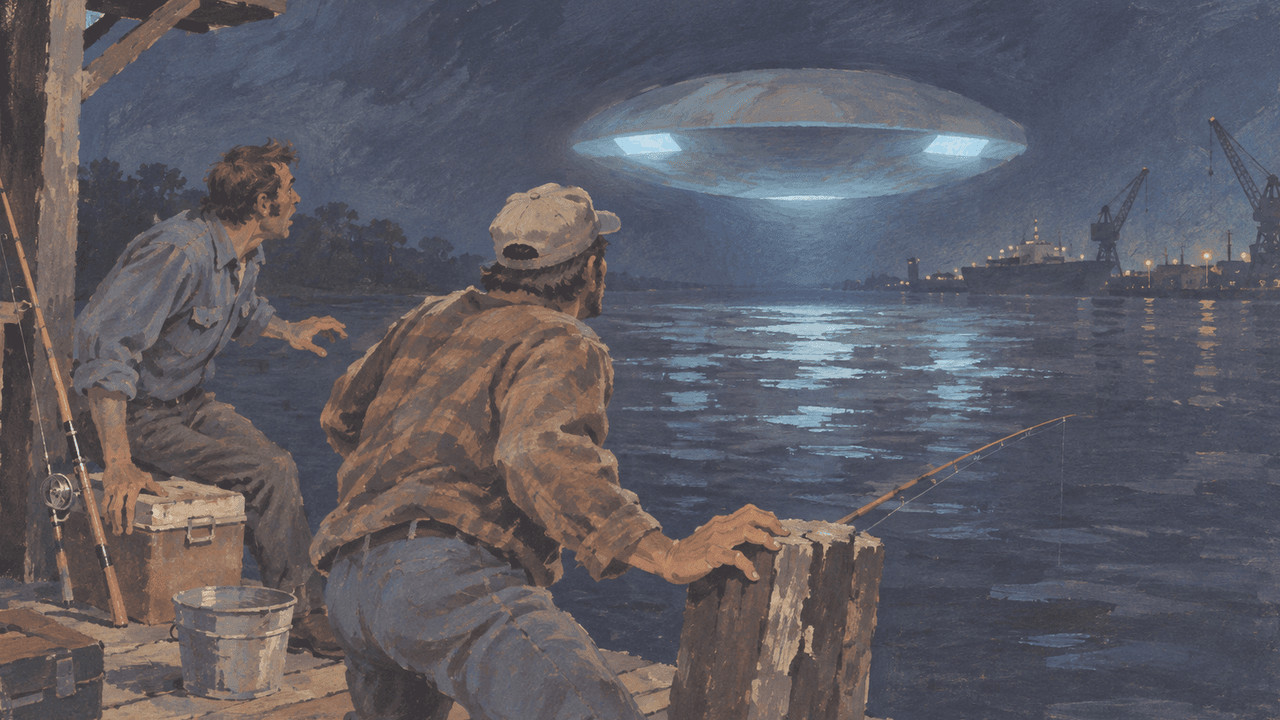
Charles Hickson, a 42-year-old foreman at the Walker Shipyard, and Calvin Parker, his 19-year-old coworker who had recently arrived from the small community of Laurel, Mississippi, were fishing off an abandoned pier on the west bank of the Pascagoula River on the evening of October 11, 1973. The location was near the old Shaupeter Shipyard, in a relatively quiet industrial stretch of the waterfront. Hickson was a Korean War veteran and father of several children; Parker was a young man recently relocated for work, quiet and unassuming. Neither had any prior involvement with UFO culture or claims.
The timing matters. The 1973 wave was nationwide -- more than a thousand sightings were logged in October alone, many by credible observers including law enforcement and military personnel. Whether this context makes the Pascagoula claim more plausible (as part of a genuine phenomenon) or less (as part of a social contagion) remains a central question in evaluating the case.
Events
The encounter
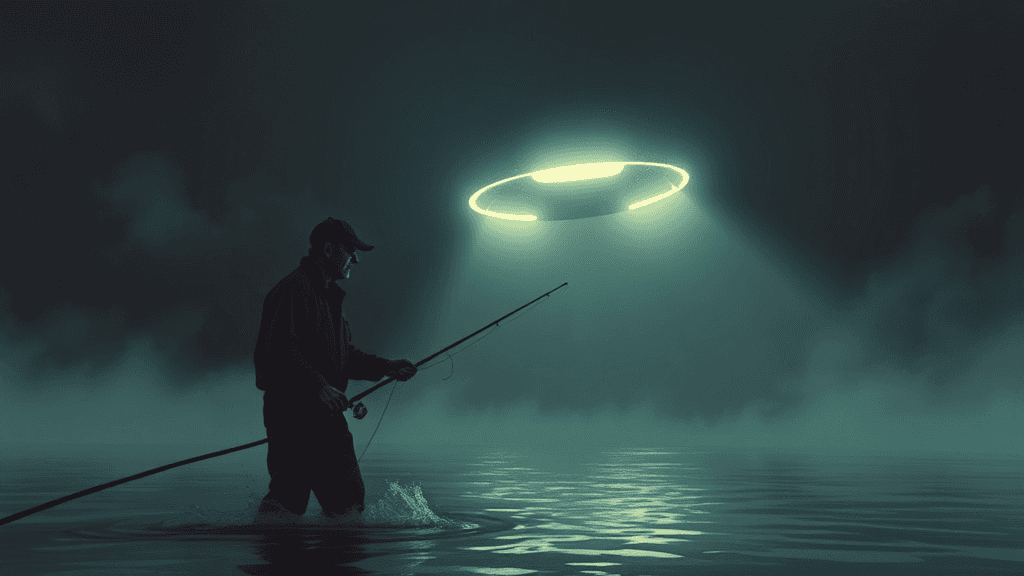
According to the men's consistent testimony, at approximately 9:00 p.m., they heard an unusual whirring or buzzing sound. Turning toward the source, they observed an elongated, oval-shaped craft -- roughly 30 to 40 feet across and 8 to 10 feet high -- hovering about two feet above the ground some 40 yards from them. The object emitted a pulsating bluish light.
Three entities emerged from the craft -- or, as both men described it, seemed to float out of an opening. The beings were approximately five feet tall with pale, greyish, wrinkled skin. Their heads were bullet-shaped or rounded, with no discernible neck. Where a nose or ears might be, thin conical projections protruded -- Hickson memorably compared them to carrots on a snowman's head. Their mouths were small slits. Most distinctively, their arms ended not in hands but in lobster-like or crab-like pincers. Their feet appeared fused together, and they moved by gliding rather than walking.
Hickson reported that two of the creatures seized him by his arms using their pincers, while the third took hold of Parker. Both men described an immediate paralysis -- an inability to move their limbs while remaining conscious. They were, according to Hickson, floated off the ground and carried into the craft. Parker, by his initial account, fainted from terror shortly after being grabbed, though he would later substantially revise this claim.
Aboard the craft
Hickson described the interior of the craft as brightly lit with no visible light source -- the walls themselves seemed to glow. He was placed in a reclined, floating position, suspended in midair as if by some unseen force. A device he described as resembling a large eye detached from the wall or ceiling and moved slowly around his body, as if scanning or examining him. The entire examination lasted, by his estimation, roughly twenty minutes, though he acknowledged that his sense of time was distorted.
Calvin Parker's account, which he elaborated on decades later in his 2018 book Pascagoula -- The Closest Encounter: My Story, differed in significant ways from the fainting narrative he had initially presented. Parker revealed that he did not lose consciousness entirely. He described being placed on a glass-like examination table inside the craft. A square object descended from the ceiling and circled around him, making clicking sounds -- an experience he later compared to undergoing an MRI. Parker also described encountering a smaller, more human-appearing being -- female in appearance, with notably elongated middle fingers -- who conducted a physical examination that included an invasive procedure on his throat, which caused bleeding. He recalled receiving some kind of injection that transformed his terror into what he described as "a sort of peaceful apathy." As he put it: "I didn't care what happened then." He would later speculate that the larger, claw-handed creatures were robotic rather than biological: "I really believe to this day it was a robot."
Both men were eventually returned to the riverbank. The craft departed, ascending with a whirring sound and disappearing into the night sky.
Investigation
The sheriff's office and the secret tape
Shaken and disoriented, Hickson and Parker initially considered not reporting the incident, fearing ridicule. They first drove to the office of the Mississippi Press, but finding no staff available at that hour, they proceeded to the Jackson County Sheriff's Department. Sheriff Fred Diamond and Captain Glenn Ryder took their report.
What happened next became one of the most cited elements of the case. After taking the men's formal statements, Diamond and Ryder left the interview room but deliberately kept a tape recorder running, hoping to catch the pair recanting or laughing about a hoax once they believed they were alone. Instead, the tape captured Hickson and Parker continuing to discuss the event in frightened, agitated tones. Parker could be heard on the verge of tears, saying he wanted to see a doctor. Hickson, attempting to console the younger man, said: "It scared me to death too, son. You can't get over it in a lifetime." At no point did either man drop the pretense, joke, or acknowledge any fabrication. The recording, which is preserved in the archives of the Jackson County Sheriff's Department and has been made available by the Hinds Community College Library, remains the case's single most compelling piece of evidence -- not for the reality of alien abduction, but for the genuine terror of the two witnesses.
Polygraph examination
On October 31, 1973, Hickson underwent a polygraph examination administered by a local operator. The examiner concluded that Hickson "told the truth as to what he believed happened," with the careful caveat: "We do not say a space ship landed or that creatures emerged from it." This qualified result has been cited by both supporters and skeptics -- believers pointing to Hickson's sincerity, critics noting the distinction between subjective belief and objective reality. Parker declined the polygraph at the time, citing emotional distress.
Keesler Air Force Base
Both men were taken to Keesler Air Force Base in nearby Biloxi for examination. Medical staff found no evidence of radiation exposure or physical injury consistent with their claims. The Air Force took no public position on the incident beyond confirming the examination had occurred. Project Blue Book had formally closed in 1969, and the Air Force initially declined involvement in the case.
Hynek and Harder
The case attracted two of the era's most prominent UFO investigators. Dr. J. Allen Hynek, the astronomer who had served as scientific consultant to the Air Force's Project Blue Book and who coined the term "close encounters," arrived in Pascagoula within 36 hours alongside Dr. James Harder, an engineering professor from UC Berkeley and director of research for the Aerial Phenomena Research Organization (APRO).
Harder and Hynek interviewed the two men separately and attempted regressive hypnosis. Harder's session with Hickson had to be halted because the subject became so distressed when reliving the experience that continuing was deemed inadvisable. At a subsequent press conference, both researchers told reporters that the men's accounts appeared to be based on a real experience. Hynek called the case "one of the most compelling I have encountered," citing the witnesses' demeanor, consistency, and lack of apparent motive for fabrication. Hynek's endorsement carried weight: he had spent two decades debunking UFO reports for the Air Force before reversing his position and becoming the field's most respected scientific figure.
The case for
Several factors have sustained the Pascagoula case's reputation as one of the stronger abduction claims in the UFO literature:
Witness consistency. Hickson and Parker told essentially the same core story -- with allowances for their different vantage points and emotional states -- across decades of interviews, hypnosis sessions, and public appearances. Their accounts did not inflate or embellish in the ways common to hoaxes.
The secret tape. The covert recording by Sheriff Diamond remains the case's most powerful piece of evidence. It captures genuine emotional distress in a moment when the witnesses had every reason to drop any pretense.
Investigator assessments. The involvement and positive assessments of Hynek and Harder lent the case unusual academic credibility for an abduction report.
Corroborating witnesses. Beginning in 2019, Maria Blair came forward publicly to state that she and her then-husband Jerry had been on the river that evening and witnessed a blue light rising from the area where the abduction was said to have occurred. She reported seeing what appeared to be an illuminated object moving along the river corridor. Other local witnesses provided similar accounts of unusual lights that evening. Their testimony, given independently decades later, is consistent with the original geographic and temporal details.
The polygraph. While limited in scope, the polygraph result supports the conclusion that Hickson was not consciously lying.
Personal cost. Neither man profited significantly from the encounter. Parker's life was essentially derailed by it -- he lost multiple jobs as reporters pursued him, suffered a temporary divorce, abandoned plans to become a preacher, and spent decades hiding under the alias "Randy." Hickson pursued some publicity but never achieved financial gain commensurate with a deliberate hoax.
The case against
Skeptical analyses, most notably by journalist Joe Eszterhas writing for Rolling Stone and by aviation journalist and UFO skeptic Philip Klass, raised several objections:
Lack of independent physical evidence. The alleged landing site was within view of two 24-hour toll booth operators on a nearby highway bridge, neither of whom reported seeing anything unusual that night. Security cameras at the adjacent Ingalls Shipyard also captured nothing anomalous. For an event involving a glowing, hovering craft, the absence of any corroborating footage or testimony from these nearby vantage points is notable.
Hickson's background. Eszterhas's investigation revealed that Hickson had been terminated from a foreman position at Ingalls Shipyard under unfavorable circumstances, involving allegations that he offered promotions to colleagues in exchange for personal loans he could not repay. Skeptics argued this suggested a character capable of deception, though supporters reasonably noted that workplace financial disputes are hardly evidence of UFO fabrication.
Evolving testimony. Parker's account changed significantly over the decades. He initially claimed to have fainted and remembered nothing of the interior of the craft. By 2018, he described a detailed examination by a humanoid female entity, an injection, and throat surgery. Skeptics view this as embellishment or the creation of false memories over time; Parker and his supporters framed it as the gradual disclosure of memories he had suppressed out of fear, shame, and a desire for a normal life.
Hickson's subsequent claims. In 1974, Hickson reported three additional UFO encounters, which struck many researchers -- even sympathetic ones -- as undermining the original case's credibility. Multiple-encounter claimants are viewed with greater suspicion in UFO research circles.
Hypnosis limitations. Modern psychology has broadly discredited hypnotic regression as a reliable means of recovering accurate memories, noting that the process can create false memories as easily as it recovers real ones. The Harder and Hynek hypnosis sessions, while dramatic at the time, carry little evidentiary weight by contemporary scientific standards.
Cultural impact
The Pascagoula abduction became one of the defining cases of the 1970s UFO era, alongside the Travis Walton abduction of 1975 and the investigations of researcher Budd Hopkins. It helped establish the abduction narrative as a distinct category within UFO reports, moving beyond mere sightings into claims of direct physical interaction with non-human entities.
Hickson self-published UFO Contact at Pascagoula in 1983, providing his detailed account. The case was featured in numerous television documentaries, books on UFO phenomena, and academic analyses of the abduction phenomenon. It appeared on series including Unsolved Mysteries, Sightings, and various History Channel programs.
Parker's long silence -- and his eventual decision to speak in 2018 with the publication of Pascagoula -- The Closest Encounter: My Story, co-authored with researcher Philip Mantle -- generated a major resurgence of interest. The book became an unexpected Amazon bestseller and was featured in USA Today and national publications. A sequel, Pascagoula -- The Story Continues: New Evidence & New Witnesses, followed, incorporating the testimony of corroborating witnesses who had come forward after four decades of silence.
On June 22, 2019, a Mississippi historical marker was unveiled at the site of the alleged abduction on the Pascagoula River. Funded by the Jackson County Historical Society and approved by the city, the marker commemorates the event. Parker attended the unveiling -- alongside members of Hickson's family -- and was reportedly moved to tears, describing it as long-awaited validation after decades of ridicule and disruption.
The case has also become significant in discussions of how abduction claims affect the lives of claimants. Parker's story -- the lost jobs, the broken marriage, the assumed identity, the abandoned vocation, the decades of nightmares -- serves as a case study in the personal toll exacted on those who report anomalous experiences, regardless of whether those experiences have a prosaic explanation.
Current status
Charles Hickson died of a heart attack on September 9, 2011, at the age of 80. He maintained his account without significant deviation until the end of his life.
Calvin Parker died on August 24, 2023, at the age of 68, after a battle with kidney cancer. In his final years, Parker had become more open about his experience, attending conferences and giving interviews. He described the publication of his books as liberating, saying the nightmares that had plagued him for decades finally ceased: "After the book came out, I put all this behind me... just a big relief."
The Pascagoula case remains one of the most debated incidents in UFO history. It lacks the physical trace evidence that characterizes cases like Rendlesham Forest or the Trans-en-Provence case, but the secret tape recording, the corroborating witnesses who emerged decades later, and the undeniable personal cost borne by both men ensure it retains a prominent place in the literature. The 50th anniversary in October 2023 -- coming just weeks after Parker's death -- prompted renewed media coverage and public reflection on one of the Gulf Coast's strangest and most enduring mysteries.
Witnesses
Charles Hickson (1931--2011) -- 42-year-old shipyard foreman and Korean War veteran. Primary narrator of the encounter; described the craft, beings, and examination in detail. Maintained his account consistently until his death.
Calvin Parker (1954--2023) -- 19-year-old shipyard worker from Laurel, Mississippi. Initially reported fainting during the encounter; decades later revealed detailed memories of an examination aboard the craft. Published two books about the experience beginning in 2018.
Maria and Jerry Blair -- Came forward in 2019 claiming they were on the Pascagoula River that evening and witnessed a blue light rising from the area of the alleged encounter. Their testimony is geographically and temporally consistent with the original report.
Evidence
The secret tape recording -- Sheriff Fred Diamond covertly recorded Hickson and Parker when left alone after giving their statements, expecting to catch them recanting. Instead, the tape captured continued distress and discussion consistent with genuine trauma.
Polygraph examination -- A local polygraph examiner concluded on October 31, 1973 that Hickson "told the truth as to what he believed happened," though the examiner carefully noted this did not confirm the objective reality of the event.
Keesler AFB medical examination -- Both men were examined at Keesler Air Force Base and cleared of radiation exposure. No physical injuries consistent with their claims were found.
Hynek-Harder assessment -- Dr. J. Allen Hynek and Dr. James Harder interviewed the men separately under hypnosis and publicly stated the accounts appeared based on real experience.
Corroborating witness testimony -- Multiple witnesses came forward beginning in 2019 reporting unusual aerial lights in the Pascagoula River area on the night in question.
Absence of contradicting evidence -- While toll booth operators and security cameras at nearby Ingalls Shipyard recorded nothing unusual, the timing and viewing angles have been debated.
Historical marker -- A Mississippi historical marker was unveiled at the site on June 22, 2019, providing official civic recognition of the event.
Filed under
Watch
The Alien Abduction: Pascagoula man says he had an encounter with aliens
The Pascagoula Alien Abductions: The Most Perfect ET Case ft. Philip Mantle | Special Episode
"In Contact" The Pascagoula UFO Abduction. Directed by Charles Hickson
Pascagoula man recalls the time he was abducted by aliens
Pascagoula Abduction and Strange Looking Humanoid Creatures (1973) - FindingUFO
Where this entry came from
ProvenanceAgent indexedUpdated 6mo ago9 sources
Drafted by the archive's AI research agent from the sources below; corrections from readers are reviewed and folded in.
- First indexed
- 26 APR 26 // 23:23Z
- Last updated
- 26 APR 26 // 23:23Z
- Pascagoula incident, Wikipedia
- An Interview with Calvin Parker: The Pascagoula Alien Abduction, Country Roads Magazine
- Man says 1973 UFO 'abduction' incident turned life upside down, NBC News
- Pascagoula Alien Abductions of 1973: 50 Years Later, Darkhorse Press
- Calvin Parker, who claimed he was abducted by aliens in Pascagoula in 1973, has died, WLOX
- Listen to 1973 Recording of Hickson and Parker Discussing their Alien Abduction, Hinds Community College Library
- Pascagoula -- The Closest Encounter: My Story, Calvin Parker and Philip Mantle, Amazon
- The Pascagoula abduction, USA, 1973, Patrick Gross, UFOs at Close Sight
- Pascagoula UFO 1973 Historical Marker, Historical Marker Database
Notes
- Pascagoula incident, Wikipedia
- An Interview with Calvin Parker: The Pascagoula Alien Abduction, Country Roads Magazine
- Man says 1973 UFO 'abduction' incident turned life upside down, NBC News
- Pascagoula Alien Abductions of 1973: 50 Years Later, Darkhorse Press
- Calvin Parker, who claimed he was abducted by aliens in Pascagoula in 1973, has died, WLOX
- Listen to 1973 Recording of Hickson and Parker Discussing their Alien Abduction, Hinds Community College Library
- Pascagoula -- The Closest Encounter: My Story, Calvin Parker and Philip Mantle, Amazon
- The Pascagoula abduction, USA, 1973, Patrick Gross, UFOs at Close Sight
- Pascagoula UFO 1973 Historical Marker, Historical Marker Database
Also available
Pascagoula 73
Four-part docuseries exploring the shocking 1973 Pascagoula UFO abduction of Charles Hickson and Calvin Parker, featuring previously unheard recordings from the night of the encounter and exclusive interviews with witnesses and researchers.
Alien Contact: The Pascagoula UFO Encounter
Re-opens the seminal 1973 alien abduction case with new eye witnesses confirming the UFO encounter, featuring survivor Calvin Parker's account and details previously unexposed about the incident near Pascagoula, Mississippi.
Files of the Unexplained: File: Pascagoula Alien Abduction
Series: First episode of Netflix's documentary series exploring unexplained phenomena. Examines the 1973 Pascagoula fishing trip that led to an alleged alien encounter and the widespread media attention that followed, changing two men's lives forever.
Into the Unknown: The Pascagoula Alien Abductions
Historical documentary examination of the 1973 Pascagoula UFO abduction case, featuring Charles Hickson's account of the encounter and exploring the aftermath and impact of this controversial UFO event.
Buying through these links supports the library. We may earn a commission.