The UFO Library: Military encounter
Mediterranean RC-135 Encounter (Mount Olympus Radar), 1982
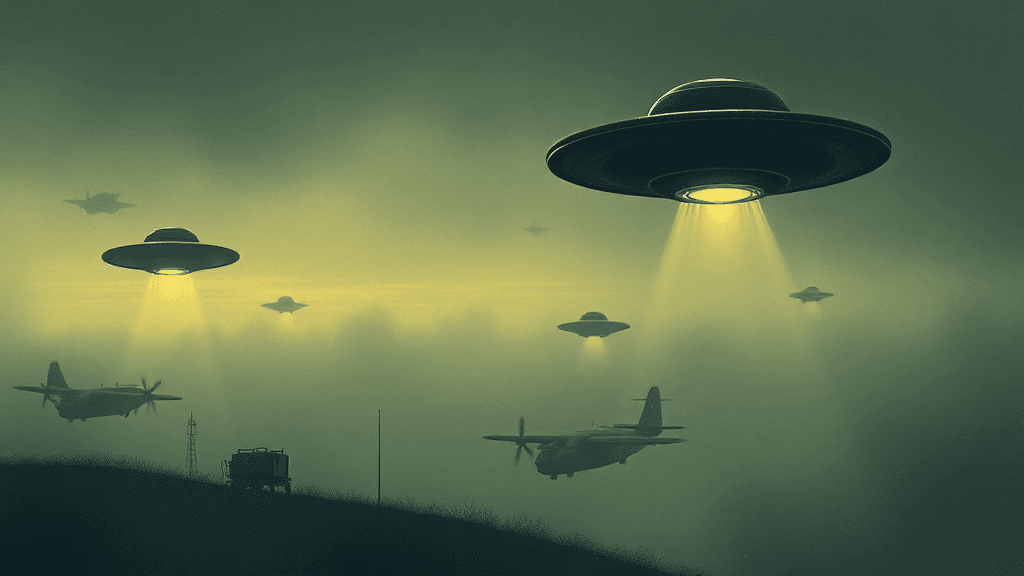
On 19 October 1982 the whole crew of a USAF RC-135 reconnaissance aircraft reported a large, light-covered object that shadowed them for 90 minutes over the eastern Mediterranean, an event followed from RAF Troodos in Cyprus and revealed only when British files were opened in 2017.
Background
In the autumn of 1982 the eastern Mediterranean was one of the most heavily watched pieces of sea and sky in the world. The Cold War was at a tense point, and the region was still unsettled by the 1982 Lebanon War, fought that summer along the coast only a few hundred kilometres east of Cyprus. American and Soviet naval forces shadowed one another, and electronic-intelligence aircraft flew slow, repetitive patterns at high altitude to listen to what the other side was transmitting.
The Boeing RC-135 is the workhorse of that trade. A converted transport about 136 feet long, with a wingspan of roughly 130 feet, it carries a flight crew of pilots and a navigator plus a large team of mission specialists operating signals-intelligence equipment. In a typical sortie it flies a fixed "racetrack" orbit, turning back and forth along the same line for hours. That detail matters to this case, as discussed below.
On the ground, the aircraft were supported and overheard by British facilities on Cyprus. RAF Troodos, on the slopes of Mount Olympus in the island's mountains, was the base of 280 Signals Unit and housed radar and listening equipment. The nearby sovereign base at RAF Akrotiri supported RAF fighter operations. This chain of installations is why a mid-air event involving an American aircraft left a paper trail in British files.
Events
The account that exists today comes from a Ministry of Defence file opened at The National Archives at Kew in June 2017, as one of the last 15 UFO files the MoD transferred. Folklorist and UFO historian David Clarke examined it and published the first public description on 30 June 2017.
According to that file, on 19 October 1982 a USAF RC-135 with the call sign "Beano 73" was flying at about 35,000 feet over the eastern Mediterranean, monitoring Soviet military activity. British personnel at Troodos were listening to the American crew's radio calls as the event began shortly after 4 pm local time. The crew reported a large object that their radar picked up as it approached from the south. A signal from Troodos to the MoD on 20 October describes it as "initially about two miles from wing of RC-135", which then "moved position around aircraft and closed". The same signal says the object "tailed Beano 73 for 90 mins on its northeast/southwest race track" and that it was seen by the "whole crew". Another phrase from the file describes it as covered in "a multitude of flashing lights 20 at a time". The signal characterises the object as "larger than [a] RC-135".
As the encounter developed, the aircraft's navigator reportedly appealed to ground controllers for help. Two US Navy F-14 fighters were launched from an aircraft carrier, and an RAF Phantom was diverted from a night-flying exercise to intercept the object south of Cyprus. As the three interceptors closed, the RC-135 crew watched the object depart toward the African coast. The fighter pilots saw nothing.
Troodos personnel monitored the whole episode for about 90 minutes. But the file records that the object was not detected by British air-defence stations, "nor was it seen on any ground or seaborne radar, including at 280 SU". In other words, the principal record of an unusual radar contact is the American aircraft's own radar, not a corroborating British ground return.
Investigation
The file shows that the incident was treated as more than idle curiosity. Officials ordered a transcript of the tape recording of the radio traffic between the spy-plane crew and ground controllers. Copies of the resulting report were circulated to the RAF's Assistant Chief Scientist, to the operations staff, to DI55 (the MoD's air-intelligence section that handled such matters), and to DSTI. Film from the Troodos radar was examined by photographic experts in London, and large prints made from the radar picture were prepared for intelligence officers. A secret investigation followed, and its results were sent to the US Department of Defense in November 1982.
None of that evidence survives in the released file. Clarke reported that the file does not say what happened to the film, and that the results of the joint UK/US investigation do not appear in it. Asked by a reader whether the original material still exists, Clarke replied that he doubted it, saying the MoD had done "a very good job of destroying anything that might have been evidential" and that only "bits and pieces" had escaped the shredder. He also noted that the file as a whole runs to several hundred pages and only two pages concern this incident, and that it had not been digitised at the time.
The file does contain one tentative explanation, from a senior RAF official: "We have a strong suspicion that the 'UFO' was a mirage effect from lights on the coast of Israel or Lebanon." That is a suspicion, not the conclusion of a documented analysis, and the file does not show how it was reached.
The same file also holds a separate survey in which an RAF Group Captain, answering a Parliamentary Question from MP Martin Redmond, collated air-defence UFO reports for the thirty years to 1996. He found "no reports or mention" of UFOs detected by air-defence ground radars or by 11/18 Group aircraft. This sits oddly beside the 1982 episode and is a reminder that the Troodos incident was handled as a special case outside routine air-defence reporting.
The case for / against
For taking it seriously. The witnesses were a full military aircrew, trained to identify aircraft and to report precisely, working with specialist electronic equipment. The report was made in real time on a monitored radio link, so the British listeners could hear it as it happened. It prompted a multi-agency response, including interceptors and a transcript, and a British-US investigation. Commenters on Clarke's article, such as Robert Powell, argued that a trained crew of electronic-intelligence specialists would be unlikely to mistake stationary lights for a pursuing object while also suffering an anomalous radar return.
Against. Almost every strong element is second-hand. What survives is a summary signal and a minute, not the crew's own words, the radar data, or the transcript. The interceptors saw nothing, and no ground or shipborne radar saw anything. A phrase such as "circled around the aircraft" is someone's paraphrase of a real-time radio report that has not been published, so its meaning cannot be checked.
That is the point made by Martin Shough, a researcher known for technical analyses of radar-visual cases, in comments on Clarke's post. He argued that if the airborne radar was also affected by anomalous propagation, it could have produced an unexpected echo from a distant coast or mountains. Because the RC-135 was flying a racetrack, the relative bearing of a stationary mirage would swing as the aircraft turned, which could make a static source seem to "circle round". He described the situation as "insufficient information" and cited other plane-following light cases already attributed to high-altitude mirage ducts. The RAF official's coastal-lights idea is of the same family as a superior mirage.
Another commenter, Robert Moore, relaying a suggestion from Sefton Disney in the ASSAP discussion, proposed a sprite or similar high-altitude lightning effect. Shough replied that sprites occur at altitudes roughly ten times that of the RC-135 and over distant thunderstorms, so a cluster that appeared close to the aircraft would in fact be hundreds of miles away and would not circle; he said this explanation faces the same limitations as the mirage one and the data to choose between them is missing.
Other commenters argued the opposite, that the mirage explanation is a cheap official answer and does not account for the radar contact. One former air-defence radar watcher wrote simply that UFOs "don't exist". These are reader opinions, not evidence, but they show how the fragmentary record accommodates almost any prior view.
Cultural impact
The case appeared late and quietly. It was published in 2017, the year The New York Times revealed the Pentagon's AATIP programme and the Navy's "Tic Tac" video entered public debate, and it was read through that lens as a Cold War forerunner of modern military UAP encounters involving aircrew, radar and scrambled interceptors. It also fed the familiar argument among researchers that the most interesting official records are the ones that go missing: here the radar film, the transcript and the joint investigation. It is a minor case in the wider literature, but a useful example of how a handful of lines in an archive file can reopen a forgotten incident.
Current status
The incident remains unexplained in the sense that nobody has published the data needed to explain it. Sources for the date and details are a single news-style summary of two pages in a large MoD file; the Black Vault holds a scan of a related MoD file (DEFE 24/2061/1) but that scan is image-only and could not be text-searched for this entry. Secondary accounts also differ slightly on the year of an associated Troodos operations record, so the chronology should be checked against the original file before being treated as settled. The call sign, altitude and flight pattern are as reported by Clarke from the file. The US side of the story, including any Air Force or Navy records of the F-14 launch, has not surfaced publicly. Until it does, the case is best treated as a well-attested report of a puzzling experience by a credible crew, with no verified physical or instrumental data and no settled explanation.
Witnesses
The entire flight crew of USAF RC-135 call sign "Beano 73" (two pilots, a navigator, and mission specialists; none are named in the released papers). Personnel at RAF Troodos (280 Signals Unit) who listened to the radio exchange and tracked the aircraft. Crews of two US Navy F-14 fighters and an RAF Phantom who were sent to intercept and saw nothing.
Evidence
Two pages in a larger Ministry of Defence file at The National Archives: a Troodos-to-MoD signal of 20 October 1982 and a minute noting the mirage suspicion. The file refers to a radio-tape transcript, Troodos radar film examined in London, and a UK/US investigation sent to the US Department of Defense in November 1982, none of which survive in the released papers. No photographs are mentioned, and no ground or shipborne radar corroborated the object.
Filed under
Where this entry came from
ProvenanceAgent indexedUpdated 10d ago7 sources
Drafted by the archive's AI research agent from the sources below; corrections from readers are reviewed and folded in.
- First indexed
- 28 OCT 26 // 15:19Z
- Last updated
- 02 NOV 26 // 04:44Z
- UFO Files exclusive: Cold War spyplane incident (article and reader discussion), David Clarke, DrDavidClarke.co.uk
- A Cold War Close Encounter, Fortean Times
- DEFE 24/2061/1 (UK MoD UFO file scan), The Black Vault
- Boeing RC-135, Wikipedia
- RAF Troodos, Wikipedia
- Anomalous propagation, Wikipedia
- Sprite (lightning), Wikipedia
Notes
- UFO Files exclusive: Cold War spyplane incident (article and reader discussion), David Clarke, DrDavidClarke.co.uk
- A Cold War Close Encounter, Fortean Times
- DEFE 24/2061/1 (UK MoD UFO file scan), The Black Vault
- Boeing RC-135, Wikipedia
- RAF Troodos, Wikipedia
- Anomalous propagation, Wikipedia
- Sprite (lightning), Wikipedia