The UFO Library: Mass sighting
The 1954 French UFO Wave (Flap d'Automne)
An unprecedented wave of UFO sightings swept across France from September to November 1954, peaking with 84 documented cases on October 3 alone, including landed-craft encounters, physical traces, and reports of small humanoid beings.
Background
By the autumn of 1954, France had already absorbed nearly a decade of American "flying saucer" lore, filtered through newsreels, pulp magazines, and the occasional skeptical newspaper column, but had not yet produced a homegrown wave of its own scale. The United States had its 1947 dawn with Kenneth Arnold and its 1952 Washington D.C. radar-visual flap; France, still rebuilding after the war and mid-decolonization in Indochina and North Africa, had mostly watched from a distance. That changed abruptly in September 1954, when a single, richly detailed encounter in a small industrial town in the Nord department ignited a chain reaction of reports that would eventually be called the Flap d'Automne — the Autumn Wave — one of the most intensely documented UFO flaps of the twentieth century.
The social and media climate mattered as much as any individual sighting. Provincial and national newspapers, hungry for a compelling story amid otherwise grim postwar news, gave the phenomenon prominent, often breathless coverage. Popular magazines like RADAR ran illustrated spreads. Once the story became a sensation, sightings bred further sightings — a pattern later ufologists and sociologists would recognize as a hallmark of "flap" dynamics, in which genuine ambiguous stimuli (aircraft, meteors, planets, weather balloons, ball lightning) combine with heightened public attention and imaginative elaboration to produce a self-sustaining surge of reports.
Events
The Quarouble encounter (September 10, 1954)
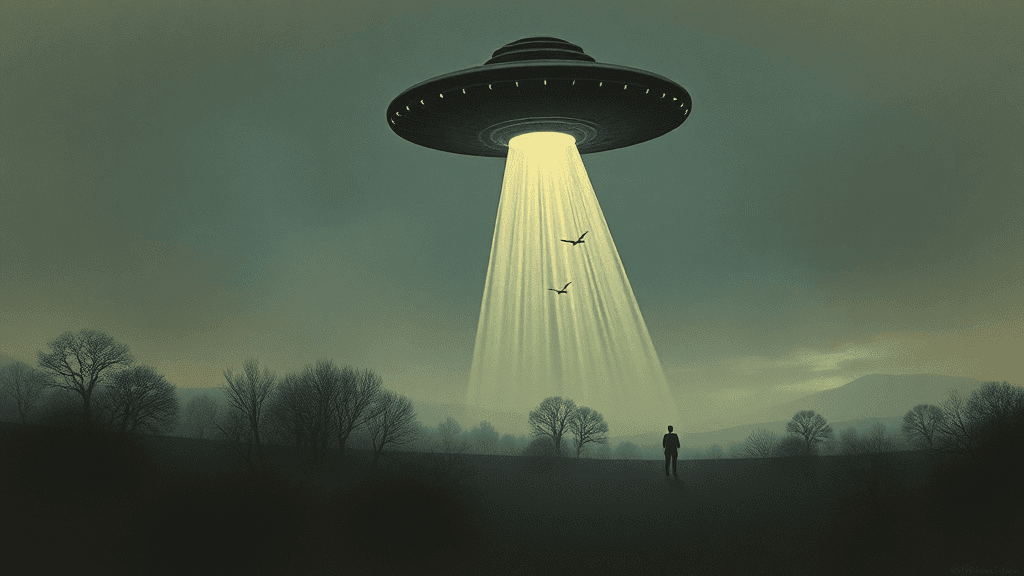
The case that is generally credited with starting the wave in earnest took place in Quarouble, a small commune in Nord near the Belgian border. Marius Dewilde (1921–1996), a metalworker who lived with his family in a disused railway station house, was alerted by his dog's frantic barking around 10:30 p.m. Stepping outside with a flashlight, Dewilde said he saw a dark, elongated object resting on the nearby railway tracks, six or seven meters away. Hearing footsteps behind him, he turned his light on two small figures — by his estimate roughly 80 centimeters to a meter tall — wearing suits that resembled diving gear, with helmets that reflected his flashlight beam "as if they were wearing a mirror." Before he could react, a beam of light from the object struck him and left him momentarily paralyzed. By the time he recovered, the two beings had re-boarded the craft, which lifted off, changing color as it climbed and vanished into the night.
What elevated the Quarouble case above an ordinary uncorroborated sighting was the physical aftermath. Local police, the Air Force gendarmerie, and agents of the DST (France's internal security service) examined the site and reported a shallow depression in the rail ballast, stones that appeared carbonized or scorched, and symmetrical marks pressed into the wooden railway sleepers that investigators could not immediately explain. A second, daylight sighting was reported at the same location roughly a month later, on or around October 10, reinforcing Quarouble's status as an epicenter of the wave. Dewilde would later describe lingering respiratory problems, and locals reported his dog's death within days and unexplained cattle deaths on nearby farms — details that spread through press retellings but were never independently substantiated and likely reflect folkloric embellishment layered onto the original account.
The wave crests (late September – October 1954)
Within weeks, similar reports were arriving from across France at a striking rate. The National Investigations Committee on Aerial Phenomena (NICAP), the American civilian research group that later archived many European cases, counted 84 sightings on October 3, 1954 alone — 76 of them in France, with the remainder reported abroad in India, Lebanon, Quebec, Switzerland, England, Italy, and Austria, suggesting (to believers) either a genuinely global phenomenon or (to skeptics) a media-driven pattern-recognition cascade riding on ordinary astronomical and aerial traffic.
Among the most cited cases from this peak period:
- Doncourt-Village (October 11): Farmers reported an eerie whistling sound and observed a flat, disc-like object rising rapidly and vertically from ground near a forest edge; investigators afterward found patches of burnt or scorched earth at the purported landing spot.
- Fonfrède, Loire (October 11): A milk delivery driver making early rounds said his van's engine died and his headlights failed as a large, multicolored luminous object — glowing blue and pink at its base — hovered nearby. When the object departed, his electrical systems reportedly came back to life on their own, an early French example of the "vehicle interference" motif that would recur in later UFO literature worldwide.
- Boulevard Pereire, Paris (October 23): Multiple city witnesses described an orange, parachute-shaped object hanging motionless in the sky before vanishing, leaving what several described as a pinkish afterglow or trail.
- Châteauneuf-du-Pape (September 1954): The wave reached even the wine country of the southern Rhône, where mayor Lucien Jeune and the village council, half in earnest and half tongue-in-cheek, passed a municipal ordinance whose Article 1 prohibited "the overflight, the landing and the takeoff of aircraft known as flying saucers or flying cigars, whatever their nationality," from the commune's territory, out of professed concern for the vineyards. Forest officers and municipal police were nominally charged with enforcement. The story has enjoyed a long afterlife in wine and travel journalism as a charming footnote to the wave, with writers noting — accurately, if impishly — that no saucer incidents have troubled the appellation since.
Decline (November 1954)
By November, the frequency of reports fell off sharply but did not stop entirely. On November 4, farmers near Pontivy in Brittany described an intensely bright, white, oval-shaped object visible even in daylight, with a luminosity compared to a searchlight beam. By the close of the year, the wave had effectively run its course, though France would continue to be one of the most UFO-report-dense countries in Europe for decades afterward.
Investigation
Official French reaction was measured and, in public statements at least, dismissive. Engineer-General Paricaud, a technical adviser at the French Air Ministry, told the press that the contradictory and inconsistent testimonies had produced no genuinely new information, and suggested that many of the glowing-disc reports seen at dusk were likely reflections of sunlight in the upper atmosphere — drawing an explicit comparison to the American radar-visual wave of 1952. Some individual sightings were attributed by officials to "classic rockets," weather phenomena, or aircraft, explanations the press frequently challenged given the specificity of witness accounts and, in the Quarouble case, physical trace evidence.
At Quarouble specifically, the involvement of the Air Force gendarmerie and the DST gave the case an unusual degree of official attention for a UFO report of the period — a sign that authorities, whatever their public skepticism, took the possibility of a genuine unidentified craft (whether atmospheric, foreign military, or otherwise) seriously enough to investigate physical evidence rather than dismiss the report outright. No public French government report from the era concluded that Dewilde's account was fraudulent, though no official explanation was ever conclusively offered either.
The deeper, more systematic investigation of the wave came not from the state but from private citizens. Aimé Michel (1919–1992), a French science writer, mathematician, and pioneering ufologist, spent months after the wave collecting sighting reports from newspapers and correspondents and plotting them on Michelin road maps of France. His analysis, published as Mystérieux Objets Célestes ("Mysterious Celestial Objects") in 1958, proposed that many same-day sightings fell along straight lines — great circles across the Earth's surface — a pattern he named orthoteny, and interpreted as evidence of purposeful, guided flight paths rather than random atmospheric phenomena. The book, alongside Michel's methodical, non-sensational tone, did much to establish French ufology as a field that at least aspired to scientific rigor, and it remains a key primary source for the wave's chronology and geography.
The case for and against
The case for treating 1954 as evidence of a genuine anomalous phenomenon rests on several features that distinguish it from more casual UFO scares: a large number of geographically dispersed, independent witnesses — including professionals such as police officers and delivery drivers who had no evident motive to fabricate; broadly consistent physical descriptions (cigar or disc shapes, intense multicolored luminosity); recurring secondary effects such as vehicle ignition failure; and, in the Quarouble case, physical trace evidence examined by trained investigators, including carbonized ballast stones and marks on wooden railway sleepers that were not immediately explained by conventional means.
The case against is built on the well-documented dynamics of a media-amplified flap. Once Quarouble became a national sensation, France's newspapers actively solicited and rewarded UFO stories, creating strong incentive and priming effects for witnesses to interpret ordinary stimuli — meteors, aircraft lights, Venus near the horizon, ball lightning, even hoaxes by attention-seekers — as extraordinary. Statistically, a nation of tens of millions of people, primed by daily press coverage to look at the sky, will generate many ambiguous reports in a short window purely by chance. And the wave's most systematic attempt at scientific validation, Michel's orthoteny theory, did not survive scrutiny: Harvard astronomer Donald H. Menzel challenged Michel's statistics in a running dispute carried out in the pages of Flying Saucer Review during the mid-1960s, and computer scientist and ufologist Jacques Vallée later ran computer analyses of the claimed alignments and concluded that the overwhelming majority — quite possibly all — were attributable to chance, given how many sighting locations were available to draw lines through. Subsequent critics also noted that Michel appeared to have selectively sampled cases, and in some instances adjusted dates or locations, to make the alignments fit more neatly. Michel himself eventually conceded orthoteny was a "false trail." That the wave's flagship scientific theory collapsed under statistical scrutiny does not, by itself, debunk any individual sighting, but it substantially weakens the claim that the wave exhibited a structured, non-random pattern.
Cultural impact
The 1954 wave left a disproportionately large mark on UFO culture relative to its brief, few-month span. It is widely regarded as the moment French ufology came of age as an organized field of inquiry, generating a body of case files, press archives, and analytic literature (above all Michel's) that later researchers — including the country's eventual government-linked study group, GEPAN, founded within the French space agency CNES in 1977 — would draw upon directly. The wave also gave the world one of ufology's most enduringly quoted footnotes: the Châteauneuf-du-Pape flying-saucer ordinance, still cited today in wine writing and general-interest journalism as proof of how thoroughly the panic penetrated French public life, right down to a village council legislating against alien cigars over its vineyards. The Dewilde case at Quarouble, meanwhile, became a template for the "landed craft with small humanoid occupants and physical traces" narrative that would recur, with variations, in cases worldwide for decades afterward.
Current status
No French government body has ever issued a definitive, comprehensive explanation for the 1954 wave as a whole; individual cases were addressed piecemeal at the time, generally with reference to misidentified aircraft, astronomical objects, or atmospheric optical effects, without resolving the more striking cases such as Quarouble to universal satisfaction. The wave is treated today primarily as a historical case study — cited by believers as one of the best-documented clusters of high-quality UFO testimony on record, and by skeptics as a textbook example of how media saturation can manufacture the appearance of a coordinated phenomenon out of a background rate of ordinary misperception. Patrick Gross's long-running archival project, UFOs at Close Sight, remains the most complete public repository of primary-source press clippings and case files from the wave, and Michel's Mystérieux Objets Célestes, despite the failure of its central orthoteny thesis, is still consulted as the closest thing to a contemporaneous field survey of the events.
Witnesses
Marius Dewilde (Quarouble, Sept. 10 landed-craft/humanoid encounter); Air Force gendarmerie and DST investigators at Quarouble; farmers at Doncourt-Village; a milk delivery driver at Fonfrède, Loire; multiple civilian witnesses on Boulevard Pereire, Paris; farmers at Pontivy, Brittany; and hundreds of additional documented civilian witnesses across France, chiefly farmers, delivery workers, and police officers.
Evidence
Physical traces at Quarouble examined by police, Air Force gendarmerie, and DST agents: a depression in the railway ballast, carbonized/scorched stones, and unexplained symmetric marks on wooden railway sleepers. Burnt ground reported at the Doncourt-Village landing site. Vehicle electrical interference (engine stall, headlight failure and restoration) reported at Fonfrède. Cross-referenced press archives and NICAP's tally of 84 sightings on October 3, 1954. Aimé Michel's systematic case-mapping in Mystérieux Objets Célestes (1958), though its central orthoteny thesis was later statistically discredited by Donald Menzel and Jacques Vallée.
Filed under
Watch
Hyllyyn vai pyllyyn? Käydään läpi lahjoitusleffat!
Where this entry came from
ProvenanceAgent indexedUpdated 3mo ago9 sources
Drafted by the archive's AI research agent from the sources below; corrections from readers are reviewed and folded in.
- First indexed
- 06 JUN 26 // 12:18Z
- Last updated
- 22 JUL 26 // 04:46Z
- Marius Dewilde, Wikipedia Contributors, Wikipedia
- UFOs at Close Sight: the 1954 French flap, September 10, Quarouble, Nord, Patrick Gross, UFOs at Close Sight
- UFOs at Close Sight: The 1954 French Flap, Patrick Gross, UFOs at Close Sight
- The Sudden And Explosive French UFO Wave Of 1954, UFO Insight Editorial, UFO Insight
- Aimé Michel, Wikipedia Contributors, Wikipedia
- Aimé Michel: Tribute to the Great French Ufologist, New Dawn Magazine, New Dawn Magazine
- Orthoteny – a lost cause: Part 2, Donald H. Menzel, Donald H. Menzel (republished)
- The 1954 French UFO Craze That Led To The World's Weirdest Wine Law, VinePair Staff, VinePair
- 'Martians Are Here!' Inside France's 1954 UFO Frenzy With Humanoids and Face-To-Face Encounters, IBTimes UK Staff, IBTimes UK
Notes
- Marius Dewilde, Wikipedia Contributors, Wikipedia
- UFOs at Close Sight: the 1954 French flap, September 10, Quarouble, Nord, Patrick Gross, UFOs at Close Sight
- UFOs at Close Sight: The 1954 French Flap, Patrick Gross, UFOs at Close Sight
- The Sudden And Explosive French UFO Wave Of 1954, UFO Insight Editorial, UFO Insight
- Aimé Michel, Wikipedia Contributors, Wikipedia
- Aimé Michel: Tribute to the Great French Ufologist, New Dawn Magazine, New Dawn Magazine
- Orthoteny – a lost cause: Part 2, Donald H. Menzel, Donald H. Menzel (republished)
- The 1954 French UFO Craze That Led To The World's Weirdest Wine Law, VinePair Staff, VinePair
- 'Martians Are Here!' Inside France's 1954 UFO Frenzy With Humanoids and Face-To-Face Encounters, IBTimes UK Staff, IBTimes UK
Also available
Quarouble 1954
Modern documentary examining the famous September 10, 1954 UFO encounter in Quarouble, France, when railway worker Marius Dewilde witnessed two small humanoid beings and a landed spacecraft, one of the most significant close encounters in French ufology history. Combines archival footage, reconstructions, and witness testimonies.
Les Chercheurs d'OVNIS
French-German co-production documentary investigating UFO mysteries and reality, featuring interviews with witnesses of UFO sightings and military documents. Includes coverage of major cases from the 1954 French UFO wave, including the famous Quarouble encounter.
Les Soucoupes Volantes
Early television documentary examining the intense autumn 1954 French UFO wave, presented by renowned French UFOlogist Aimé Michel. Covers the peak of sightings in France during October 1954 and analyzes patterns in reported encounters with apparent humanoid beings. Aired on ORTF (French National Television).
Buying through these links supports the library. We may earn a commission.