The UFO Library: Humanoid encounter
Boianai UFO Incident
Mass sighting of a disc-shaped craft with humanoid figures at an Anglican mission in Papua New Guinea; witnesses reported apparent interaction via waving and light signals.
The Sighting
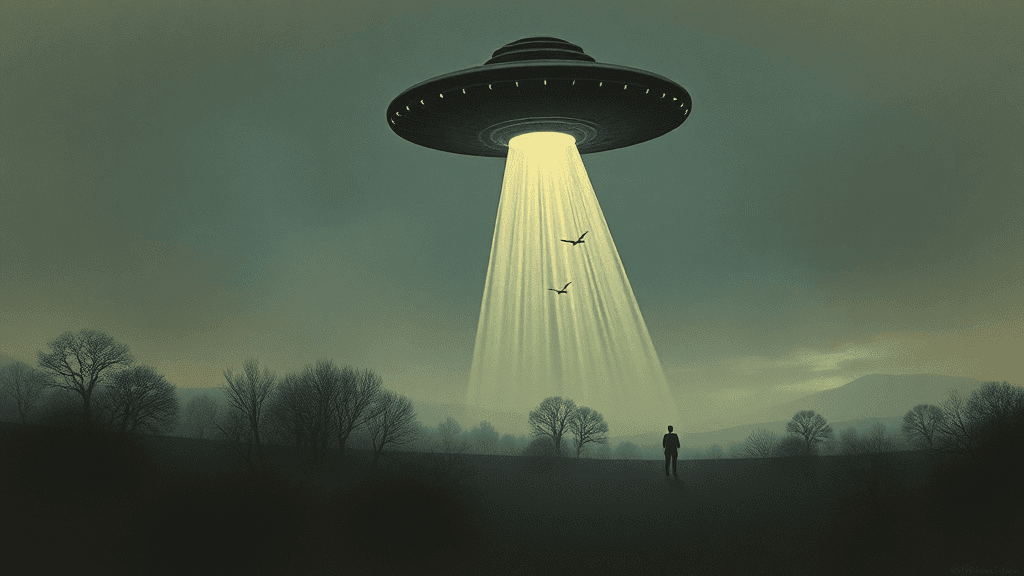
On the evening of June 26, 1959, Reverend William Broughton Gill, an Australian Anglican missionary stationed at Boianai in Papua New Guinea, observed a bright light approaching from the northwest sky. The craft descended to approximately 100 meters above the mission station. What began as a solitary observation quickly expanded into a mass sighting when Gill called others to witness the phenomenon. By evening's end, 38 people—including Gill, local teachers Steven Gill Moi and Ananias Rarata, and medical technicians—had gathered to observe the object.
The craft was described as disc-shaped with a prominent superstructure resembling a deck and bridge, rendered in a dull yellow or bright orange color. Most strikingly, four humanoid figures were distinctly visible moving about the top surface of the craft. The beings appeared diminutive in stature and human-like in form, though their exact features remain unclear from available accounts.
The Interaction
What distinguishes the Boianai sighting from most UFO reports is the apparent two-way interaction between witnesses and the craft occupants. As Gill and others watched, a teacher standing beside him raised his arm and waved. One of the figures on the craft appeared to reciprocate the gesture, waving back. Emboldened by this response, the mission group called out to the beings and beckoned them to descend, but received no response beyond the initial wave.
Gill sent a schoolboy to retrieve a flashlight. When the witnesses illuminated the craft with repeated flashes, the entire object appeared to respond by tilting slightly—"as though it was acknowledging the flashes of the torch," in Gill's own words. This exchange continued for approximately one hour before the craft rose vertically and disappeared into the night sky. The following evening, June 27th, similar craft returned, and comparable sightings were reported from this second encounter.
Documentation and Investigation
Gill's account gains significant weight from his contemporaneous documentation. Immediately following the sightings, he recorded detailed observations in writing—notes that would later be obtained by media outlets and circulated widely. By August 1959, accounts of the incident had reached Australian political circles; copies of Gill's report were distributed to every member of the House of Representatives.
The Boianai event was not isolated. It formed part of a larger UFO wave affecting Papua New Guinea in June and July 1959, with approximately 60 sightings reported across the region during this period. Dr. J. Allen Hynek, the renowned astronomer and civilian UFO investigator, visited Papua New Guinea in the mid-1970s specifically to follow up on these accounts. He interviewed six of the original Boianai witnesses, all of whom corroborated Gill's version of events without significant discrepancy.
Witness Credibility
A critical factor in assessing this case is the credibility of the witnesses. Gill was a respected Anglican priest with no prior interest in UFO phenomena. Indeed, before the sightings, he had theorized that UFO reports might be explained by atmospheric electricity or residual effects from atomic bomb testing. His skepticism lent weight to his subsequent testimony when he became convinced—based on direct observation—that the objects were intelligently controlled craft operated by some form of conscious beings. The presence of trained medical and educational staff among the witnesses further elevated the case's evidentiary value, as these individuals possessed observational discipline and training in precise documentation.
Witnesses
Rev. William Broughton Gill (Anglican missionary, primary witness); teachers Steven Gill Moi and Ananias Rarata; Mrs. Nessle Moi; medical technicians; 34 other mission staff and nearby residents (38 total witnesses across two nights)
Evidence
Contemporaneous written documentation by Father Gill; report distributed to Australian House of Representatives (August 1959); multi-night consistency; corroboration by six witnesses interviewed by Dr. J. Allen Hynek in the 1970s
Filed under
Watch
“They waved back!” Father William B. Gill on witnessing a UFO with beings in Papua New Guinea, 1959
Pilot Spots UFO Zoom Past Mid-Flight (S5) | The Proof Is Out There
The Boianai UFO Encounter
UFO ENCOUNTER Takes an Unexpected Turn When...
Priest's Puzzling UFO SIGHTING from Papua New Guinea in 1952
Where this entry came from
ProvenanceAgent indexedUpdated 5mo ago4 sources
Drafted by the archive's AI research agent from the sources below; corrections from readers are reviewed and folded in.
- First indexed
- 29 MAY 26 // 09:18Z
- Last updated
- 29 MAY 26 // 09:18Z
- Father Gill & the 1959 Papua New Guinea UFO Sighting, John Greenewald Jr., The Black Vault Case Files
- Father Gill / Papua New Guinea Sighting (June 26, 1959), UFO Evidence
- Papua New Guinea Sighting (1959), Close Encounter Project
- The Boianai Visitants Over Papua New Guinea, UFO Insight
Notes
- Father Gill & the 1959 Papua New Guinea UFO Sighting, John Greenewald Jr., The Black Vault Case Files
- Father Gill / Papua New Guinea Sighting (June 26, 1959), UFO Evidence
- Papua New Guinea Sighting (1959), Close Encounter Project
- The Boianai Visitants Over Papua New Guinea, UFO Insight
Also available

The Phenomenon
Comprehensive documentary examining UFO phenomena featuring eyewitness accounts and government testimony, includes an interview with Anglican priest Father William Gill about the 1959 Boianai sighting where 38 mission members witnessed a craft with occupants.

Top Secret UFO Projects: Declassified
Netflix documentary series examining declassified UFO research and government investigations. Series includes coverage of the Boianai Papua New Guinea 1959 sighting where Father William Gill and 37 mission staff witnessed a craft and exchanged signals with apparent occupants.

UFOs Are Here
Australian documentary featuring interviews with UFO researchers and witnesses including Anglican priest Father William Gill, who witnessed a disc-shaped craft with humanoid figures at Boianai, Papua New Guinea on June 26-27, 1959.
Buying through these links supports the library. We may earn a commission.