The UFO Library: Physical trace
Tully Saucer Nests
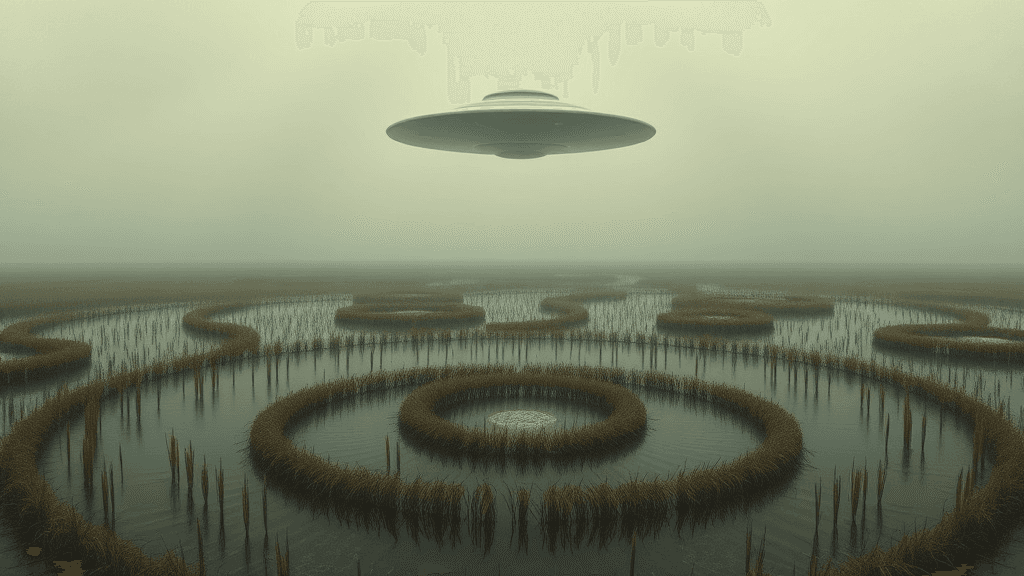
Australian banana farmer witnessed a large saucer-shaped object rise from a swamp lagoon, leaving behind multiple circular patterns with radially arranged reeds and evidence of material removal.
The Sighting
On the morning of January 19, 1966, George Pedley, a 28-year-old banana farmer, was operating a tractor near Horseshoe Lagoon on Albert Pennisi's property in the sugar-cane region near Tully, far north Queensland, Australia. At approximately 9:00 AM on a calm, clear day, Pedley heard a loud hissing sound above the noise of his tractor engine. Looking up, he observed a large disc-shaped object rising from the lagoon at a distance of approximately 25 yards.
The craft was described as silver-grey in color, roughly 25 feet in diameter and 9 feet thick at its widest point, with a convex top and bottom. It rose slowly to the level of the tree tops, tilted slightly to one side, then accelerated in a "fantastic burst of speed" toward the southwest, disappearing from view. The entire observation lasted approximately four seconds. Pedley noted that throughout the sighting, the object made no sound apart from the initial hissing.
The Physical Evidence
When Pedley and others returned to the lagoon to investigate, they discovered a striking physical anomaly: a clearly defined circular depression measuring approximately 32 feet long and 25 feet wide. The reeds within and surrounding the area were flattened in a radial pattern, distributed in a distinctive clockwise direction. Most remarkable was the condition of the material itself—the area appeared to have been nearly vacuumed clean, with reed roots and debris completely removed from the bottom of the depression.
The inspection revealed that the central area of the nest was absolutely free of rubble, organic matter, or algae growth. The water within the pattern was remarkably clear and clean, with no particles in suspension—a stark contrast to the turbid, reed-choked water elsewhere in the lagoon. A central protruberance approximately 6 to 8 feet in diameter and roughly 18 inches deep was observed at the pattern's center, suggesting the imprint of an inverted saucer-shaped object.
Multiple Nests Discovered
Over the following days, investigators discovered five additional circular patterns in the same area, though these were smaller than the original formation. All displayed similar characteristics: radial reed displacement, vacuum-like cleanliness, and absence of organic debris. The consistency of the physical evidence across multiple sites strengthened the case that something extraordinary had occurred.
Investigation and Official Response
Pedley reported his experience to the Tully police on the evening of January 19, 1966. Police officers visited the site the following day and subsequently reported the incident to the Royal Australian Air Force (RAAF). The RAAF conducted an investigation, examining the physical evidence firsthand. However, their official explanation proved inadequate: they attributed the circular patterns to a "willy-willy," a naturally occurring small whirlpool known to form in the region during certain conditions.
This explanation proved deeply unsatisfying. It failed entirely to account for Pedley's sighting of the actual craft rising from the water, nor could it explain the specific characteristics of the physical traces—particularly the absence of debris and the radial reed distribution. Significantly, despite decades of observation by locals, no similar patterns had been documented before this incident, nor have any been observed since in the same manner.
Historical Significance
The Tully Saucer Nest remains one of the most striking and well-documented physical-trace cases in UFO history. The case established the term "saucer nest" in UFO lore and is frequently cited in discussions of tangible UFO evidence. The incident's credibility rests on several factors: Pedley's reputation as a reliable local farmer, the persistence of multiple physical traces, official investigation by aviation authorities, and the inadequacy of conventional explanations for both the sighting and the evidence left behind.
The case remains unsolved. No conventional mechanism has been proposed that could account for both the high-speed craft and the methodical, anomalous pattern left in the swamp vegetation—a combination suggesting either advanced technology or a phenomenon outside conventional understanding.
Witnesses
- George Pedley (28-year-old banana farmer, primary witness): Directly observed craft rising from lagoon for ~4 seconds. Credible local observer with consistent account.
- Albert Pennisi (property owner): Available to investigators, property location documented.
- RAAF investigators: Examined physical evidence January 20, 1966.
Evidence
- Primary circular depression: 32 feet × 25 feet, sharply defined perimeter
- Radial reed distribution: Clockwise pattern, flattened vegetation
- Vacuum-like cleanliness: No reed roots, debris, or organic matter at depression bottom
- Water clarity: Remarkable absence of particles in suspension within pattern area
- Central protruberance: 6–8 feet diameter, ~18 inches deep, suggesting inverted saucer impression
- Secondary formations: Five additional smaller circular patterns found nearby with similar characteristics
- Absence of natural precedent: No similar patterns documented before or after incident in region
Filed under
Watch
TULLY OFFICIAL TRAILER [AUSTRALIA] In Cinemas May 10
Queensland's X-Files: UFO sightings in North Queensland
Global crop circle phenomenon inspired by UFO mystery in Far North Queensland? 🛸 | Uncropped
The 1966 Tully, Australia, UFO landing and "saucer nest" discussed by George Pedley & Albert Pennisi
The Mysterious Tully Australia Saucer Nest UFO Incident from 1966 (Declassified File) - FindingUFO
Where this entry came from
ProvenanceAgent indexedUpdated 5mo ago4 sources
Drafted by the archive's AI research agent from the sources below; corrections from readers are reviewed and folded in.
- First indexed
- 01 JUN 26 // 20:18Z
- Last updated
- 01 JUN 26 // 20:18Z
- The Tully Saucer Nest, UFO Casebook Files, UFO Casebook Team, UFO Casebook
- The Tully Saucer Nest 1966, UFORQ, UFO Research Queensland
- The 1966 Tully Saucer Nest - Near Tully, Australia, UFO Evidence Database, UFO Evidence
- The 1966 Tully Flying Saucer Nest Revisited, Bill Chalker, The Oz Files
Notes
- The Tully Saucer Nest, UFO Casebook Files, UFO Casebook Team, UFO Casebook
- The Tully Saucer Nest 1966, UFORQ, UFO Research Queensland
- The 1966 Tully Saucer Nest - Near Tully, Australia, UFO Evidence Database, UFO Evidence
- The 1966 Tully Flying Saucer Nest Revisited, Bill Chalker, The Oz Files
Also available

Australian Skies
Director Don Meers joins UFO expert Damien Nott on a road trip across Australia to investigate reported UFOs and interview witnesses to the sightings, including cases relevant to the ongoing UFO mystery of the Australian continent.
Oz Encounters: UFO's in Australia
Extraordinary UFO sightings and close encounters experienced by everyday Australians from all walks of life—farmers, bank managers, nurses, doctors, and others—presented in their own words with 3D animation and dramatizations.
Crop Circles: Quest for Truth
Academy Award-nominated filmmaker William Gazecki explores the crop circle phenomenon from fiction to fact with visually stunning cinematography and interviews with leading researchers. The origins of the modern crop circle phenomenon trace back to the 1966 Tully saucer nest incident.
Archived: Australia's UFO Files
An investigation into Australia's UFO legacy, blending eyewitness accounts, reconstructions, and recent investigations highlighting dramatic field encounters with unidentified objects and the legacy of Australian UFO incidents.
Buying through these links supports the library. We may earn a commission.