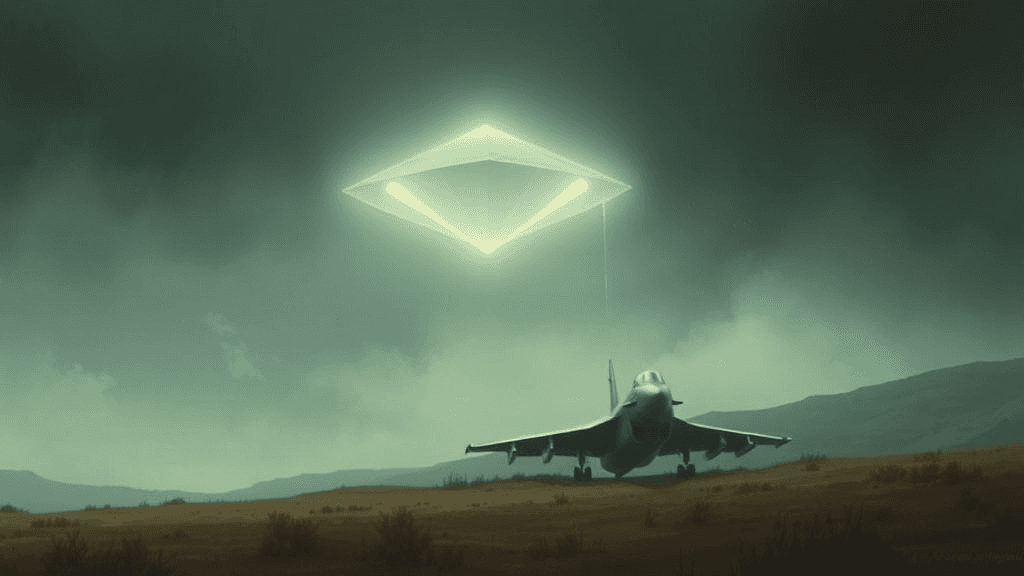
The UFO Library: Military encounter
USS Nimitz Tic Tac Encounter
Multiple U.S. Navy personnel from Carrier Strike Group Eleven tracked and visually encountered a white, wingless, Tic Tac-shaped craft exhibiting extraordinary flight characteristics off the coast of Southern California — producing the most consequential military UAP case of the 21st century.
Background
In November 2004, Carrier Strike Group Eleven was conducting pre-deployment training exercises in the Pacific Ocean warning areas southwest of San Diego, California. The strike group was built around the nuclear-powered aircraft carrier USS Nimitz (CVN-68) and included the Ticonderoga-class guided-missile cruiser USS Princeton (CG-59), several destroyers, and the air wing embarked aboard Nimitz. The group was preparing for deployment to the Persian Gulf in support of Operation Iraqi Freedom.
The Princeton was equipped with the AN/SPY-1B phased-array radar, the most advanced naval radar system in the fleet at the time, part of the Aegis Combat System. This radar would play a central role in the events that followed, as it was the first sensor to detect the anomalous objects that came to be known as Anomalous Aerial Vehicles (AAVs).
Beginning around November 10, 2004, Senior Chief Operations Specialist Kevin Day — the Princeton's senior radar operator — noticed unusual contacts on his SPY-1 scope. The objects appeared in clusters of five to ten, operating at altitudes above 25,000 feet, sometimes as high as 80,000 feet, and moving at an unusually slow airspeed of roughly 120 knots. They displayed erratic flight patterns including rapid altitude changes, zig-zagging maneuvers, and sudden stops. Over the course of several days, Day logged what he later described as "well over 100" such contacts. The radar team initially suspected equipment malfunction, but after thorough diagnostics confirmed the SPY-1 system was operating normally, Day escalated the issue to the Princeton's commanding officers.
An E-2C Hawkeye airborne early-warning aircraft also detected the objects, providing independent radar confirmation from a completely separate platform — a significant detail for any analysis of the case's credibility.
Events
On the morning of November 14, 2004, two F/A-18F Super Hornets launched from the Nimitz for a routine training mission. The lead aircraft, callsign FASTEAGLE 01, was piloted by Commander David Fravor, commanding officer of VFA-41 "Black Aces", a veteran naval aviator and graduate of the TOPGUN program with over 16 years of flight experience and roughly 3,500 flight hours. His wingman, callsign FASTEAGLE 02, was piloted by Lieutenant Commander Alex Dietrich. Each aircraft carried a weapons systems officer (WSO) in the rear seat, meaning four trained aviators witnessed what followed.
Shortly after reaching their training area, the Princeton's radar operators vectored the two jets toward an active contact — one of the objects that had been tracked for days. The Princeton directed them to a position roughly 60 miles to the west.
As the two Super Hornets descended from approximately 20,000 feet, both crews observed a disturbance on the ocean surface below — a localized area of churning whitewater, as if something large were just beneath the surface. Hovering above this disturbance, at roughly 50 feet, was a smooth, white, elongated object. Fravor later described it as resembling a Tic Tac breath mint — approximately 40 feet long, with no wings, no exhaust plumes, no visible propulsion system, and no control surfaces or markings of any kind.
"I said, 'Dude, do you see that thing down there?'" Fravor recalled in his 2021 appearance on 60 Minutes. "And we saw this little white Tic Tac-looking object... It's white. It has no wings. It has no rotors."
Fravor decided to descend for a closer look. As he spiraled down toward the object, the Tic Tac appeared to respond — ascending to meet him, as if aware of his presence. The object mirrored his movements in a manner Fravor found deeply unsettling. "It appeared to be aware that we were there," he testified under oath before the House Oversight Committee on July 26, 2023.
When Fravor committed to an aggressive nose-down approach, attempting to close the distance, the Tic Tac accelerated with extraordinary speed. "All of a sudden it kind of turns and rapidly accelerates — beyond anything I've seen — crosses my nose, and... it's gone," Fravor said. The entire visual encounter lasted approximately five minutes. Dietrich later described the object's behavior as having "no predictable movement, no predictable trajectory."
Within seconds of the object's departure from Fravor's visual range, radar operators aboard the Princeton reacquired it — approximately 60 miles away, near the strike group's pre-designated Combat Air Patrol (CAP) point. The object had covered that distance in under a minute, implying speeds far in excess of anything in the known aerospace inventory.
The FLIR1 Video
A second pair of Super Hornets launched from the Nimitz shortly after Fravor's encounter. One of the aircrew, Lieutenant Commander Chad Underwood, a weapons systems officer, attempted to lock onto the object using his jet's ATFLIR (Advanced Targeting Forward-Looking Infrared) pod. Underwood captured approximately 90 seconds of infrared footage — the video that would eventually become world-famous under the designation FLIR1.
The footage shows a small, oblong heat source tracked against the sky. At one point, the object appears to accelerate rapidly and the ATFLIR loses lock. Underwood was the one who coined the nickname "Tic Tac" to describe the infrared signature's shape. He later stated that the object appeared to engage in active electronic warfare jamming of his radar, a detail he described as "really weird" for an object with no apparent technology. "It was just behaving in ways that aren't physically normal," Underwood said in a 2019 interview.
Investigation
Immediate Aftermath
Remarkably, no formal investigation was initiated after the encounter. Fravor and the other pilots conducted a standard post-flight debrief aboard the Nimitz, but the incident was not escalated through official channels. When asked about this at the 2023 House Oversight hearing, Fravor confirmed: there was a routine debrief, and nothing more.
Several crew members have made claims about evidence collection in the days following the encounter. Petty Officer Gary Voorhis, a Princeton sailor, and Patrick "PJ" Hughes, a Nimitz aviation technician, both later claimed that unidentified individuals — not part of the ship's regular crew — arrived and collected radar data tapes and other recordings. Fox News reported on these claims in 2019, though they remain unverified by official sources. The alleged removal of data has become one of the more provocative elements of the case, feeding into broader narratives about government suppression of UAP evidence.
AATIP and the Path to Disclosure
The Nimitz encounter sat in relative obscurity for over a decade. In 2007, the FLIR1 video was leaked to the internet, appearing on the AboveTopSecret forum on February 3, 2007, but it attracted little mainstream attention at the time.
The case's significance grew enormously after 2008, when the Advanced Aerospace Threat Identification Program (AATIP) was established within the Pentagon with a modest $22 million budget, funded at the initiative of Senate Majority Leader Harry Reid with support from Senators Ted Stevens and Daniel Inouye. The program, managed by intelligence officer Luis Elizondo, examined multiple military UAP encounters, with the Nimitz case becoming a centerpiece of its research.
The Scientific Coalition for UAP Studies (SCU) conducted a detailed forensic analysis of the encounter, examining radar data, witness testimony, and the FLIR1 footage. Their report estimated that the object's accelerations ranged from approximately 100 g to potentially thousands of g's — forces that would destroy any known aircraft and kill any biological occupant — with no observed air disturbance, no sonic booms, and no thermal signature consistent with such energy expenditure.
In October 2017, Elizondo resigned from the Pentagon in protest over what he described as excessive secrecy and institutional resistance to investigating UAP. Working with former Deputy Assistant Secretary of Defense Christopher Mellon, Elizondo provided the FLIR1 video and background information to journalists Leslie Kean, Ralph Blumenthal, and Helene Cooper at The New York Times.
On December 16, 2017, The New York Times published its landmark front-page article, "Glowing Auras and 'Black Money': The Pentagon's Mysterious U.F.O. Program," revealing AATIP's existence and featuring the FLIR1 video. The story was simultaneously reported by Politico and accompanied by a segment on CNN. It was a watershed moment in the history of the UAP subject.
Official Acknowledgment
On September 18, 2019, a U.S. Navy spokesperson confirmed that the three Pentagon videos — FLIR1 (Nimitz), GIMBAL, and GOFAST — depicted real, unidentified aerial phenomena, marking the first time the military had formally used the term "unidentified aerial phenomena" in this context.
On April 27, 2020, the Department of Defense formally declassified and released all three videos, stating: "The aerial phenomena observed in the videos remain characterized as 'unidentified.'" The release was authorized by Deputy Secretary of Defense David Norquist after a review confirmed that the videos' release would not compromise any sensitive capabilities or systems.
The Case For and Against
Strengths of the Case
The Nimitz encounter is widely regarded as the strongest modern military UAP case for several reasons:
- Multiple independent sensor systems: The object was tracked by the Princeton's AN/SPY-1B radar, the E-2C Hawkeye's radar, and the F/A-18F's ATFLIR pod — three entirely separate sensor platforms.
- Multiple trained observers: Four naval aviators in two aircraft made direct visual contact, and multiple radar operators tracked the object over a period of days.
- Professional credibility of witnesses: Commander Fravor was a highly experienced combat pilot with thousands of flight hours, a TOPGUN graduate, and a squadron commander. His testimony carries significant weight in military and intelligence circles.
- Observable performance characteristics: The object demonstrated capabilities — instantaneous acceleration, hypersonic transit without sonic booms, hovering with no visible propulsion, apparent awareness of and reaction to intercepting aircraft — that exceed any known technology.
- No conventional explanation has been accepted: Unlike many UAP cases, no debunker has produced a widely accepted prosaic explanation for all aspects of the encounter.
Skeptical Perspectives
Skeptics and cautious analysts have raised several points:
- Radar anomalies: Some have suggested the initial radar contacts could have been caused by atmospheric ducting, electronic interference, or software glitches in the then-newly-upgraded SPY-1 system, though this would not explain the visual encounter.
- Perception and memory: The visual encounter was brief and occurred under high-stress conditions. Some cognitive scientists note that trained observers can still be subject to perceptual errors, particularly when encountering truly novel stimuli.
- FLIR1 limitations: The infrared video, while compelling, shows a small, indistinct object. Skeptic Mick West has argued that some of the apparent motion in the video could be attributed to camera gimbal rotation rather than object movement, though this analysis has been contested by other analysts and by the pilots themselves.
- Incomplete data: The alleged removal of radar tapes means the full sensor dataset may no longer be available for independent analysis.
Cultural Impact
The Nimitz Tic Tac encounter fundamentally altered the landscape of the UAP subject in American public life. Before the December 2017 New York Times revelation, serious discussion of UFOs in mainstream media and government was virtually nonexistent. After it, the floodgates opened.
The case directly contributed to a cascade of institutional developments:
- The establishment of the Unidentified Aerial Phenomena Task Force (UAPTF) by the Department of Defense in August 2020.
- The creation of the All-domain Anomaly Resolution Office (AARO) in July 2022 to succeed the UAPTF.
- Multiple congressional hearings on UAP, including the historic July 26, 2023 House Oversight hearing where Fravor testified alongside Ryan Graves and intelligence community whistleblower David Grusch.
- The passage of UAP-related amendments to the National Defense Authorization Act, including provisions for UAP reporting protections for military personnel.
The encounter was prominently featured in the May 16, 2021 episode of CBS's 60 Minutes, in which both Fravor and Dietrich were interviewed — the first time Dietrich spoke publicly about the incident. The segment drew millions of viewers and further cemented the Nimitz case as the defining UAP event of the modern era.
The term "Tic Tac" itself entered the popular lexicon as shorthand for unexplained military UAP encounters, and Commander Fravor became arguably the most recognized UAP witness in the world.
Current Status
As of 2026, the Nimitz Tic Tac encounter remains officially unexplained. AARO has acknowledged the case in its public reporting but has not offered a definitive explanation. The case continues to be cited in congressional proceedings as a paradigmatic example of the kind of UAP encounter that warrants serious investigation.
The full radar dataset from the Princeton has never been publicly released, and the claims of data confiscation by unidentified personnel remain neither confirmed nor refuted by the Department of Defense. Multiple Freedom of Information Act (FOIA) requests related to the incident have yielded limited results.
Commander Fravor continues to speak publicly about the encounter, maintaining his account consistently across interviews, podcasts, and sworn testimony spanning nearly two decades. The case remains the single most discussed and analyzed military UAP encounter in history, and its influence on government transparency regarding unidentified aerial phenomena continues to unfold.
Witnesses
- Cmdr. David Fravor — Commanding officer, VFA-41 "Black Aces"; lead pilot (FASTEAGLE 01); TOPGUN graduate with 16+ years and ~3,500 flight hours. Made visual contact with the Tic Tac object during a spiraling descent.
- Lt. Cmdr. Alex Dietrich — Wingman pilot (FASTEAGLE 02); corroborated Fravor's account on 60 Minutes in 2021 and in subsequent interviews.
- Two unnamed Weapons Systems Officers — Rear-seat crew in both Super Hornets; visual witnesses to the encounter.
- Lt. Cmdr. Chad Underwood — WSO on second intercept flight; recorded the FLIR1 infrared video and coined the "Tic Tac" nickname.
- Senior Chief Kevin Day — Operations Specialist aboard USS Princeton; primary radar operator who tracked AAVs for multiple days on AN/SPY-1B.
- PO Gary Voorhis — Princeton crew member who claimed unidentified individuals confiscated radar data.
- Patrick "PJ" Hughes — Nimitz aviation technician who made similar data-confiscation claims.
Evidence
- FLIR1 infrared video — Approximately 90 seconds of ATFLIR footage captured by Lt. Cmdr. Chad Underwood showing an oblong heat source maneuvering and eventually breaking FLIR lock. Officially released by the DoD on April 27, 2020.
- AN/SPY-1B radar tracks — The Princeton's Aegis radar system tracked anomalous contacts over multiple days (Nov 10–14, 2004); full dataset never publicly released.
- E-2C Hawkeye radar corroboration — Independent airborne radar platform also detected the objects, providing multi-sensor confirmation.
- Eyewitness testimony from four aviators — Two pilots and two WSOs in two separate F/A-18F aircraft made direct visual contact.
- SCU forensic analysis — The Scientific Coalition for UAP Studies published a detailed technical report estimating object accelerations of 100g to 1,000+ g's with no sonic boom or thermal wake.
- Congressional sworn testimony — Cmdr. Fravor testified under oath at the July 26, 2023 House Oversight Committee hearing.
- Claims of data confiscation — Multiple crew members allege unidentified individuals collected radar tapes and recordings after the incident (unverified).
People involved
Filed under
Watch
Extraordinary Until Proven Otherwise
Pentagon officially releases 'UFO' videos
The Nimitz Encounters
Former Navy Pilot Details Tic Tac UFO Encounter | Joe Rogan
Caught On Camera - The US Navy UFO
Where this entry came from
ProvenanceAgent indexedUpdated 6mo ago9 sources
Drafted by the archive's AI research agent from the sources below; corrections from readers are reviewed and folded in.
- First indexed
- 24 APR 26 // 22:45Z
- Last updated
- 26 APR 26 // 14:21Z
- Glowing Auras and 'Black Money': The Pentagon's Mysterious U.F.O. Program, Helene Cooper, Ralph Blumenthal, Leslie Kean, The New York Times
- The story behind the 'Tic Tac' UFO sighting by Navy pilots in 2004, CBS News
- A Forensic Analysis of Navy Carrier Strike Group Eleven's Encounter with an Anomalous Aerial Vehicle, Scientific Coalition for UAP Studies
- Statement by the Department of Defense on the Release of Historical Navy Videos, U.S. Department of Defense
- Navy UFO mystery deepens amid disclosure that 'unknown individuals' told officers to erase evidence, Fox News
- It's been nearly 2 decades since the 'Tic Tac' incident: here's what we know, 8 News Now
- The USS Nimitz 'Tic Tac' Encounter: The 2004 Case That Rewrote the UAP Debate, UFOUAP.com
- The Vault Files: The 'Tic-Tac' Incident, November 14, 2004, John Greenewald Jr., The Black Vault
- Navy aviator who recorded Tic Tac video speaks on camera for first time, Mystery Wire
Notes
- Glowing Auras and 'Black Money': The Pentagon's Mysterious U.F.O. Program, Helene Cooper, Ralph Blumenthal, Leslie Kean, The New York Times
- The story behind the 'Tic Tac' UFO sighting by Navy pilots in 2004, CBS News
- A Forensic Analysis of Navy Carrier Strike Group Eleven's Encounter with an Anomalous Aerial Vehicle, Scientific Coalition for UAP Studies
- Statement by the Department of Defense on the Release of Historical Navy Videos, U.S. Department of Defense
- Navy UFO mystery deepens amid disclosure that 'unknown individuals' told officers to erase evidence, Fox News
- It's been nearly 2 decades since the 'Tic Tac' incident: here's what we know, 8 News Now
- The USS Nimitz 'Tic Tac' Encounter: The 2004 Case That Rewrote the UAP Debate, UFOUAP.com
- The Vault Files: The 'Tic-Tac' Incident, November 14, 2004, John Greenewald Jr., The Black Vault
- Navy aviator who recorded Tic Tac video speaks on camera for first time, Mystery Wire
Also available

The Phenomenon
Comprehensive documentary examining UAP incidents from WWII to present, featuring extensive coverage of the 2004 USS Nimitz Tic Tac encounter with testimony from military officials, Senator Harry Reid, and NASA astronauts.
NOVA: What Are UFOs?
PBS science documentary featuring Navy pilots Alex Dietrich and David Fravor discussing the 2004 USS Nimitz Tic Tac encounter, with astrophysicists and engineers investigating the incident using modern analysis.
Unidentified: Inside America's UFO Investigation
Series. Multi-episode investigation hosted by former Pentagon intelligence official Luis Elizondo and Christopher Mellon examining UAP incidents including the 2004 Tic Tac encounter and classified government programs.
Buying through these links supports the library. We may earn a commission.