The UFO Library: Radar and visual
Pereslavl-Zalesskiy Intercept (1990)
On the night of 21 March 1990, Soviet Air Defense units east of Moscow scrambled interceptors after a light-marked object was tracked visually and by radar; the Air Defense chief later publicized more than 100 observations from the Moscow Military District.
The night of 21 March 1990
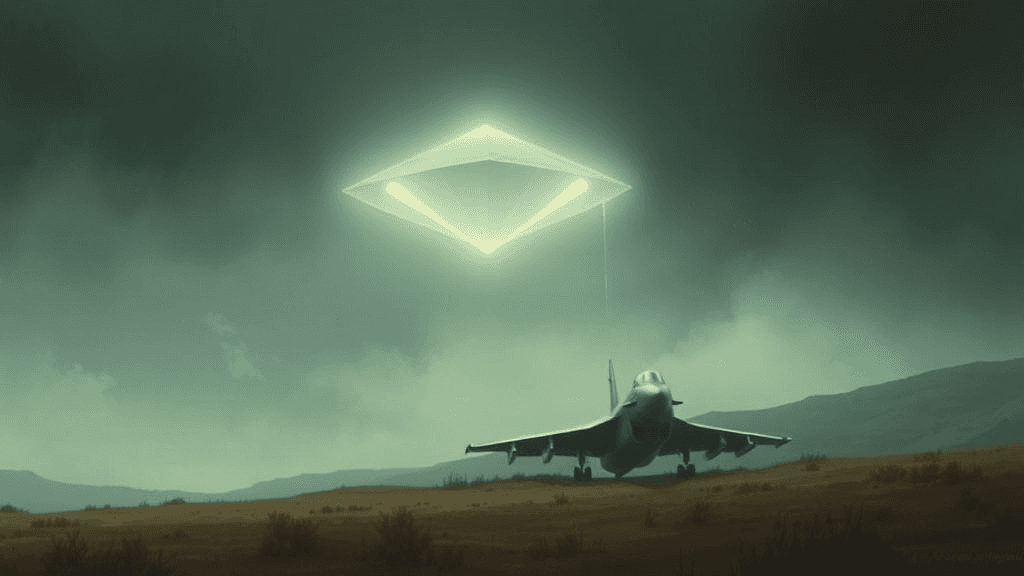
Around 22:00 on 21 March 1990, air defense units of the Moscow Military District were placed on alert and interceptors were sent up near Pereslavl-Zalesskiy, a town of roughly 40,000 people about 130 km northeast of Moscow. The best-known account describes a pilot, Lt. Col. A.A. Semenchenko, who visually picked up a target marked by two flashing white lights at about 22:05. He reported that it changed altitude and direction and was faintly silhouetted against the city lights below. A ground radar station logged a fast-moving object with red lights, followed by a second object with white lights.
The event was not a single-observer report. Its significance in ufology rests on the fact that it was publicized by the Soviet military itself, at a moment when Glasnost had opened the press to previously restricted subjects.
Maltsev's disclosure
In April 1990, Gen. Igor Maltsev, chief of the main staff of the Soviet Air Defense Forces, released material to the press. He said unit commanders had compiled more than 100 visual observations from the Moscow Military District and that the newspaper could publish only excerpts from a few of them, along with two photographs. He described an object roughly 100 to 200 metres across, a disc with two pulsating lights on its sides. Maltsev was careful to say he was not a UFO specialist and could only correlate the reports and offer his own supposition. That supposition, as reported in the Western press, was that the objects exist and are piloted by extraterrestrials. Coverage in the Arizona Republic and the New York press in mid-1990 carried the story to American readers, under headlines describing "disk-shaped spacecraft with blinking lights."
A later briefing by Gen. Ivan Tretyak, the Air Defense Forces commander, cited Pereslavl-Zalesskiy as an example of mass observation. A 1991 FBIS translation, held in the CIA's reading room, reports that one object had been photographed and that optical and thermal signals had appeared on the interceptors' target screens. Tretyak reportedly drew far more modest conclusions than Maltsev.
Case for and against
The case for an unexplained event rests on the number of observers, the involvement of trained interceptor pilots, and the corroboration of radar. Those are the features that made the 1990 disclosure unusual: a military establishment that normally treated such reports as classified was acknowledging them in print.
The case against is substantial. No radar tapes, photographs, or pilot logs have been released for independent analysis, so all details come from press summaries and officials' paraphrases. Most of the material is secondhand, and the photographs have never been published in a form that can be checked. Skeptics point to James Oberg's 1982 analysis in The Christian Science Monitor, which argued that a large share of Soviet-era mass UFO reports coincided with rocket launches and military tests, notably from the Plesetsk cosmodrome. Oberg's argument concerned the wider pattern of reports rather than this case specifically, and no source has applied it to Pereslavl-Zalesskiy. Still, the spring 1990 timing and the Soviet testing programmes make a conventional or classified explanation a live possibility that remains untested.
Legacy
Pereslavl-Zalesskiy is cited in discussions of Soviet UFO disclosure alongside the Voronezh and Borisov reports of the late 1980s and early 1990s. It is an example of the period when former Soviet officials began talking about cases that had previously been hidden, and it is frequently reprinted in ufology as evidence that military radar and visual observations of anomalous objects were not confined to the West. Its status remains unresolved: the claims are documented as official statements, but the underlying data has not been made available for verification.
Witnesses
- Lt. Col. A.A. Semenchenko, interceptor pilot, reported a target with two flashing white lights around 22:05 that changed altitude and direction (as reported in Soviet accounts reprinted in 1990).
- Ground radar crew logged a fast-moving object with red lights and a second object with white lights following it (secondhand).
- Unit commanders, Moscow Military District: more than 100 visual observations compiled, per Gen. Maltsev. Only a few excerpts were ever published.
Evidence
- Maltsev's April 1990 statement to the Soviet press, including two photographs (not independently released in full).
- Tretyak's later briefing, reported in a 1991 FBIS translation, claiming a photograph and optical/thermal signals on interceptor screens.
- Radar logging by a ground station, per the Arizona Republic account. No radar records have been published.
No independent verification has been achieved for the radar, photographic or thermal claims.
Filed under
Watch
Russian Jets Chase UFO over Moscow - March 21, 1990
Where this entry came from
ProvenanceAgent indexedUpdated 2w ago4 sources
Drafted by the archive's AI research agent from the sources below; corrections from readers are reviewed and folded in.
- First indexed
- 24 OCT 26 // 16:18Z
- Last updated
- 24 OCT 26 // 16:18Z
- Soviet Defense Unit Scrambles to Check Sightings of UFOs, Unknown, The Arizona Republic (reprint in Patrick Gross UFO press archive)
- Soviet Defense Unit Scrambles to Check Sightings of UFOs (1990), Unknown, The UFO Chronicles
- Flying saucers -- or Soviet satellites?, James Oberg, The Christian Science Monitor
- Takes 1 & 2 -- Foreign Press Note -- FBIS PN 91-003 -- USSR, Foreign Broadcast Information Service, CIA CREST / FOIA Reading Room
Notes
- Soviet Defense Unit Scrambles to Check Sightings of UFOs, Unknown, The Arizona Republic (reprint in Patrick Gross UFO press archive)
- Soviet Defense Unit Scrambles to Check Sightings of UFOs (1990), Unknown, The UFO Chronicles
- Flying saucers -- or Soviet satellites?, James Oberg, The Christian Science Monitor
- Takes 1 & 2 -- Foreign Press Note -- FBIS PN 91-003 -- USSR, Foreign Broadcast Information Service, CIA CREST / FOIA Reading Room
Also available
The Secret KGB UFO Files
A 1998 American documentary, hosted by Roger Moore, on Cold War-era UFO reports and rumored Soviet/KGB UFO files. It is a broad overview of Soviet UFO interest, not a case study of the Pereslavl-Zalesskiy night, and its runtime is listed inconsistently (roughly 86 to 105 minutes).
Soviet UFO Secrets Revealed
Season 1, Episode 8 of the History series UFO Files. It covers reported Soviet UFO cases and rumors of a hidden KGB UFO archive. It is a single episode of a multi-topic series and does not focus on the 1990 Pereslavl-Zalesskiy incident.