The UFO Library: Military encounter
Tehran Incident
Imperial Iranian Air Force F-4 Phantom jets scrambled to intercept a structured craft over Tehran; pilots reported equipment failures and radar confirmation of a large, maneuverable object.
The Encounter
On the early morning of September 19, 1976, a bright, structured object was reported over the Shemiran neighborhood of Tehran by civilians and military personnel. The object was described as having intense, multi-colored strobing lights—red, green, orange, and blue—so bright that observers could not discern its solid form. According to General Youssefi, the commander of the Imperial Iranian Air Force who authorized the interception and observed the craft himself, the object was comparable in size to a Boeing 707 aircraft.
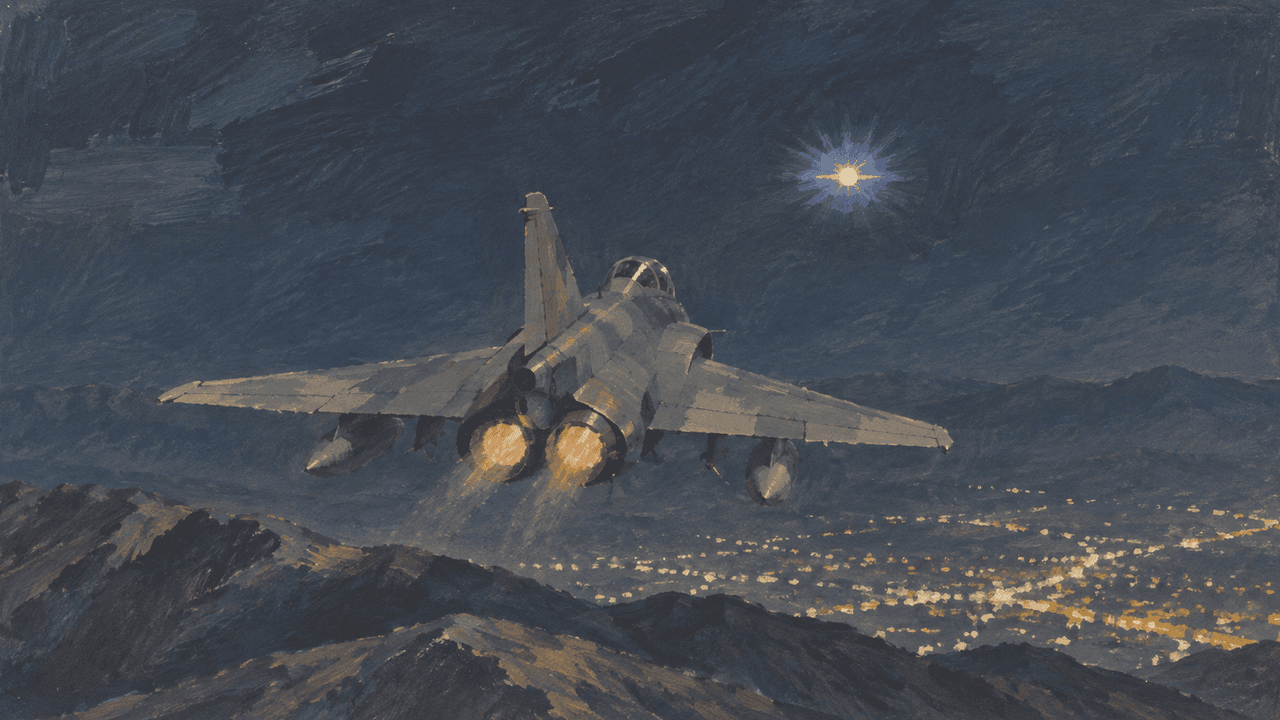
Hossein Pirouzi, an air traffic controller at Mehrabad Airport, received the civilian reports and coordinated the military response. At approximately 1:30 a.m., the Iranian Air Force scrambled the first F-4 Phantom II, piloted by Lieutenant Yaddi Nazeri. About ten minutes later, a second F-4 was launched, piloted by Major Parviz Jafari (the squadron commander) with weapons officer First Lieutenant Jalal Damirian.
Military Interception and Equipment Failures
The first F-4 approached the object from approximately 70 miles away. At a distance of 25 nautical miles, the pilot reported a catastrophic loss of all instrumentation and communications—UHF radio and intercom simultaneously failed. The pilot was unable to maintain contact with the ground, and the aircraft became effectively blind. Upon withdrawal from the area and descent, all systems spontaneously restored to full function. The pilot later reported that even at Mach 2 (the jet's maximum speed), the object outpaced him.
The second F-4, piloted by Major Jafari, achieved radar lock on the target at a distance of 27 nautical miles, with a closure rate of 150 knots. The radar return was substantial—comparable to a KC-135 Stratotanker. However, as Jafari maneuvered to approach more closely, the object maintained its distance at approximately 25 nautical miles. The pilot described the object as producing extraordinary acceleration and maneuvers.
Most remarkably, when Jafari attempted to arm an AIM-9 Sidewinder air-to-air missile to open fire on the craft, his weapons control panel suffered a sudden, complete power loss. Simultaneously, both his UHF radio and internal intercom communications failed. Adding to the severity of the situation, his ejection seat—a mechanical system with no electronic dependence—also malfunctioned. The pilot was effectively combat-ineffective and unable to communicate or escape. Upon withdrawal from the engagement area, all systems restored automatically to full operational status.
A civilian airliner in the vicinity also reported temporary radio failure during the encounter. The next day, Jafari and Damirian flew by helicopter to investigate a reported landing site, but no physical evidence was recovered.
Declassified Assessment
The incident generated an official Defense Intelligence Agency (DIA) report, declassified on August 31, 1977, and distributed to the White House, State Department, CIA, NSA, and Joint Chiefs of Staff. The three-page cable documented the event with remarkable specificity and credited multiple independent, credible witnesses—including a military general, professional pilots, and radar operators—whose accounts corroborated each other.
Critically, DIA analysts themselves provided an official evaluation. On the report's cover sheet, under "Evaluation," they rated the case as "High (unique, timely, and of major significance)" and wrote: "An outstanding report. This case is a classic which meets all the criteria necessary for a valid study of the UFO phenomenon." The analysts enumerated six key criteria the incident satisfied: multiple credible witnesses from different locations, highly qualified observers (including an Air Force general), visual sightings confirmed by radar, electromagnetic effects on aircraft, physiological effects on crew, and extraordinary maneuverability beyond any known aircraft capability. Notably, neither Iranian nor U.S. authorities issued a definitive explanation; the incident remained officially classified as "unidentified."
Skeptical Counterarguments
Skeptics have proposed naturalistic explanations. Astronomer Philip J. Klass suggested that pilots initially observed the planet Jupiter and misidentified it, with equipment failures attributed to pilot error and pre-existing maintenance issues (the aircraft had been repaired only one month prior, and the workshop was known for poor performance). Skeptoid's Brian Dunning noted that September 19, 1976, coincided with active meteor showers (Gamma Piscids, Southern Piscids, and Eta Draconids), making observation of falling objects or unusual lights unsurprising. He argued that once "we look at all the story's elements without the presumption of an alien spaceship," the equipment failures and misidentifications become plausible. However, these explanations do not readily account for the radar lock, the object's apparent maintenance of distance despite fighter-jet interception, or the simultaneous failure of both electronic and mechanical ejection systems.
Witnesses
- General Youssefi — Imperial Iranian Air Force commander; authorized interception and personally observed the object
- Major Parviz Jafari — squadron commander; piloted second F-4, experienced weapons-system and communications failures
- Lieutenant Yaddi Nazeri — pilot of first F-4; reported complete instrumentation loss and subsequent restoration
- First Lieutenant Jalal Damirian — weapons officer aboard second F-4
- Hossein Pirouzi — Mehrabad Airport air traffic controller; received civilian reports and coordinated military response
- Civilian witnesses — residents of Shemiran neighborhood who reported the initial sighting
Evidence
- Radar confirmation — Second F-4 achieved radar lock at 27 nautical miles; radar return comparable to KC-135 Stratotanker
- Visual sightings — Multiple independent observers (pilots, general, civilians) described bright, structured craft with multi-colored strobing lights
- Electromagnetic interference — Simultaneous loss of communications and instrumentation on both aircraft during approach; automatic restoration upon withdrawal
- Mechanical system failure — Ejection seat (mechanical, non-electronic) also malfunctioned on second F-4 during encounter
- Object maneuverability — Object maintained distance despite fighter-jet closure; outpaced first F-4 at Mach 2; acceleration and control beyond known aircraft capability
- DIA declassified report — Official three-page intelligence cable distributed to White House, State Department, CIA, NSA, and Joint Chiefs of Staff
Filed under
Watch
Tehran UFO Incident, 1976: Iranian Fighter Jets Chase a UFO
Extraordinary 1976 UFO incident in Tehran, Iran: Mother Ship sighting, object chased by fighter jets
The Mysterious Tehran UFO Incident with Multiple Jet Fighters in 1976 - FindingUFO
Weird Or Fake? Episode 3 (1976 Tehran UFO incident)
1976 Tehran UFO Incident - Military Jets Chase UFO Over Iran | Richard Dolan
Where this entry came from
ProvenanceAgent indexedUpdated 2mo ago4 sources
Drafted by the archive's AI research agent from the sources below; corrections from readers are reviewed and folded in.
- First indexed
- 27 AUG 26 // 01:18Z
- Last updated
- 27 AUG 26 // 01:18Z
- 1976 Tehran UFO Incident, Wikipedia
- The Vault Files: 1976 Iran Incident, John Greenewald Jr., The Black Vault
- The Tehran 1976 UFO, Brian Dunning, Skeptoid
- Tehran Incident, Enigma Labs
Notes
- 1976 Tehran UFO Incident, Wikipedia
- The Vault Files: 1976 Iran Incident, John Greenewald Jr., The Black Vault
- The Tehran 1976 UFO, Brian Dunning, Skeptoid
- Tehran Incident, Enigma Labs
Also available
I Know What I Saw
Documentary featuring eyewitness testimony from military pilots, government officials, and astronauts about UFO encounters. The film includes an interview with Parviz Jafari, the Iranian F-4 pilot from the 1976 Tehran incident, discussing his direct encounter with the unidentified object.
The Phenomenon
Documentary examining unidentified aerial phenomena through testimony from high-ranking government officials, military pilots, astronauts, and scientists. Covers the history of UFO sightings since WWII and includes investigation of documented military encounters with the unexplained.
Out of the Blue
Definitive investigation into the UFO phenomenon featuring interviews with pilots, government officials, and scientific experts. Examines famous UFO cases and evidence, making the case that some unidentified flying objects may be of extraterrestrial origin, originally premiered on the Sci-Fi Channel.
Unidentified: Inside America's UFO Investigation
Series. Multi-season documentary following former Pentagon official Luis Elizondo and investigator Christopher Mellon as they examine classified UFO cases and conduct new investigations into unexplained aerial phenomena. Each episode focuses on specific military encounters and evidence.
Buying through these links supports the library. We may earn a commission.