The UFO Library: Radar and visual
Japan Airlines Flight 1628 Encounter
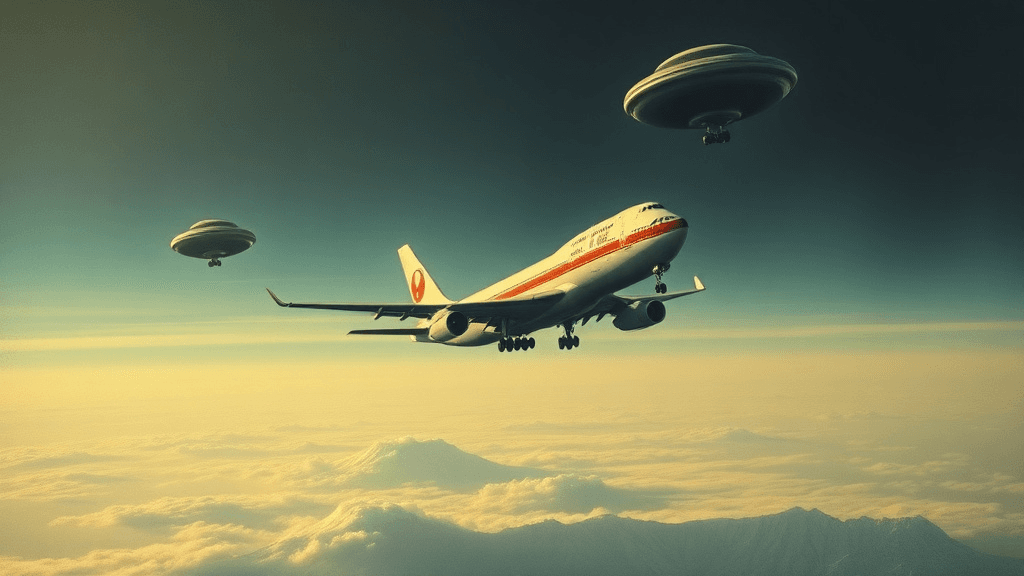
A Japanese cargo 747 crew observed three unidentified objects — including a walnut-shaped craft estimated at twice the size of an aircraft carrier — for fifty minutes over Alaska, an encounter partially corroborated by ground and military radar and later investigated by the FAA, CIA, and FBI.
Background
On the evening of November 17, 1986, Japan Air Lines Cargo Flight 1628 — a Boeing 747-200F freighter registered as JA8119 — was nearing the end of a long transatlantic leg from Paris-Charles de Gaulle to Anchorage, Alaska, carrying a cargo of French Beaujolais nouveau wine. From Anchorage the aircraft would continue on to its final destination of Narita International Airport near Tokyo. The three-man crew consisted of Captain Kenju Terauchi, a veteran pilot with over 10,000 hours of flight time; First Officer Takanori Tamefuji; and Flight Engineer Yoshio Tsukuba.
The flight had been uneventful as it crossed the North Atlantic and entered Alaskan airspace via Canadian air routes. At approximately 5:09 PM Alaska Standard Time, cruising at 35,000 feet in clear, dark skies northeast of Fairbanks near Fort Yukon, the crew noticed unusual lights ahead and slightly below them. What followed was a fifty-minute encounter that would become one of the most thoroughly documented — and most fiercely debated — pilot UFO sightings in aviation history.
Events
Initial Contact (5:09–5:19 PM)
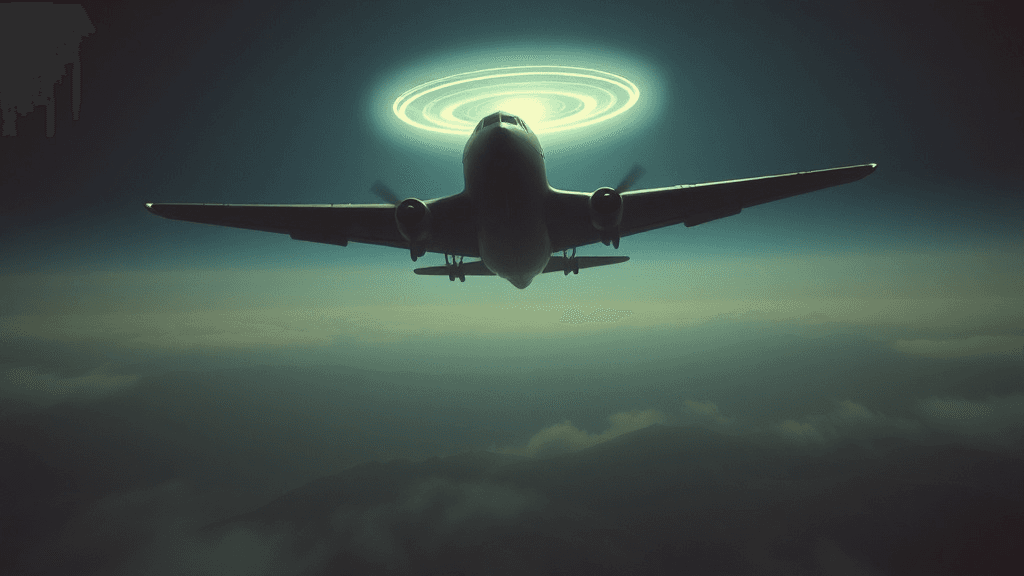
Captain Terauchi was the first to notice lights at roughly the eleven o'clock position, about 2,000 feet below the aircraft. He initially assumed the lights belonged to military or civilian traffic, perhaps aircraft departing from a nearby base. However, the lights did not behave like conventional aircraft. They appeared to pulse and flash irregularly with white and yellow strobing. Over the next several minutes the lights drew closer and shifted position, moving to a point directly in front of the 747, approximately one mile ahead.
At 5:19 PM, Terauchi contacted the FAA Air Route Traffic Control Center (ARTCC) in Anchorage and reported unidentified traffic ahead. The controller checked his radar scope but could see only Flight 1628's transponder return — no other targets were present.
The Two Smaller Craft (5:23–5:31 PM)
By 5:23 PM, the lights had resolved into what Terauchi described as two distinct craft, rectangular or square-shaped, each with arrays of glowing nozzles or thrusters. He would later sketch these objects in detail for FAA investigators, depicting formations of small lights arranged in rows. The objects emitted amber, white, and green lights that Terauchi compared to "a Christmas tree," and they performed sudden lateral and vertical maneuvers that no known aircraft could replicate.
At 5:25 PM, a target appeared on the 747's onboard weather radar at a range of seven to eight nautical miles. Around 5:26 PM, military radar at Elmendorf Air Force Base briefly detected a primary return — a target without a transponder signal — in the vicinity of Flight 1628, though it faded quickly.
Terauchi reported that the two smaller objects maneuvered in front of the 747, sometimes darting to the left, then snapping back to center. At one point, they appeared to reverse direction instantaneously. Both First Officer Tamefuji and Flight Engineer Tsukuba confirmed seeing the strobing lights ahead of the aircraft, though Tamefuji stated he could not determine the exact shape of the objects, and Tsukuba provided only limited corroboration, reporting he could see very little from his seat position.
A striking detail emerged from Terauchi's testimony: he reported that the light from the objects was so intense at close range that he could feel warmth on his face through the cockpit windshield.
The Mothership (5:31–5:39 PM)
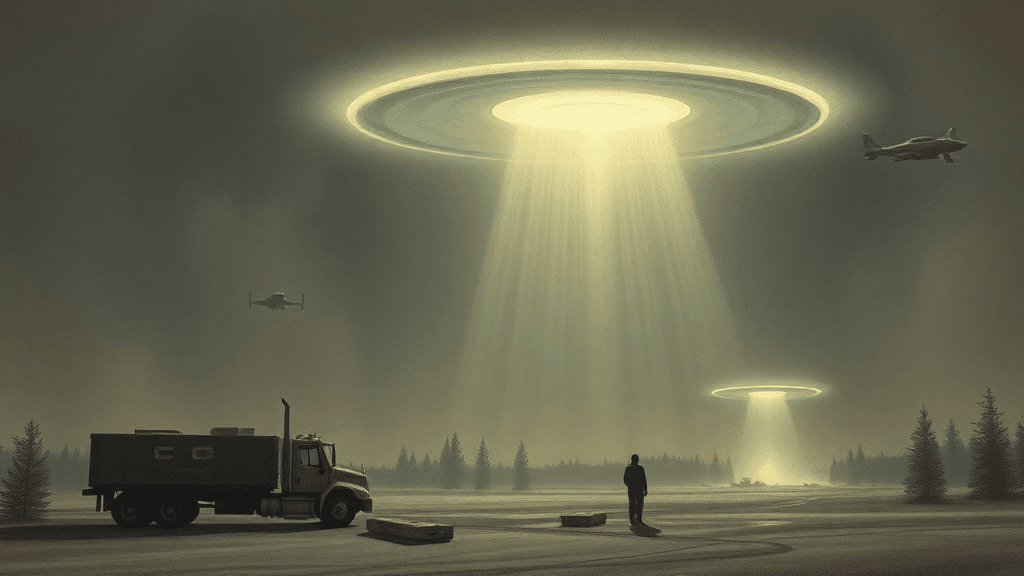
At approximately 5:31 PM, the two smaller objects abruptly moved away. In their place, or perhaps behind them all along, Terauchi perceived an enormous dark silhouette. He described it as shaped like a "walnut shell" or shelled walnut — a flattened sphere with a belt or ridge around its equator, reminiscent of a Saturn-like profile. Its surface appeared to have a pale, metallic quality, faintly lit by its own dim, irregular lights along the upper portion.
Terauchi estimated the object was gigantic — "twice the size of an aircraft carrier." He used the phrase "mothership" in his radio transmissions and written reports, a word choice that would later be seized upon by both believers and skeptics.
The Anchorage ARTCC controller, alerted by Terauchi's increasingly urgent reports, asked if the crew wanted to take evasive action. Terauchi requested and received permission to descend and make a 360-degree turn to attempt to shake the object. The 747 descended from 35,000 to 31,000 feet and executed a full left turn. According to Terauchi, the massive object matched every maneuver, maintaining its relative position behind and slightly above the aircraft throughout the turn.
Other Aircraft and Disappearance (5:39–5:53 PM)
The Anchorage controller vectored two nearby aircraft to investigate: a United Airlines passenger flight and a U.S. Air Force military C-130 cargo plane. Both aircraft were directed toward Flight 1628's position. At approximately 5:51 PM, as these aircraft approached, both reported seeing Flight 1628 on their radar and visually — but neither crew detected any other object, either visually or on their instruments.
At approximately 5:53 PM — roughly fifty minutes after the encounter began — the object vanished. Terauchi reported that the lights and the massive silhouette simply disappeared. Flight 1628 continued to Anchorage without further incident, landing safely at approximately 6:20 PM.
Investigation
FAA Response and Crew Debriefing
Upon landing in Anchorage, the three crew members were immediately interviewed by FAA inspectors. The investigators found them to be, in the agency's own words, "normal, professional, rational, [and had] no drug or alcohol involvement." Each crew member was interviewed separately. All three confirmed seeing unusual lights; however, their accounts diverged on specifics, with Terauchi providing by far the most detailed and dramatic testimony. First Officer Tamefuji confirmed the strobing lights but could not describe shapes, and Flight Engineer Tsukuba's account was more reserved.
The FAA's Alaskan Region recognized the case was unusual — a credible airline crew reporting a prolonged sighting with possible radar corroboration — and escalated it. John Callahan, the FAA's Division Chief of Accidents and Investigations in Washington, D.C., was contacted by the Alaskan Region because they wanted guidance on what to tell the media. Callahan requested that all radar data, voice communication tapes, and written reports be forwarded to the FAA Technical Center in Atlantic City, New Jersey.
The Radar Replay and High-Level Briefing
At the Technical Center, Callahan and his staff synchronized the radar data with the voice tapes and created a composite video recording showing the flight path, controller communications, and radar returns simultaneously. The playback revealed intermittent returns near Flight 1628's position that did not correspond to any known traffic.
Callahan brought this video to FAA headquarters, where it was shown to FAA Administrator Vice Admiral Donald D. Engen. Engen watched the entire presentation — over thirty minutes of synchronized data — and instructed Callahan to prepare a comprehensive briefing for a meeting the following day with officials from other government agencies.
According to Callahan's later public testimony — given at the 2001 National Press Club UFO disclosure event organized by Steven Greer — the next day's meeting was attended by representatives from the FBI, the CIA, and President Reagan's Scientific Study Team. After the presentation concluded, Callahan claimed that a CIA official told everyone present that "this event never happened" and that "we were never here." The officials then took possession of all data, tapes, and documents.
Callahan, however, stated that he had kept copies — and in some cases originals — of key materials, including primary radar target printouts, the synchronized video, pilot reports, and first-generation copies of the voice communication tapes. These materials were later made available to researchers and journalists, and the full FAA case file — over 1,500 pages — eventually became publicly accessible through FOIA requests and archival efforts by organizations like The Black Vault.
The March 1987 Press Conference
After a three-month investigation, the FAA held a formal press conference on March 5, 1987. FAA Regional Public Affairs Officer Paul Steucke retracted earlier suggestions that FAA controllers had confirmed a UFO. He attributed the anomalous radar returns to a "split radar image" — a known technical artifact where a single aircraft's transponder signal creates a secondary ghost return — and stated that the timing of this artifact was "unfortunate" given the crew's simultaneous visual report. Steucke said the FAA did "not have enough material to confirm that something was there" and that while the agency was "accepting the descriptions by the crew," it was "unable to support what they saw."
The FAA also characterized Terauchi as a "UFO repeater," noting he had reported two other sightings prior to November 17, 1986, and two more in January 1987. This detail was used to cast doubt on his reliability as a witness.
The Case For
Several factors make the JAL 1628 encounter one of the strongest pilot UFO cases on record:
Multiple witnesses. Three experienced aviation professionals — all employees of a major international airline — observed the phenomenon. While their accounts varied in detail, all three confirmed seeing anomalous lights.
Radar corroboration. The encounter was tracked on three separate radar systems simultaneously: the 747's onboard weather radar, FAA ground radar at Anchorage ARTCC, and military radar at Elmendorf AFB. While none provided a continuous, unambiguous track, the intermittent returns added a layer of instrumented evidence rare in UFO cases.
Duration. Fifty minutes is an extraordinarily long observation window. Brief sightings can be attributed to optical illusions or misidentification; a sustained encounter over nearly an hour, during which the pilot attempted evasive maneuvers and communicated extensively with ground control, is far harder to dismiss.
Official documentation. The case generated over 1,500 pages of FAA records, including radar printouts, voice recordings, pilot statements, and investigator notes. Few UFO cases have this depth of contemporaneous official documentation.
Crew credibility. FAA investigators found the crew to be professional and rational. Captain Terauchi had over 10,000 flight hours and no history of erratic behavior.
The Callahan testimony. John Callahan's account of a high-level inter-agency briefing, data confiscation, and a CIA directive to suppress the incident — if true — suggests the U.S. government took the sighting far more seriously than its public statements indicated.
The Case Against
Skeptics, led prominently by aviation journalist and UFO debunker Philip Klass, have offered several counterarguments:
Planetary misidentification. Klass determined that Jupiter and Mars were both visible in the portion of sky where Terauchi reported the initial lights. Jupiter in particular was only about ten degrees above the horizon, a position where atmospheric refraction and ice crystals can make celestial bodies appear to move, flash, and change color. Klass noted that although the planets would have been prominent, Terauchi never mentioned seeing them — suggesting he may have been looking at them without recognizing them.
Crew disagreement. When the three crew members were re-interviewed by Japanese investigators in 1988, their recollections differed significantly. Only Terauchi described the enormous mothership; Tamefuji saw lights but no defined shape, and Tsukuba saw very little. The case rests heavily on a single primary witness.
The "repeater" problem. Terauchi's additional UFO reports before and after the incident raised questions about observer bias. Pilots who have had one anomalous experience may be primed to interpret ambiguous stimuli as additional sightings.
Radar explanations. The split radar return theory offered by the FAA is a documented technical phenomenon. The intermittent military radar hits at Elmendorf were officially attributed to clutter or equipment artifacts. No radar system provided a continuous, solid track of a second object.
Dr. Richard Haines's rebuttal. It should be noted that skeptical explanations have themselves been challenged. Richard F. Haines, a retired NASA research scientist who studied thousands of aviation sightings, argued that the objects moved rapidly across relative positions — from twelve o'clock to ten o'clock and back — behavior no planet could exhibit relative to a steadily flying aircraft. "There's no way it could be a planet," Haines stated.
Cultural Impact
The JAL 1628 incident made international headlines and became, alongside the Rendlesham Forest case of 1980 and the Belgian UFO wave of 1989–1990, one of the defining UFO events of the Cold War era. It was among the first major pilot sightings to receive sustained mainstream press coverage in the United States and Japan simultaneously, featured prominently in newspapers including The New York Times, The Washington Post, and The Japan Times.
The incident had significant professional consequences for Captain Terauchi. Japan Air Lines reassigned him from flight duty to a desk position following his public statements about the encounter — a move widely interpreted as institutional punishment for speaking openly about a UFO sighting. Terauchi eventually returned to flying status but never recanted his account, maintaining until his retirement that the encounter involved technology "far more advanced than our own."
The case became a touchstone in debates about pilot credibility in UFO reporting. It highlighted the professional risks that airline crews face when reporting anomalous aerial phenomena — a chilling effect that researchers believe has suppressed countless pilot reports over the decades. This dynamic was explicitly cited during the 2017–2023 push for formal UAP reporting mechanisms within the U.S. military and civilian aviation.
John Callahan's testimony about CIA involvement and data confiscation became a key narrative in the UFO disclosure movement. His 2001 National Press Club appearance, organized by Dr. Steven Greer's Disclosure Project, placed the JAL 1628 case at the center of arguments that the U.S. government has systematically suppressed UFO evidence. Callahan's account has been cited in numerous books, documentaries, and congressional discussions about UAP transparency.
The case was featured in the television series Unsolved Mysteries and has been the subject of multiple books, including Olav Phillips's JAL Flight 1628 — UFO Intercept over Alaska: The Official Reports (2019), which compiles the declassified FAA file.
Current Status
The full FAA case file for JAL Flight 1628 is publicly available through the Internet Archive and The Black Vault, making it one of the most accessible primary-source UFO case files in existence. The incident remains officially unresolved by the FAA, which neither confirmed nor denied the presence of an unidentified object.
In the context of the modern UAP disclosure era — catalyzed by the 2017 New York Times revelations about AATIP and the subsequent congressional hearings — the JAL 1628 case has experienced renewed attention as a historical precedent for radar-visual encounters reported by trained aviation professionals. It is frequently cited alongside the 2004 USS Nimitz "Tic Tac" encounter and the 2015 Gimbal and Go Fast videos as evidence that anomalous aerial phenomena have been documented by credible observers using multiple sensor modalities over a span of decades.
Captain Terauchi retired from Japan Air Lines and has largely withdrawn from public life. His original sketches and written statements remain among the most detailed first-person pilot accounts in UFO literature.
Witnesses
Captain Kenju Terauchi — Primary witness; 47 years old at the time with over 10,000 flight hours. Provided detailed sketches and written testimony describing two smaller craft and a walnut-shaped mothership. Described feeling warmth from the objects' light on his face. Never recanted.
First Officer Takanori Tamefuji — Age 39. Confirmed seeing two strobing lights ahead of the aircraft but could not determine the shape of the objects and did not describe a mothership.
Flight Engineer Yoshio Tsukuba — Age 33. Provided limited corroboration; reported seeing very little from his seat position.
FAA Air Traffic Controllers — Anchorage ARTCC controllers tracked the flight and observed intermittent anomalous radar returns near Flight 1628's position.
United Airlines and USAF C-130 crews — Directed to investigate; both saw Flight 1628 but reported no other objects visually or on radar.
Evidence
FAA radar data — Intermittent primary returns near Flight 1628 recorded at Anchorage ARTCC; later attributed by the FAA to split radar returns.
Military radar (Elmendorf AFB) — Three brief primary hits on targets without transponder signals, officially attributed to clutter.
Onboard weather radar — Captain Terauchi's 747 weather radar showed a green, cloud-like target at 7–8 nautical miles.
Voice communication tapes — Real-time recordings of Terauchi's communications with Anchorage ARTCC during the encounter.
FAA case file — Over 1,500 pages of documentation including radar printouts, crew interview transcripts, investigator notes, and pilot sketches. Publicly available via FOIA.
John Callahan's retained materials — FAA Division Chief kept copies of radar data, synchronized video replay, voice tapes, and pilot reports after alleged CIA confiscation of originals.
Captain Terauchi's sketches — Detailed hand-drawn illustrations of both the smaller craft and the walnut-shaped mothership, submitted with his official statement.
Filed under
Watch
Boeing 747 Followed by a UFO | An Out Of This World Encounter | Japan Air Lines Flight 1628
Japan Airlines 1628 UFO Encounter, 1986
The Remarkable Japanese Airline 1628 Pilots Close UFO Encounter in 1986 - FindingUFO
The Flight 1628 UFO Incident
Japan Air Lines Cargo Flight 1628 - UFO Incident Animation
Where this entry came from
ProvenanceAgent indexedUpdated 6mo ago8 sources
Drafted by the archive's AI research agent from the sources below; corrections from readers are reviewed and folded in.
- First indexed
- 26 APR 26 // 22:22Z
- Last updated
- 26 APR 26 // 22:22Z
- FAA Japan Air Lines Flight 1628 Records, Federal Aviation Administration, Internet Archive
- The Vault Files: 1986 Alaska JAL Flight 1628, John Greenewald Jr., The Black Vault
- What Really Happened to Japan Airlines Flight 1628 in 1986?, Jazz Shaw, The Debrief
- JAL 1628: Capt. Terauchi's Marvelous 'Spaceship', Philip J. Klass, Skeptical Inquirer
- Controller confirms UFO sighting, UPI, United Press International
- The JAL Flight 1628 UFO Incident: Declassified Files Reveal a 50-Minute Encounter Over Alaska, TOCANA, TOCANA Paranormal News Media
- Japanese Airlines Flight 1628 - 1986, MUFON, MUFON
- Close encounter over Interior Alaska draws coverage on UFO show, Fairbanks Daily News-Miner, Fairbanks Daily News-Miner
Notes
- FAA Japan Air Lines Flight 1628 Records, Federal Aviation Administration, Internet Archive
- The Vault Files: 1986 Alaska JAL Flight 1628, John Greenewald Jr., The Black Vault
- What Really Happened to Japan Airlines Flight 1628 in 1986?, Jazz Shaw, The Debrief
- JAL 1628: Capt. Terauchi's Marvelous 'Spaceship', Philip J. Klass, Skeptical Inquirer
- Controller confirms UFO sighting, UPI, United Press International
- The JAL Flight 1628 UFO Incident: Declassified Files Reveal a 50-Minute Encounter Over Alaska, TOCANA, TOCANA Paranormal News Media
- Japanese Airlines Flight 1628 - 1986, MUFON, MUFON
- Close encounter over Interior Alaska draws coverage on UFO show, Fairbanks Daily News-Miner, Fairbanks Daily News-Miner
Also available

The Phenomenon
Comprehensive UFO documentary featuring interviews with military, government, and aviation officials. Includes coverage of the JAL Flight 1628 incident, one of the most credible UFO encounters in aviation history involving a Boeing 747 cargo flight over Alaska in 1986.
The Alaska Triangle - Flight 1628 and Thunderbird
Season 1, Episode 8 of The Alaska Triangle documentary series. Focuses on the Japan Airlines Flight 1628 UFO encounter, investigating one of aviation's most-documented UFO cases involving a 747 cargo flight pursued by unidentified objects for 400 miles over Alaska in November 1986.
UFOs: The Lost Evidence - JAL Flight 1628 Episode
Documentary series episode examining the JAL Flight 1628 UFO incident. Features analysis of the three eyewitness accounts from the crew, corresponding radar returns tracked by air traffic controllers, and declassified FAA records from one of aviation's most credible UFO encounters.
Buying through these links supports the library. We may earn a commission.