The UFO Library: Other
Heaven's Gate Mass Suicide (Hale-Bopp, 1997)
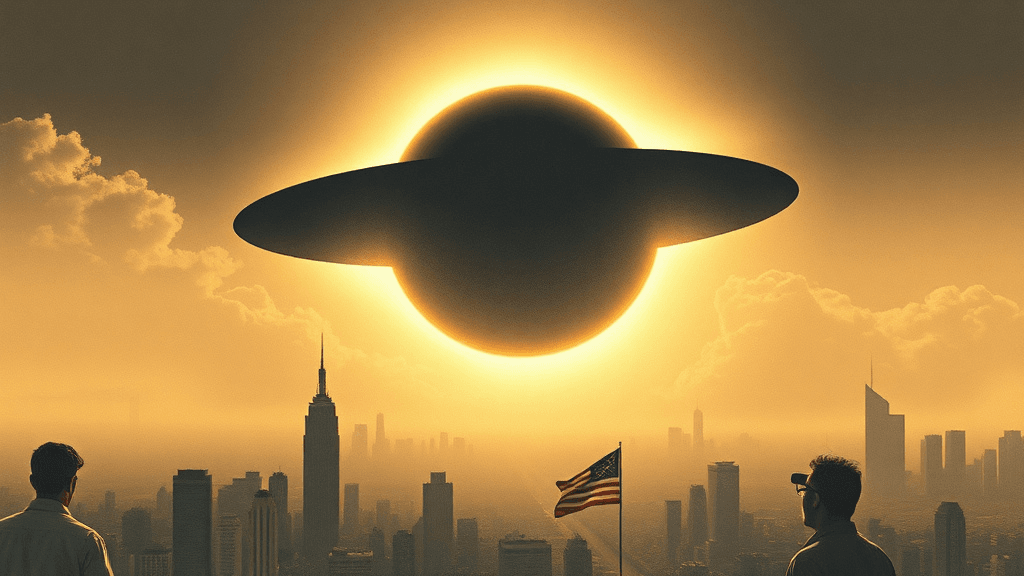
Thirty-nine members of the Heaven's Gate movement died in a rented Rancho Santa Fe mansion over several days in March 1997, believing a UFO trailing Comet Hale-Bopp would carry their souls away.
On 26 March 1997, sheriff's deputies in Rancho Santa Fe, a wealthy community north of San Diego, entered a rented mansion and found 39 dead members of Heaven's Gate. The group, led by Marshall Applewhite and Bonnie Lu Nettles, had timed its deaths to the closest approach of Comet Hale-Bopp. It remains one of the largest mass suicides on American soil and one of the most consequential episodes in the modern history of UFO belief.
Background
Applewhite, a former music professor, and Nettles, a nurse, met in March 1972 and founded the group around 1974. Its teaching blended Christian apocalyptic imagery with science-fiction ideas. In April 1975, in Studio City, Los Angeles, the two presented themselves to about 80 people as the two witnesses described in the Book of Revelation, and about 25 people joined. After a September 1975 meeting in Waldport, Oregon, roughly 20 more people left public life to follow them, and the group went underground. From 1976 it stopped recruiting and adopted a strict monastic lifestyle.
Nettles died of cancer in 1985. That was a serious problem for a doctrine that promised followers would ascend alive in a spacecraft, and Applewhite reworked it into the idea of a "Next Level": the body was a "vehicle" and consciousness would move on to a new one. Members dressed alike, in black shirts and sweatpants, and wore armbands reading "Heaven's Gate Away Team", a Star Trek reference.
The comet and the deaths
Comet Hale-Bopp was discovered in 1995 by Alan Hale and Thomas Bopp and was exceptionally bright. By early 1997 Applewhite had concluded that the comet was cover for a spacecraft trailing it, and that death would release members from their bodies and carry them aboard. Applewhite recorded a farewell video, "Do's Final Exit", on 19 and 20 March 1997.
According to autopsy and toxicology reports, the deaths began around 22 to 23 March and occurred in groups over about three days. Members mixed phenobarbital into applesauce or pudding, drank vodka, and sealed plastic bags over their heads. The victims ranged in age from 26 to 72. An anonymous 911 call, later traced to former member Rio DiAngelo, brought deputies to the house on the afternoon of 26 March. The first deputies found ten bodies, then obtained a search warrant that revealed the rest. The bodies were covered in purple blankets and wore matching black Nike shoes, and reporting from the scene noted no obvious trauma. Sources disagree on some details, including the breakdown of the victims by sex.
Investigation and aftermath
Authorities declined to link the deaths to the Order of the Solar Temple suicides, which had occurred on 22 March 1997. Sociologist Janja Lalich called the deaths murder, while UCLA psychiatrist Louis J. West called them the result of a hoax. A package sent to former member Rio DiAngelo contained two videotapes and a letter reading "we have exited our vehicles just as we entered them."
The comet connection also drew attention from the UFO community. Radio host Art Bell discussed a "companion object" trailing Hale-Bopp, and Alan Hale publicly criticized the broadcasts for promoting "deception about an imaginary spacecraft." Whether such coverage contributed to the group's decision is unknown and has been debated. Copycat suicides followed in 1997 and 1998, including a man near Marysville, California, and two former members in May 1997.
Significance for UFO culture
Heaven's Gate is usually cited as the most dramatic example of how UFO belief can turn lethal when it is joined to charismatic authority and total isolation. For ufologists and skeptics alike, it is a case study in what the contactee tradition could become. Jacques Vallée's Messengers of Deception (1979) had already criticized contactee groups, including this one, for exploiting their followers.
The case also complicates simple narratives about the UFO subculture. Most UFO believers never endorsed suicide, and the group was an extreme outlier even among fringe belief communities. Still, its story shows how the rhetoric of space visitors, salvation, and transcendence can interact with a real astronomical event. Hale-Bopp was a genuine, widely observed comet, and that is part of why the deaths were so disturbing: the sky the group looked to was one that millions of people could see.
A replica display about the case is held at the San Diego Sheriff's Museum in Old Town, and the Rancho Santa Fe house has since been demolished. The episode is remembered as a lesson rather than as evidence for or against extraterrestrial visitation.
Witnesses
Retired San Diego County homicide detective Chuck Curtis was the first officer on scene and later recalled that "they kept finding more bodies and more bodies" as the search continued. Former member Rio DiAngelo, who made the 911 call, received the package of videotapes and letters the group had sent out.
Evidence
The group's farewell videotapes, a letter reading "we have exited our vehicles just as we entered them," and autopsy and toxicology reports form the core record. Accounts differ on the exact sequence and dates of the deaths.
Filed under
Watch
Heaven’s Gate cult members record farewell messages: 20/20 ‘The Cult Next Door’ Preview
Videos inside Heaven's Gate house reveal those lured into cult: 20/20 ‘The Cult Next Door’ Preview
UFO-Cult Suicide | National Geographic
What Really Happened in the Heaven's Gate Cult? (REUPLOAD)
Heaven’s Gate Cult Member Recalls Bizarre House Rules
Where this entry came from
ProvenanceAgent indexedUpdated 2w ago4 sources
Drafted by the archive's AI research agent from the sources below; corrections from readers are reviewed and folded in.
- First indexed
- 23 OCT 26 // 01:18Z
- Last updated
- 23 OCT 26 // 01:18Z
Notes
Further reading

Cosmic Suicide (opens in a new tab)
An early account of Heaven's Gate from its 1970s origins through the 1997 mass suicide, published the same year.

Heaven's Gate: America's UFO Religion
An academic study arguing Heaven's Gate should be understood as a religious movement within American UFO belief.
Buying through these links supports the library. We may earn a commission.
Also available
Heaven's Gate: The Cult of Cults
A four-part docuseries (about 51 minutes per episode) built from never-before-seen footage and first-person accounts from former members and their families, tracing the group from its 1970s recruiting years to the Hale-Bopp comet and the 1997 mass suicide in Rancho Santa Fe.
The Cult Next Door: The Mystery and Madness of Heaven's Gate
A two-hour 20/20 special hosted by Diane Sawyer that revisits the 1997 deaths of 39 members, using archival tapes and audio of leader Marshall Applewhite, interviews with a former member who left before the deaths, and two survivors speaking publicly for the first time.