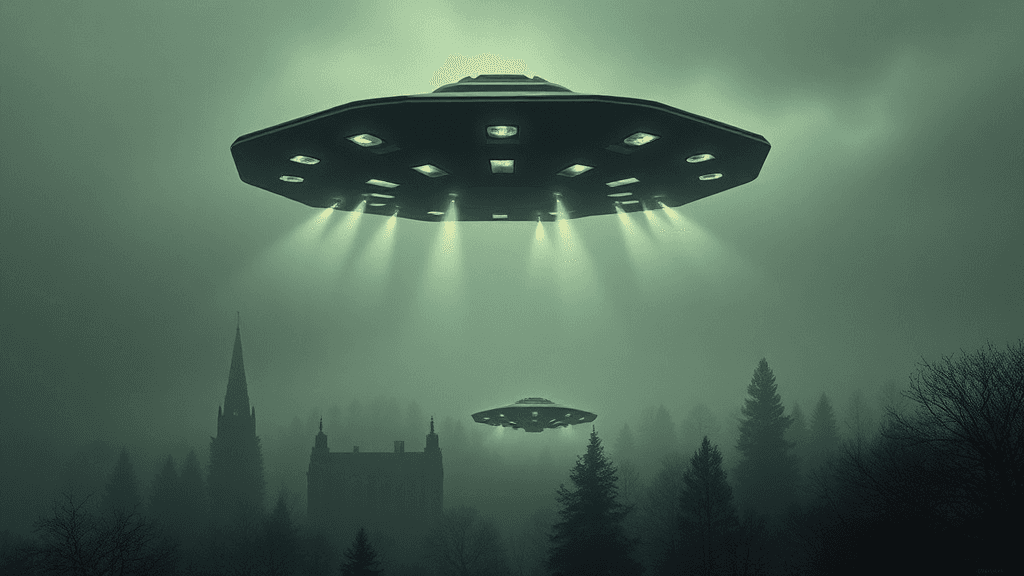
The UFO Library: Mass sighting
Belgian UFO Wave (1989-1990)
A wave of over 2,000 sightings of large, silent, triangular craft across Belgium from late 1989 through 1991, culminating in a Belgian Air Force F-16 scramble on March 30-31, 1990, with radar confirmation of anomalous targets.
Background
Belgium in the late 1980s was an unlikely setting for one of the most significant UFO events in European history. A small, densely populated NATO member state wedged between France, Germany, and the Netherlands, it had no particular tradition of UFO sightings and no cultural predisposition toward flying saucer enthusiasm. The Cold War was winding down -- the Berlin Wall had fallen on November 9, 1989, just twenty days before the first major sighting -- and public attention was firmly fixed on the political upheavals sweeping across Europe.
What made the Belgian wave exceptional was not the strangeness of the reports themselves -- triangular UFOs had been reported elsewhere before -- but the institutional response. Rather than dismissing or ignoring the sightings, the Belgian Air Force took them seriously from the start, collaborating openly with civilian researchers and eventually releasing radar data to the public. This transparency was virtually unprecedented in the history of military UFO encounters and remains a model that advocates for disclosure frequently cite.
The civilian side of the investigation was led by SOBEPS (Societe Belge d'Etude des Phenomenes Spatiaux), a Brussels-based organization founded in 1971 by Lucien Clerebaut, Michel Bougard, and others. SOBEPS had built a small but disciplined network of field investigators over nearly two decades, and the wave would become the defining case of their existence. By the time the sightings subsided in 1993, they had amassed over 2,000 eyewitness reports comprising 20,000 pages of documentation, 400 hours of audio recordings, and 600 full field investigations.
Events
The Night of November 29, 1989
The wave began in earnest on the evening of November 29, 1989, in the area around Eupen, a quiet town near the German border in eastern Belgium. At approximately 5:30 PM, two gendarmes (Belgian national police officers), Heinrich Nicoll and Hubert Von Montigny, were on routine patrol when they observed an extraordinary object in the sky.
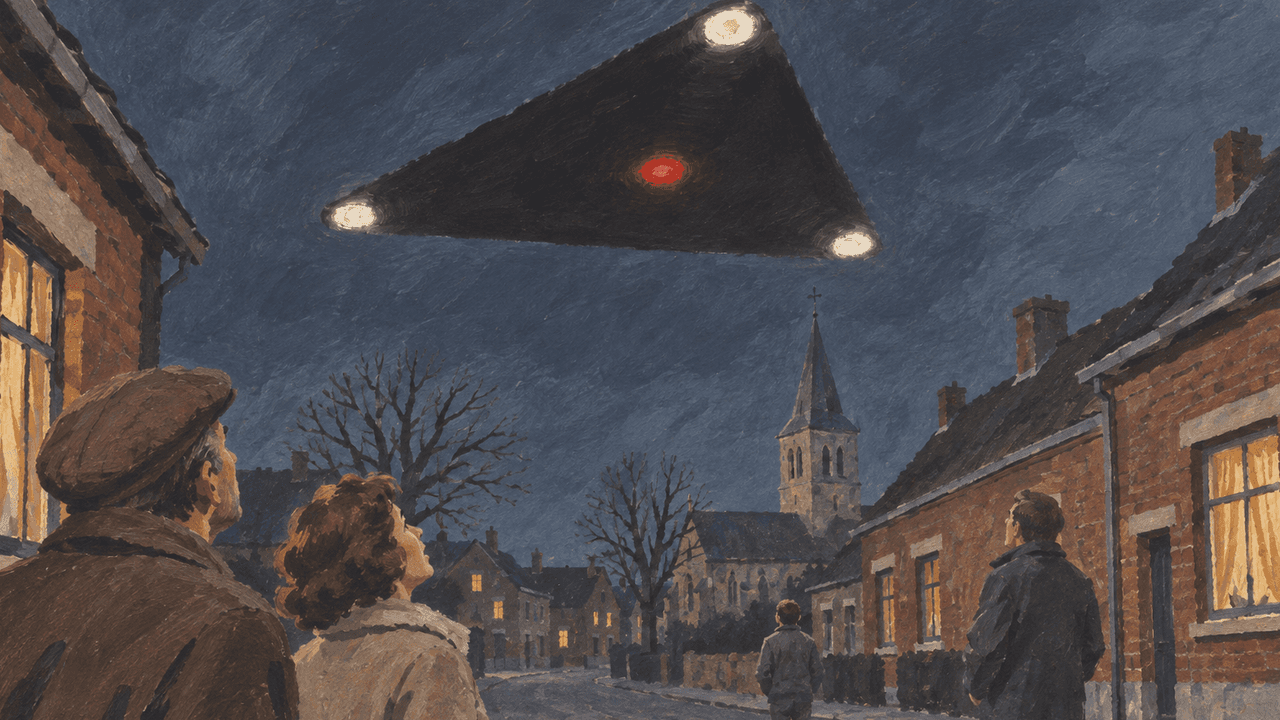
What they saw, and what they would watch for more than thirty minutes, was a large triangular platform hovering silently above an open field. The craft had three powerful spotlights at its corners, each emanating from large circular surfaces that illuminated the ground below. At the center of the dark, flat underside was what the officers described as a "red gyrating beacon" -- a pulsating reddish-orange light that rotated slowly. The object was estimated to be roughly 30 meters (about 100 feet) across each side.
The gendarmes radioed their dispatcher and continued to observe as the craft began to move, drifting slowly and silently toward Eupen, following the road at extremely low altitude. Its movement was unhurried, almost deliberate, as though surveying the terrain below. At one point it stopped and appeared to direct its beams downward, as if scanning or measuring the ground.
Nicoll and Von Montigny were not the only witnesses that night. Two additional officers, Dieter Plummans and Peter Nicoll, independently observed a similar object near the Gileppe Dam, a reservoir southeast of Eupen. Across the region, 30 separate groups of witnesses -- including three groups of police officers -- filed reports. Initial reports exceeded 140 on that single evening. Colonel Wilfried De Brouwer, then Chief of Operations of the Royal Belgian Air Force, later estimated that "considering approximately one person out of ten reports, more than 1,500 people must have witnessed the phenomenon at over seventy locations" that night alone.
The Wave Continues
The sightings did not stop after November 29. Throughout December 1989 and into early 1990, reports continued to pour in from across Belgium. On December 11, 1989, Lieutenant Colonel Andre Amond, a Belgian Army civil engineer, reported a detailed sighting of a similar triangular craft. His military background and technical training lent particular weight to his account.
Witnesses consistently described the same basic object: a large, dark, triangular or occasionally trapezoidal craft, silent or nearly so, moving at low altitude and low speed, with three bright white lights at the corners and a central red or orange flashing light. Some witnesses added additional details -- one described a dome with illuminated rectangular windows on the upper surface, while another compared the object to "an aircraft carrier turned upside down." The consistency of these descriptions across hundreds of independent witnesses, many of whom had no knowledge of each other's reports, was striking.
The F-16 Scramble: March 30-31, 1990
The Belgian wave reached its dramatic climax on the night of March 30-31, 1990, when the Belgian Air Force attempted to intercept one of the objects using two F-16 Fighting Falcons.
At 22:50 on March 30, the supervisor at the Control Reporting Center (CRC) at Glons received reports that three unusual lights forming an equilateral triangle were moving toward Thorembais-Gembloux, southeast of Brussels. The Traffic Control Center at Semmerzake confirmed an unknown radar return. After verification, at 00:05 on March 31, two F-16s were scrambled from Beauvechain Air Base.
Over the next hour, the pilots attempted nine separate interceptions. On several occasions, the onboard radar briefly locked onto targets, but the contacts behaved in ways that defied conventional aerodynamics. According to the recorded radar data, the target's speed changed "from 150 to 970 knots" -- roughly 170 to 1,100 miles per hour -- in minimal time. Its altitude shifted from 9,000 feet to 5,000 feet and then up to 11,000 feet, at one point descending toward ground level. These accelerations, if the radar readings were accurate, would have generated forces far beyond the tolerance of any known aircraft or pilot.
Critically, however, neither pilot ever achieved visual contact with the object. They saw nothing with their own eyes despite the radar indications. This fact would become central to the subsequent debate over the case's significance.
Investigation
The Belgian Air Force Response
Colonel De Brouwer's response to the wave was remarkable for its openness. He established a Special Task Force to work with the national Gendarmerie and with SOBEPS, sharing military data with civilian researchers -- a level of cooperation that astonished the international UFO community. Major P. Lambrechts prepared a preliminary report on the March 30-31 incident, and a detailed technical analysis of the radar data was carried out by Colonel Salmon and M. Gilmard at the Belgian Air Force's Electronic War Center, completed in 1992.
The Salmon-Gilmard analysis produced nuanced results. While SOBEPS initially reported nine radar locks during the F-16 intercept, the military's own analysis found only three genuine lock-ons -- and determined that in all three cases, the F-16s had inadvertently locked onto each other. The remaining radar contacts were attributed to Bragg scattering, a well-known atmospheric phenomenon in which radar beams are refracted by layers of air with different temperatures or humidity levels, producing false returns. Professor Auguste Meessen, a physicist at the Catholic University of Louvain who served as SOBEPS's principal scientific consultant, accepted the Bragg scattering hypothesis for most of the contacts but noted that at least one radar trace remained unexplained.
SOBEPS Documentation
SOBEPS published two substantial volumes on the wave -- Vague d'OVNI sur la Belgique (1991) and a second volume in 1994 -- which remain the most comprehensive primary-source collections on the case. General De Brouwer, by then promoted, agreed to write the postface for the first volume while still in active service, an extraordinary gesture of institutional endorsement. Of the more than 2,000 reported sightings SOBEPS collected, approximately 650 were investigated in detail, and roughly 500 of those could not be attributed to known aircraft, celestial phenomena, or other conventional explanations.
The Petit-Rechain Photograph
In early April 1990, at the height of the wave, an anonymous photographer submitted what appeared to be a remarkably clear photograph of a dark triangular craft with three bright lights at its corners and a reddish light at the center -- precisely matching witness descriptions. The image, taken near the village of Petit-Rechain in Liege province, became the most iconic visual associated with the Belgian wave and was reproduced in newspapers, books, and documentaries worldwide.
The photograph was subjected to extensive analysis. Scientists at CNES (France's national space agency), the Belgian Royal Military Academy, and NASA scientist Richard Haines all examined it. Physicist Andre Marion's digital analysis identified "lines of force" in the image that he argued would be extremely difficult to fabricate. For over two decades, the Petit-Rechain photo served as one of the most compelling pieces of UFO photographic evidence in existence.
Then, on July 26, 2011, a man named Patrick Marechal appeared on the Belgian television channel RTL-TVI and confessed that the photograph was a hoax. He claimed to have constructed it using a painted styrofoam panel to fool his co-workers. The confession was a significant blow to the case's credibility, though some researchers noted that Marechal was unable to convincingly recreate the image when challenged, and the original analyst Marion maintained that the optical properties observed in the photograph would be "particularly difficult" to fabricate with such simple materials. The debate over the photo's authenticity, while largely settled in favor of hoax, has never been entirely closed.
The case for
Several features distinguish the Belgian wave from the vast majority of UFO cases and lend it enduring credibility:
Volume and consistency of witnesses. Over 2,000 sightings were reported across more than a year. Witnesses included police officers, military personnel, and a lieutenant colonel. The descriptions were remarkably consistent -- dark triangle, white corner lights, red central beacon, silent flight, low altitude -- even among witnesses who had no contact with each other.
Military radar confirmation. While the radar data from March 30-31 proved more ambiguous than initially reported, the fact that military radar stations at both Glons and Semmerzake detected anomalous returns contemporaneously with visual sightings on the ground lends weight to the idea that something physical was present in the airspace.
Institutional transparency. The Belgian Air Force did not dismiss, suppress, or ridicule the reports. Their open collaboration with SOBEPS and their willingness to release radar data for independent analysis stands in sharp contrast to the secrecy that characterized most military UFO investigations of the 20th century. If the sightings had mundane explanations, one might expect the Air Force to have found and publicized them.
No stealth aircraft explanation. De Brouwer personally consulted with U.S. intelligence officials and confirmed that no American stealth aircraft -- including the F-117 Nighthawk or B-2 Spirit -- were being flown over Belgium during the wave. Belgian Defense Minister Leo Delcroix stated publicly that "American authorities have assured us that there were never any aerial test flights" in Belgian airspace.
The case against
Skeptics have raised significant objections:
The radar data collapse. The most dramatic element of the case -- the F-16 radar intercept -- largely disintegrated under scrutiny. The military's own analysis attributed the contacts to Bragg scattering and mutual lock-ons between the two F-16s. Without reliable radar confirmation, the March 30-31 incident reduces to ground-level visual sightings alone.
No visual contact by pilots. Despite being directed to the radar targets, neither F-16 pilot saw anything. This is difficult to reconcile with claims of a large, brightly lit object operating at relatively close range.
The Petit-Rechain hoax. The confession by Patrick Marechal removed the single most compelling piece of physical evidence from the case. While the wave does not depend on this photograph, its debunking inevitably cast a shadow over the entire episode.
Sociological explanations. Some researchers have argued that the wave exhibited characteristics of social contagion -- an initial genuine sighting (or misidentification) triggering a cascade of reports as public attention focused on the sky. Belgium's small size and dense media coverage may have amplified this effect. Once people expected to see triangles, they were more likely to interpret ambiguous lights as triangular craft.
Helicopter or conventional aircraft misidentification. While witnesses consistently described the object as silent, skeptics have noted that helicopters at certain altitudes and atmospheric conditions can appear nearly silent from the ground. The triangular light configuration could also match certain helicopter or aircraft lighting patterns viewed from below.
Cultural impact
The Belgian wave had a profound and lasting effect on UFO discourse, particularly in Europe. It demonstrated that a UFO event could be taken seriously by military authorities without provoking ridicule, and the Belgian Air Force's cooperative approach became a template that disclosure advocates worldwide pointed to as the ideal model for how governments should handle UFO reports.
The case also cemented the "black triangle" as one of the canonical UFO shapes in popular culture, alongside the classic flying saucer and the cigar-shaped craft. Triangle sightings had been reported before -- notably in the Hudson Valley wave of 1982-1986 in New York -- but the Belgian wave, with its military involvement and institutional credibility, elevated the triangle to a fixture of the UFO canon.
General De Brouwer became an important figure in the international UFO community after his retirement. On November 12, 2007, he testified at the National Press Club in Washington, D.C., at an event organized by journalist Leslie Kean and filmmaker James Fox, moderated by former Arizona Governor Fife Symington. De Brouwer stated that "the Belgian UFO wave was exceptional and the Air Force could not identify the nature, origin and intentions of the reported phenomena." His testimony featured prominently in Kean's influential 2010 book UFOs: Generals, Pilots, and Government Officials Go on the Record.
The SOBEPS investigation, meanwhile, set a standard for civilian UFO research. Their methodology -- systematic field interviews, careful documentation, collaboration with military and academic experts -- showed what a well-organized civilian group could accomplish. The two published volumes remain essential references for researchers studying the case.
Current status
More than three decades after the wave, no definitive explanation has been established. The Belgian government has never revised its position: the sightings remain unexplained. SOBEPS itself dissolved in 2007, but its successor organization, COBEPS (Comite Belge d'Etude des Phenomenes Spatiaux), continues to maintain archives and conduct research.
The case continues to be cited in the context of the modern UAP disclosure movement. When the U.S. government began taking UAP reports seriously in the wake of the 2017 New York Times revelations about AATIP, the Belgian wave was frequently invoked as a precedent -- evidence that military organizations had encountered genuinely anomalous aerial phenomena and been unable to explain them.
The Petit-Rechain hoax confession remains a cautionary tale about the fragility of photographic evidence in UFO cases, and a reminder that even well-investigated cases can contain elements of fraud alongside elements of genuine mystery. The Belgian wave's strength was never a single photograph; it was the sheer volume of credible, independent witnesses and the institutional willingness to investigate openly rather than dismiss. Those elements remain intact, and the case endures as one of the most significant UFO events of the late twentieth century.
Witnesses
- Gendarmes Heinrich Nicoll & Hubert Von Montigny -- First responders on November 29, 1989; observed the triangular craft for over 30 minutes near Eupen
- Gendarmes Dieter Plummans & Peter Nicoll -- Independent observation of similar craft near Gileppe Dam on same evening
- Lieutenant Colonel Andre Amond -- Belgian Army civil engineer; detailed sighting on December 11, 1989
- Approximately 2,000+ total witnesses across Belgium from November 1989 through 1991, including police officers, military personnel, and civilians across 70+ locations
- Two unnamed Belgian Air Force F-16 pilots -- Scrambled from Beauvechain Air Base on March 30-31, 1990; achieved radar contact but no visual confirmation
Evidence
- Radar data from Glons CRC and Semmerzake -- Two military radar stations detected anomalous returns on March 30-31, 1990, coinciding with ground visual sightings. Subsequent analysis by Col. Salmon and M. Gilmard attributed most contacts to Bragg scattering and mutual F-16 lock-ons, though at least one trace remained unexplained.
- F-16 onboard radar recordings -- Brief target lock-ons showing extreme speed changes (150 to 970 knots) and altitude shifts (9,000 to 5,000 feet) that would exceed any known aircraft's performance envelope.
- SOBEPS documentation -- Over 20,000 pages of witness reports, 400 hours of audio recordings, 600 full field investigations, published in two volumes (Vague d'OVNI sur la Belgique, 1991 and 1994).
- Petit-Rechain photograph (April 1990) -- Initially analyzed by CNES, Royal Military Academy, and NASA scientist Richard Haines as potentially genuine. Confessed as hoax by Patrick Marechal in July 2011.
- Belgian Air Force official report by Major P. Lambrechts, plus the 1992 Salmon-Gilmard technical radar analysis.
Filed under
Watch
The Belgium UFO That Defied Physics (S4) | The Proof Is Out There | History
The Unsolved Belgian UFO Wave Mystery Sightings from 1989 till 1991
This European UFO Was Spotted by Thousands of People | Belgian UFO Wave
Where this entry came from
ProvenanceAgent indexedUpdated 6mo ago8 sources
Drafted by the archive's AI research agent from the sources below; corrections from readers are reviewed and folded in.
- First indexed
- 26 APR 26 // 20:23Z
- Last updated
- 26 APR 26 // 20:23Z
- UFO Briefing Document: 1989-1990 UFO Sighting Wave in Belgium, Don Berliner & Antonio Huneeus, Biblioteca Pleyades
- Belgian UAP Wave, Enigma Labs, Enigma Labs
- 30 years later, we still don't know what really happened during the Belgian UFO wave, The Week Staff, The Week
- Belgium's Flying Triangle Wave, Antonio Huneeus, Open Minds
- The Belgian UFO Wave (COBEPS Technical Report), COBEPS, COBEPS
- Belgium Flap Study by Auguste Meessen, Auguste Meessen, UFOs at Close Sight
- Transcript of Witness Declarations from NPC UFO Conference (Nov 12, 2007), Frank Warren, The UFO Chronicles
- Triangles Over Belgium: Europe's Great UFO Mystery (1989-1990), UFO Report, UFO Report
Notes
- UFO Briefing Document: 1989-1990 UFO Sighting Wave in Belgium, Don Berliner & Antonio Huneeus, Biblioteca Pleyades
- Belgian UAP Wave, Enigma Labs, Enigma Labs
- 30 years later, we still don't know what really happened during the Belgian UFO wave, The Week Staff, The Week
- Belgium's Flying Triangle Wave, Antonio Huneeus, Open Minds
- The Belgian UFO Wave (COBEPS Technical Report), COBEPS, COBEPS
- Belgium Flap Study by Auguste Meessen, Auguste Meessen, UFOs at Close Sight
- Transcript of Witness Declarations from NPC UFO Conference (Nov 12, 2007), Frank Warren, The UFO Chronicles
- Triangles Over Belgium: Europe's Great UFO Mystery (1989-1990), UFO Report, UFO Report
Also available
The Mysterious Case of the Belgian Triangle
A 3-episode docuseries investigating the late-1980s Belgian UFO wave, when thousands of civilians and military personnel reported sightings of triangular-shaped objects. Follows the SOBEPS civil investigation group working with Belgian Air Force and gendarmerie to solve the mystery.
The Belgian UFO Wave
An episode from the documentary series Alien Files: Reopened exploring the 1990 Belgian UFO wave. Features firsthand accounts, radar evidence, and military investigations into triangular objects observed by thousands across Belgium.
Unsolved Mysteries: Belgian UFO
Classic episode from the original Unsolved Mysteries series featuring witness accounts and investigation into the Belgian UFO sightings that began in late 1989. Includes testimony from police, military officials, and civilians who observed the mysterious triangular objects.
Buying through these links supports the library. We may earn a commission.