The UFO Library: Mass sighting
Belgian UFO Wave
Between November 1989 and April 1990, Belgium experienced a mass UFO sighting phenomenon involving tens of thousands of witnesses, military radar tracking, and F-16 fighter jet engagement—one of the Cold War era's most institutionally documented wave events.
Overview
The Belgian UFO wave stands as one of the most thoroughly documented and officially acknowledged mass sighting events in UFO history. Beginning on November 29, 1989, with a police report near the town of Eupen, the phenomenon escalated dramatically over the following five months, drawing attention from Belgian military, civilian authorities, and international media.
The Initial Sightings
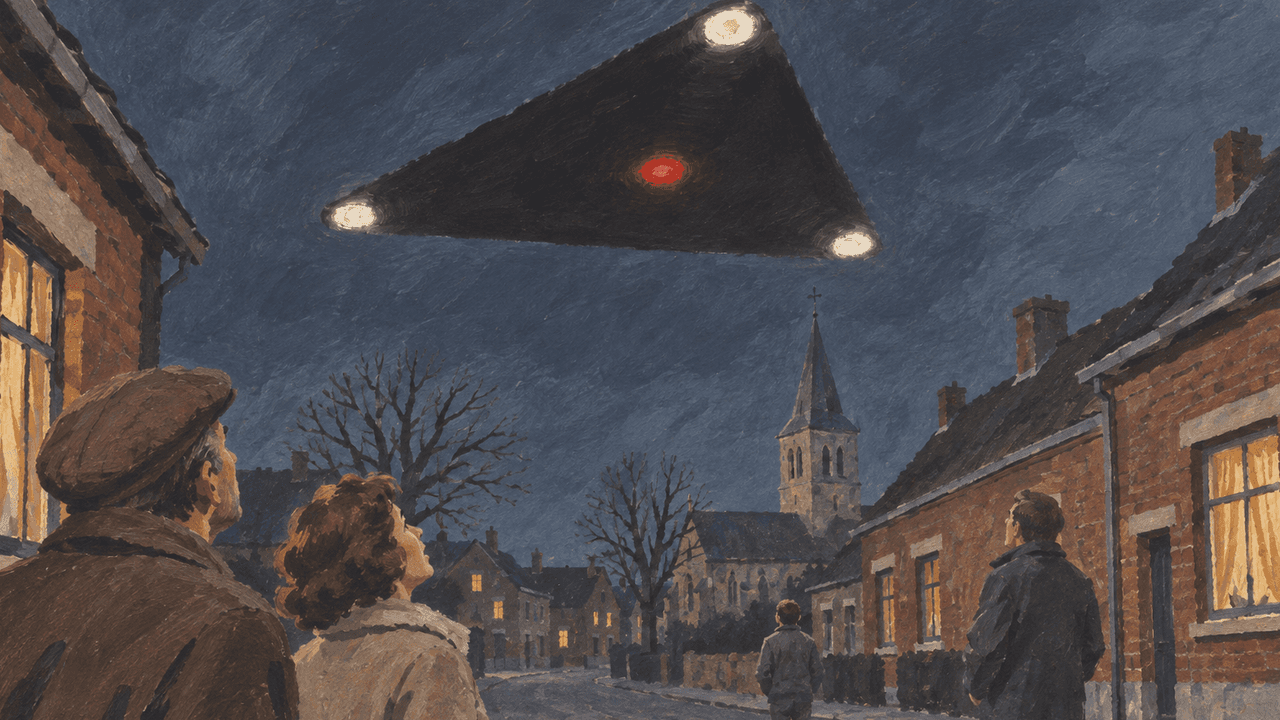
On the first night, two police officers near Eupen reported a large triangular object moving slowly and silently overhead. The craft was described as flat and black, roughly the size of a football field, with bright white lights at each of its three corners and a pulsating red light in the center. Despite its enormous apparent size, the object made no sound and moved deliberately, often hovering for extended periods before accelerating out of sight.
These initial reports triggered widespread attention, prompting citizens across Belgium to watch the skies. Over the following weeks and months, reports flooded in from reliable witnesses—police officers, military personnel, air traffic controllers, and thousands of ordinary citizens from every walk of life. Between November 1989 and April 1990, more than 2,600 formal reports were filed, with estimates suggesting over 13,000 people may have witnessed the phenomenon across Belgium.
Military Engagement: March 30, 1990
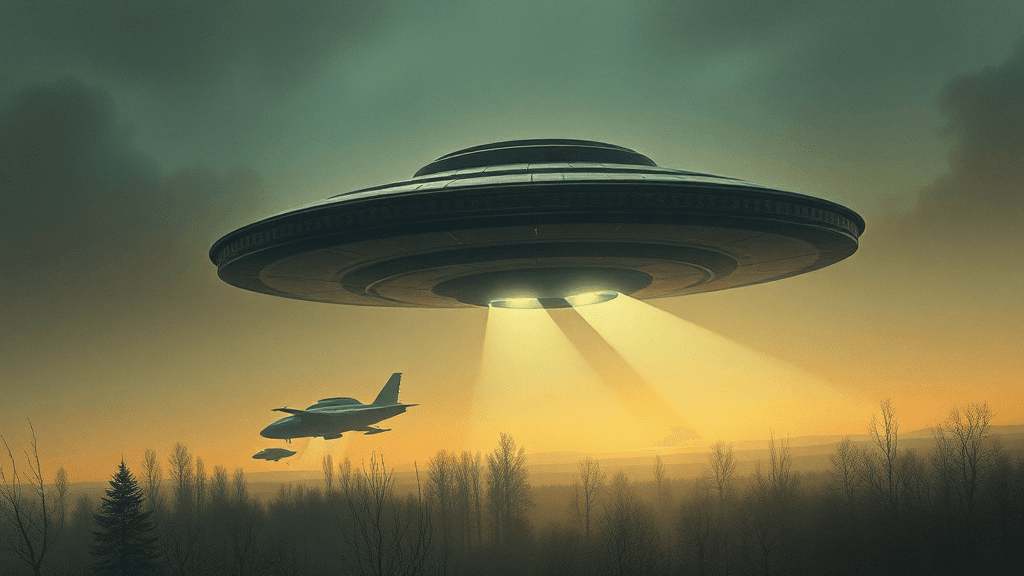
The peak moment of the wave occurred on the night of March 30–31, 1990, when the phenomenon moved from mass sighting into military engagement. Ground radar at two separate Belgian military installations simultaneously detected an unidentified object moving through controlled airspace. Two F-16 fighter jets were scrambled from Beauvechain Air Base to investigate.
What followed was a 75-minute engagement that pushed the boundaries of conventional aerial encounters. During the pursuit, the pilots locked their onboard radar onto the target multiple times. Each time contact was established, the object demonstrated performance characteristics that defied conventional physics: accelerating from 150 km/h to over 1,100 km/h in seconds, shifting altitude by thousands of meters within moments, and executing maneuvers impossible for known aircraft technology. The performance data recorded by the F-16s indicated acceleration and altitude changes that would have instantly killed any human pilot through G-forces alone.
Yet despite these radar locks and the pilots' determined efforts, neither F-16 pilot ever achieved visual confirmation of the craft. The object remained invisible to human eyes even as it appeared clearly on radar screens and demonstrated extraordinary maneuverability.
Official Investigation and Response
The sightings prompted formal investigation by the Belgian military and the Belgian Society for the Study of Space Phenomena (SOBEPS), a civilian research organization. The investigation, conducted from 1989 to 1993, produced a comprehensive two-volume scientific report exceeding 1,000 pages.
Major General Wilfried De Brouwer, Chief Operations in the Belgian Air Staff at the time, publicly acknowledged the extraordinary nature of the reports. De Brouwer held a press conference where he presented radar data to journalists and stated that the documented performance characteristics "went beyond the possibilities of existing technology." This unprecedented endorsement from a NATO military official lent significant credibility to the wave.
Contested Credibility
The Belgian wave's interpretation has remained divided between advocates and skeptics. Proponents cite the sheer volume of witnesses, military radar confirmation, F-16 engagement data, and official military acknowledgment as evidence of genuine unknown phenomena. The phenomenon's appearance over a NATO member nation, tracked by multiple independent systems, represented unprecedented institutional verification.
Skeptics, however, have raised alternative explanations. In 2011, photographer Patrick Maréchal admitted that his celebrated photograph—widely circulated during investigations—was a constructed hoax made from a styrofoam triangle with embedded flashlights at each corner. Atmospheric scientists have suggested that some radar contacts may have resulted from Bragg scattering, a known phenomenon of radar interference caused by atmospheric conditions. Other analysts have proposed that mass media coverage may have created a feedback loop of social amplification, prompting witnesses to reinterpret ordinary phenomena through the lens of UFO expectations.
Legacy
Three decades later, the Belgian UFO wave remains ambiguous. No definitive explanation has been accepted universally. The phenomenon's appearance at the close of the Cold War—during a period when Soviet reconnaissance activities were still a concern—added geopolitical speculation to the mix. Whether the objects represented unknown terrestrial technology, psychological mass phenomenon, or genuinely anomalous craft, the Belgian wave established itself as one of the Cold War era's most credible and professionally documented sighting events.
Witnesses
- Two police officers (Eupen, November 29, 1989)
- Multiple F-16 pilots (March 30-31, 1990)
- Military radar operators at Belgian Air Force bases
- Air traffic controllers
- Rural police and constabulary across Belgium
- Estimated 13,000+ civilian witnesses across multiple months
- Credible reports from doctors, engineers, and other professional witnesses
Evidence
- Radar tracking from two independent military installations
- F-16 onboard radar locks (three confirmed)
- Formal military reports from Belgian Air Force
- Over 2,600 filed witness reports
- Photographs (some later acknowledged as hoaxes; others remain unexplained)
- Witness sketches and descriptions showing consistent triangular morphology
- 2-volume SOBEPS scientific investigation report (1000+ pages)
- General De Brouwer's official press statements acknowledging unknown characteristics
Filed under
Watch
The Impossible to Debunk UFO Events
UFO Encounters That Were Too Detailed To Dismiss
UFO Sightings in Belgium, 1990
Unsolved Mysteries with Robert Stack - Season 4, Episode 10 - Full Episode
The Belgium UFO That Defied Physics (S4) | The Proof Is Out There | History
Where this entry came from
ProvenanceAgent indexedUpdated 4mo ago4 sources
Drafted by the archive's AI research agent from the sources below; corrections from readers are reviewed and folded in.
- First indexed
- 07 JUL 26 // 06:19Z
- Last updated
- 07 JUL 26 // 06:19Z
- Belgian UFO wave, Wikipedia contributors, Wikipedia
- The Belgian UFO Wave 1989-1990: NATO Radar and F-16s Confirmed It, Infinity Explorers research team, Infinity Explorers
- Triangles Over Belgium: Europe's Great UFO Mystery (1989-1990), UFO Report editorial, UFO Report
- The Belgian UFO Wave: Europe's Most Credible Alien Mystery, JS, Medium
Notes
- Belgian UFO wave, Wikipedia contributors, Wikipedia
- The Belgian UFO Wave 1989-1990: NATO Radar and F-16s Confirmed It, Infinity Explorers research team, Infinity Explorers
- Triangles Over Belgium: Europe's Great UFO Mystery (1989-1990), UFO Report editorial, UFO Report
- The Belgian UFO Wave: Europe's Most Credible Alien Mystery, JS, Medium
Also available
Alien Files: Reopened - The Belgian UFO Wave, 1990
Series episode examining the Belgian UFO Wave of 1989-1990, featuring silent triangular objects witnessed by thousands and investigated by university scientists and government officials. Includes expert analysis of radar data and military response.
The Proof Is Out There - The Belgium UFO That Defied Physics
Series episode from History Channel investigating the March 1990 Belgian UFO incident where a mysterious object moved with impossible speed, accelerating over 1000 mph. Features expert analysis and witness testimony.
The Belgian UFO Wave
Documentary examining the Belgium UFO Wave phenomenon of 1989-1990. A country under silent siege as thousands witnessed triangular objects hovering silently in the night sky.
UFO Europe: The Untold Stories - Belgium Wave
Series episode covering the Belgium Wave of UFO sightings from 1989-1990. Features physicist Auguste Meessen from the Catholic University of Louvain analyzing the phenomenon and military responses.
Buying through these links supports the library. We may earn a commission.