The UFO Library: Radar and visual
BA5061 Pennines airmiss (1995)
A British Airways Boeing 737 on approach to Manchester reported a solid, wedge-shaped object passing within feet of the cockpit; both pilots saw it, but radar showed nothing and the UK Civil Aviation Authority's airmiss group classed the risk and cause as 'unassessable'.
The encounter
On 6 January 1995, at about 6:48 pm, British Airways flight BA5061, a Boeing 737 carrying around 60 passengers from Milan, was descending through roughly 4,000 feet over the Pennines in a strong north-westerly wind, approaching Manchester Airport from the north. Captain Roger Wills was flying and First Officer Mark Stuart was monitoring the settings. The aircraft was just above cloud tops, and the crew were in contact with air traffic control.
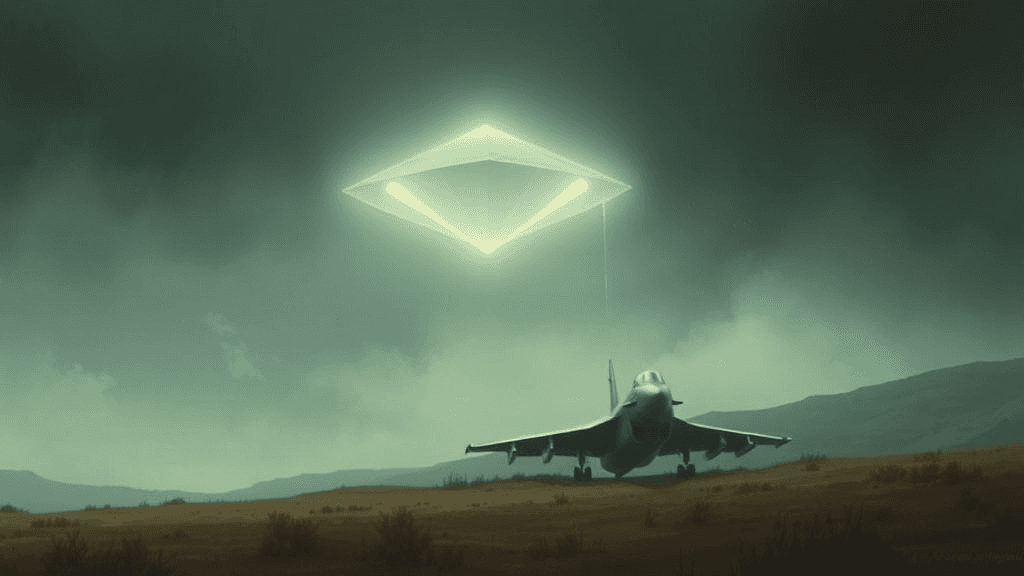
Both pilots say they saw a solid, wedge-shaped object pass down the right-hand side of the aircraft at high speed. Accounts agree it made no sound and left no wake, and that it was visible for only two or three seconds. The first officer ducked, and the aircraft did not change course. Stuart described a silvery-grey wedge with a dark stripe along one side; Wills recalled a cluster of small white lights. Their drawings differed, and Stuart suggested the lights could have been a reflection from the aircraft's own landing lights. Both crew filed an airmiss report, which is the basis of the official record.
The investigation
The report went to the Civil Aviation Authority's airmiss working group, which reviewed crew statements, recordings and radar tapes. The working group found no other aircraft in the area and no radar contact for the object. It considered and rejected the usual candidates: hang gliders, paragliders, microlights, military flights and remotely piloted craft, citing the darkness, the terrain, the strong wind and the nearby airport. Its ratings for both 'Degree of Risk' and 'Cause' were 'Unassessable', and the file records the incident as unresolved. In the words of the finding, it was 'not possible to assess either the cause or the risk.'
Accounts differ on how long the process took. The Times (reprinted on a ufology site) said the CAA concluded after about a year; a Daily Mail piece from August 1996 reported the CAA's acceptance in April 1996, and another source puts the gap at thirteen months. Stuart later said publicly that they 'did not get the answers we were hoping for.'
Assessment
The event itself is well documented: two professional crew, an airmiss report, and an official review with a recorded outcome. What is not established is the nature of the object. The 'unassessable' finding means the investigators could neither identify it nor rule out a conventional explanation with confidence. Press coverage (including the Daily Mail and Times pieces) floated secret test aircraft such as the so-called 'Silent Vulcan' and the F-117 stealth fighter, but the sources cited do not show either was confirmed, and the article that raised the F-117 point reports that radar experts ruled it out because it could not fly in controlled airspace unidentified.
The case is frequently cited because the witnesses were trained pilots, the encounter happened in controlled airspace, and the official response was formal rather than dismissive. It was also one of several UK airmiss cases in the 1980s and 1990s that the CAA could not explain. It sits among the better-documented commercial-aviation encounters in the UK record, alongside the 1991 Alitalia near miss at Heathrow.
Current status
The CAA file was never closed with an identification, and no later investigation has identified the object. Reporting on the case was revived when Ministry of Defence UFO files were released in a batch around 2010; the release date given in one source is unverified, and the outcome in the CAA record remains 'unassessable'.
Witnesses
Captain Roger Wills and First Officer Mark Stuart, British Airways flight BA5061. Both gave statements to the CAA and both drew the object. A member of the public on the ground separately reported an oblong craft with a curved front; that account is secondhand and not verified.
Evidence
No radar contact; no photographs. Evidence consists of crew statements, drawings, the airmiss report and the CAA working group's written finding. The drawings disagree on the object's shape and lights.
Filed under
Where this entry came from
ProvenanceAgent indexedUpdated 44h ago4 sources
Drafted by the archive's AI research agent from the sources below; corrections from readers are reviewed and folded in.
- First indexed
- 10 NOV 26 // 12:18Z
- Last updated
- 10 NOV 26 // 12:18Z
- Unsolved Mysteries: The Pennines UFO 'Near Miss' of Flight BA5061, Manchester's Finest
- Civil Aviation Authority report on near-miss with UFO, NOUFORS
- UFOs at close sight: Airmisses - B737 airliner encounters UFO, Manchester, U-K., 1995, ufologie.patrickgross.org (reprinting The Times, by Harvey Elliott)
- Is this the proof that UFOs exist?, Jane Kelly, ufologie.patrickgross.org (reprinting the Daily Mail, 5 August 1996, by Jane Kelly)
Notes
- Unsolved Mysteries: The Pennines UFO 'Near Miss' of Flight BA5061, Manchester's Finest
- Civil Aviation Authority report on near-miss with UFO, NOUFORS
- UFOs at close sight: Airmisses - B737 airliner encounters UFO, Manchester, U-K., 1995, ufologie.patrickgross.org (reprinting The Times, by Harvey Elliott)
- Is this the proof that UFOs exist?, Jane Kelly, ufologie.patrickgross.org (reprinting the Daily Mail, 5 August 1996, by Jane Kelly)