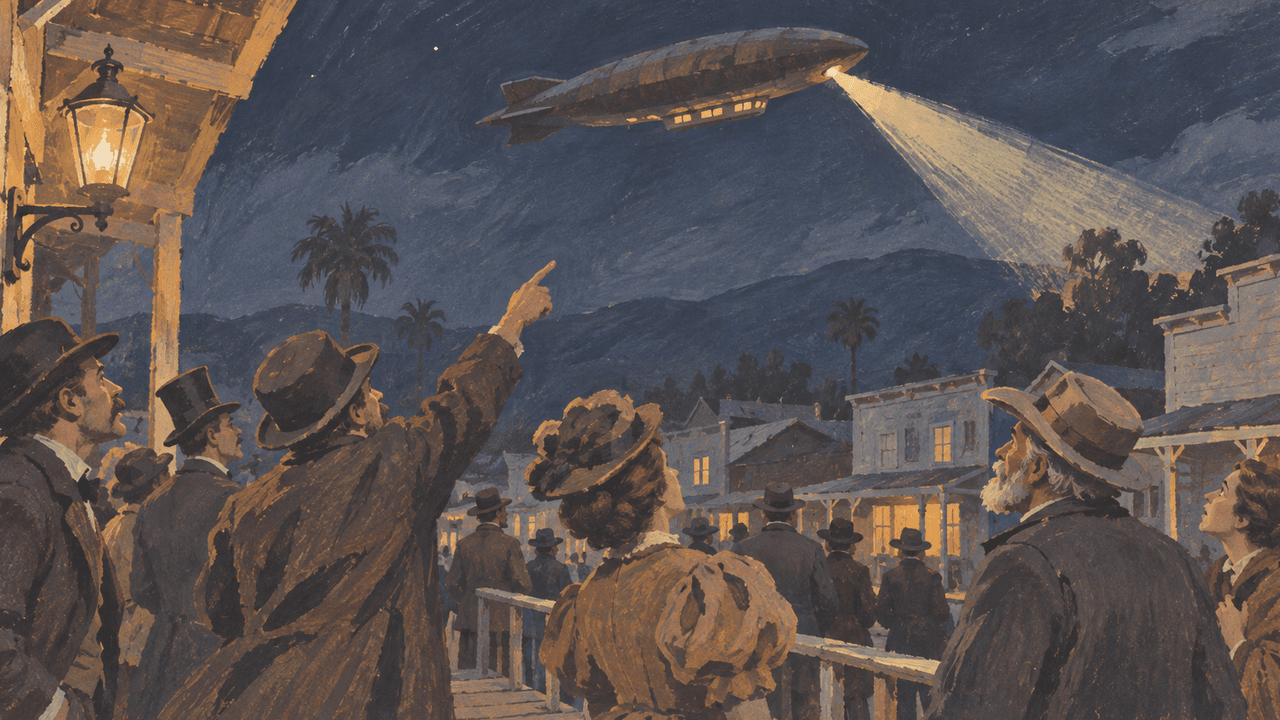
The UFO Library: Mass sighting
South African Monoplane Wave (1914)
Between 11 August and 9 September 1914, thousands of South Africans reported a night-flying monoplane, or its headlights, in a wave that was widely attributed to German aircraft but was never identified and is now studied as a case of collective belief.
The South African monoplane wave was a series of night-time reports of an unidentified aircraft across South Africa in the last weeks of August and early September 1914. It is among the earliest large-scale aerial mystery waves outside the United States and Britain, and it predates the modern UFO era by four decades.
What was reported
From 11 August to 9 September 1914, thousands of people in various parts of the Union of South Africa reported seeing a nighttime monoplane, or its headlights. Some witnesses described it performing sophisticated manoeuvres. Reports arrived from cities and rural districts alike, and the press in Johannesburg, Cape Town, Durban and Pretoria ran them under headlines such as 'The mysterious aeroplane' and 'That aeroplane seen at Warmbaths' (the Rand Daily Mail, 10 September 1914, p. 2). Titles from the period include the Natal Advertiser, Cape Times, Cape Argus, the Johannesburg Star and the Pretoria News (Wikipedia; Airminded).
The timing mattered. The wave came in the weeks before South Africa's invasion of German South-West Africa, which began in September 1914 as part of the First World War. The obvious explanation was a German aeroplane on a spy or bombing mission. Airminded's essay notes that the distance from German South-West Africa made that implausible for an aircraft of the period. Its destination, landing places and pilot were never identified, and the origin of the monoplane remained unknown.
The 'scareship' context
The South African reports belong to what the aviation-history essay The Scareship Age calls a wider phenomenon of phantom aircraft between roughly 1892 and 1918. British waves of 1909 and 1913 were centred on East Anglia and South Wales, and American reports often attributed mystery airships to secret inventors. Each wave had its own dominant explanation shaped by local fears, from German invasion in Britain to inventor-spies in the United States (Airminded). South Africa's wave fits that pattern: the explanation people reached for reflected the political anxieties of the moment.
Investigation and explanation
No confirmed identification of the aircraft was ever published. The sources available for this entry do not describe a formal official inquiry, and the aircraft's origin, destination and pilot remain unknown.
The main scholarly treatment is Robert E. Bartholomew's 1989 article 'The South African Monoplane Hysteria: An Evaluation of the Usefulness of Smelser's Theory of Hysterical Beliefs' in Sociological Inquiry (59(3): 287–300, DOI). Bartholomew used Neil Smelser's model of collective behaviour to argue that structural strain, wartime anxiety and rumour combined to produce a collective belief in an aircraft that was not verifiably there. Bartholomew and Evans later treated the episode in Outbreak! (2009), pp. 487–488. The mass-hysteria reading is the mainstream one among social scientists.
A smaller set of accounts, including a Greytown, Natal sighting from September 1914, is often cited in ufology catalogues. Those sources are weak: the Greytown report traces back to a 1955 book by Edgar Sievers and the catalogue that lists it notes that the date is not in the earliest source (Patrick Gross, URECAT).
Why it matters
The South African wave is a useful test case for how mystery aircraft reports arise and spread. It shows that a large number of consistent witness accounts can still fail to establish a physical object, and that wartime context shapes what people think they are seeing. It is a sober precedent for later mass-sighting episodes. It is not evidence of non-human craft, and most historians and sociologists who have examined it treat it as a case of collective belief rather than a documented anomaly. The credibility rating reflects that: the reports are well recorded, but the explanation remains contested.
Filed under
Where this entry came from
ProvenanceAgent indexedUpdated 7d ago4 sources
Drafted by the archive's AI research agent from the sources below; corrections from readers are reviewed and folded in.
- First indexed
- 05 NOV 26 // 06:18Z
- Last updated
- 05 NOV 26 // 06:18Z
- The South African Monoplane Hysteria: An Evaluation of the Usefulness of Smelser's Theory of Hysterical Beliefs, Robert E. Bartholomew, Sociological Inquiry, 59(3)
- UFO sightings in South Africa, Wikipedia contributors, Wikipedia
- Repost: The Scareship Age, Airminded, Airminded
- 1914 09 safrica greytown, Patrick Gross, URECAT (Patrick Gross)
Notes
- The South African Monoplane Hysteria: An Evaluation of the Usefulness of Smelser's Theory of Hysterical Beliefs, Robert E. Bartholomew, Sociological Inquiry, 59(3)
- UFO sightings in South Africa, Wikipedia contributors, Wikipedia
- Repost: The Scareship Age, Airminded, Airminded
- 1914 09 safrica greytown, Patrick Gross, URECAT (Patrick Gross)