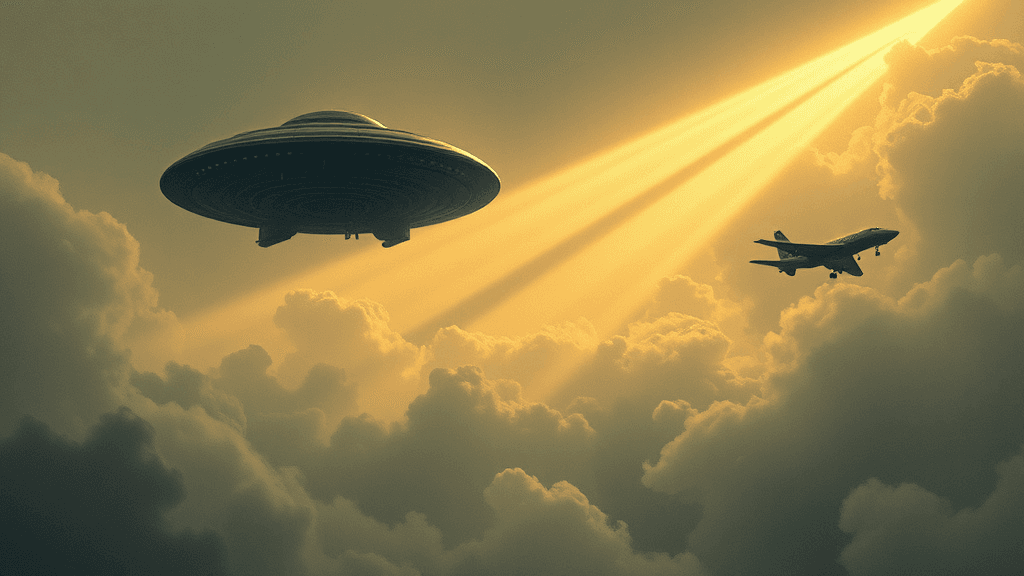
The UFO Library: Military encounter
Manises UFO Incident
On 11 November 1979 the crew of TAE Flight JK-297, carrying 109 people, reported red lights pacing their Super Caravelle near Ibiza and diverted to Manises; an Air Force Mirage F1 sent to intercept them was likewise outpaced, in what Spaniards call their most famous UFO case.
Background
In late 1979 Spain was a young democracy. Franco had died in 1975, a constitution had been approved in 1978, and the armed forces were still adjusting to civilian oversight. Spanish ufology had a recent history of airborne cases, including the 1968 Canary Islands sightings and the chain of reports collected by researchers such as Antonio Ribera and J. J. Benítez. The wider Mediterranean theatre was also unusually busy for military aviation. The Iranian hostage crisis had begun on 4 November 1979, only a week earlier, and elements of the US Sixth Fleet were operating in the western Mediterranean with electronic-warfare equipment, a detail that later became part of the debate over what happened.
The aircraft involved was a Sud Aviation Caravelle (the 'Super Caravelle' variant), operated by the Spanish charter carrier Transportes Aéreos Españoles (TAE). On Sunday 11 November 1979 it flew as Flight JK-297, a charter that departed Salzburg, Austria, and made a technical stop at Palma de Mallorca before heading for the Canary Islands (Las Palmas de Gran Canaria in most accounts; one press account says Tenerife). It carried 109 people, mostly tourists returning from or heading to holidays. In command was Captain Francisco Javier Lerdo de Tejada, a veteran airline pilot. Accounts differ on small details of the route, and the sources available are mostly press reconstructions and later Spanish ufological research, so the narrative below flags where they disagree.
Events
The sighting. At about 23:00 local time (some accounts say nearer midnight), roughly ten miles from Ibiza and cruising at about 28,000 feet, the crew saw red lights ahead that at first looked like an aircraft approaching on a collision course. Lerdo de Tejada called the air-traffic control centre in Barcelona to ask about traffic. Neither Barcelona nor the military radar at Torrejón de Ardoz near Madrid could account for any aircraft in that position.
The lights did not behave like conventional traffic. According to the usual retelling, when the captain changed altitude the lights mirrored the manoeuvre, keeping station about half a kilometre (500 metres) from the aircraft. They followed the airliner for something like seventy miles. A recording of the radio exchange, widely quoted in Spanish media, has the captain saying, in effect, that the object was much faster than the airliner and getting closer all the time, and that he was heading for Valencia ('Es mucho más rápido que nosotros y se acerca cada vez más. ¡Me voy para Valencia!'). Manises airport director Miguel Morlán later said that five lights, not one, were seen following the aircraft.
The diversion. Judging evasive action futile, the crew abandoned the Canaries leg and requested permission to land at Manises, the Valencia airport, which at the time also served military traffic. In most versions the lights disappeared shortly before touchdown; the aircraft landed safely, and the 109 occupants were unharmed though shaken. In the accounts based on ground reports, radar operators at the airport then saw three new echoes, each estimated at about 200 metres across, one of which passed close to the runway, prompting the emergency lighting to be switched on. This detail rests on secondary reporting and is not confirmed by the declassified file (see below).
The scramble. Alerted by the incident, the Spanish Air Force launched a Dassault Mirage F1 interceptor from Los Llanos air base at Albacete, flown by Captain Fernando Cámara. His account, repeated in interviews over decades, is the most dramatic element of the case. He described the object as a truncated cone or an 'inverted cup without a base' that changed colour, and said it kept its distance whenever he accelerated; at one stage he pushed the F1 to about Mach 1.4. Cámara also reported that when he closed on the object his avionics were jammed and his warning system indicated a missile-radar lock-on. He chased the lights toward Menorca for about an hour and a half before low fuel forced him back; in some versions he was subsequently vectored to overfly Sagunto, north of Valencia, where a further echo or light was reported and again drew away from him as he approached. Dozens of personnel at the base, according to press accounts, noticed something unusual in the sky that night.
Investigation
Political attention. The incident was reported in the Spanish press within days; El País ran a report headlined that a 'UFO' had forced a Caravelle to land at Manises. Interest turned political in 1980, when Socialist deputy Enrique Múgica Herzog, later Spain's Ombudsman, asked the government in parliament for an explanation. According to the accounts available, the government's answer was dismissive, referring to optical illusions, and the Defence Ministry said it could not determine the origin of the traffic. The long reticence of the armed forces fed a widespread suspicion that more was known than was being said.
Declassification. Spain was unusually open about its UFO files. Under a programme that began in 1991, the Air Force transferred its UFO reports to the public domain in batches covering roughly 1962 to 1995. The Manises file was prepared in 1994 and released in the mid-1990s (Wikipedia cites a report of the Biblioteca Central del Ejército del Aire dated 1996; some press accounts say 1994, which probably reflects the date of the file's compilation). The 1994 file concluded that the lights seen over the region by several people at various hours were of unknown origin operating in uncontrolled airspace, and it stated that no physical presence could be confirmed. A recent summary of the file in El Debate records that 'no radar contact was made with any object', though it does note radio interference and 'blockages' in the aircraft's alert system, and that Cámara's progress toward the lights was 'not at all appreciable'. El Debate notes that the Defence Ministry has since released further batches of UFO reports (80 reports, almost 2,000 pages, in a recent tranche).
Note the tension between the popular narrative, in which radar at Torrejón tracked mysterious echoes, and the official file, which says there was no radar contact. The 1980s retellings of radar confirmation come from ufological books rather than the file itself, and readers should treat claims about 'three 200-metre radar targets' with caution.
Civilian research. The first book-length treatment was Incidente en Manises (1980) by J. J. Benítez, who presented the event as a genuine unknown and helped fix the case in the public imagination. The Spanish ufologist Juan Antonio Fernández Peris, an agricultural engineer, later produced a roughly 200-page analysis, El expediente Manises (2000, Fundación Anomalía), summarised in English as 'The Manises UFO File' in 1999. His conclusion was sceptical: he proposed that the airline crew and controllers were misled by flashes from a distant chemical-industry complex some 160 km away, combined with stars and planets. The Air Force file carried a similar suggestion, which the crew and fighter pilot always rejected.
The case for / against
For an anomaly. The case has some features seldom found together. The primary witnesses were trained professionals: an experienced airline captain and his crew, and a military fighter pilot. The pursuit was recorded on radio tape. A military interception was ordered in real time, and the pilot reported equipment effects. The incident produced a parliamentary question and an official file. Spanish writers, including the journalist who titled a 2009 El Mundo retrospective 'Caso Manises, descanse en paz', routinely call it the most famous UFO case in Spain, and international popular accounts often call it the only time a commercial flight was forced to land by a UFO. The latter is a boast rather than a verified fact: nobody has systematically catalogued every diversion, and the claim says more about the case's fame than about its uniqueness.
Against an extraordinary interpretation. Several points cut the other way. First, the key radar evidence is weak or absent in the official record. Second, the visual evidence is of lights at night over water, a setting in which distance, speed and relative motion are notoriously hard to judge from a moving aircraft; lights that appear to 'follow' a plane for seventy miles are the classic signature of a distant source, such as a bright planet or a ground light, whose bearing barely changes. Third, the electronic effects Cámara reported coincide with the presence of the US Sixth Fleet's electronic-warfare activity during the Iran crisis. Cámara has rejected this, saying the fleet was too far away and the jamming occurred as he tried to lock on, but the coincidence of timing and region invites a conventional military explanation, perhaps an exercise or radar emission that nobody wished to discuss. Fourth, the chemical-complex hypothesis is unusually specific and has been criticised as strained; the distance is very large, and the crew rejected it.
On balance the case is best described as a well-reported event with a contested and unresolved explanation. Whatever the lights were, the human experience was real: trained pilots believed they were in danger, acted on it, and stuck to their accounts for decades.
Cultural impact
Manises became the touchstone of Spanish ufology. It spawned books, documentaries, radio programmes and anniversary retrospectives; the radio tape in particular has been replayed repeatedly in Spanish media. It is closely tied to the story of how Spain came to release its UFO archive in the 1990s, and it is often cited, alongside the French COMETA report, in discussions of European officialdom taking pilot reports seriously.
The case has also been used as a case study in how stories mutate. Early reports spoke of red lights; later retellings added radar echoes, a three-object formation, a perfectly shaped cone, and lock-on warnings, with the details growing more dramatic in each telling. That drift is a useful reminder when reading any account, including this one, that derives from press reports rather than the original tapes.
Current status
The Manises incident remains officially unexplained in the sense that the Spanish authorities never settled on a conventional cause, while a sceptical explanation (distant industrial flashes plus astronomical objects) exists and is rejected by the witnesses. The Ministry of Defence's online archive of declassified UFO reports allows anyone to read the formal file, although the more spectacular elements of the story, such as the jamming of the Mirage's systems, are partly omitted from the public version according to Wikipedia. Captain Cámara has told his story in numerous interviews, including a 2015 Cadena SER piece, and has not retracted it. The case continues to be discussed whenever pilots' encounters with unidentified objects return to the headlines, as they have since 2017, and it is generally ranked as one of Europe's best-known military and aviation UFO episodes. Absent the original radar and tape data in full, a definitive answer is unlikely.
Witnesses
Captain Francisco Javier Lerdo de Tejada — TAE pilot-in-command; reported the approaching red lights, consulted Barcelona control and diverted to Manises
TAE flight crew — corroborated the sighting from the flight deck
109 passengers and crew aboard — the number of occupants reported; the available accounts give little first-hand passenger detail
Captain Fernando Cámara — Spanish Air Force Mirage F1 pilot from Los Llanos (Albacete); chased the lights for about 90 minutes and reported avionics interference
Miguel Morlán — director of Manises airport; said five lights followed the aircraft
Enrique Múgica Herzog — PSOE deputy who raised the case in parliament in 1980
Air base personnel — press accounts say dozens at the base noticed something unusual
Evidence
Radio recordings: the cockpit-to-ATC exchange, in which the captain says the object is faster than the aircraft and he is diverting to Valencia, is widely quoted and replayed in Spanish media
Pilot testimony: Captain Cámara's repeated accounts of a colour-changing cone-shaped object, avionics jamming and a missile-lock warning
Official file: declassified Spanish Air Force file (prepared 1994, public by 1996) records unidentified lights of unknown origin, radio interference and alert-system blockages, but states no radar contact with any object was made; some elements about the fighter's difficulties were reportedly omitted from the public release
Disputed radar claim: popular accounts of three ~200 m radar echoes near Manises are not supported by the declassified file
Counter-analysis: Fernández Peris's sceptical report (flashes from a distant chemical plant, stars and planets); possible US Sixth Fleet electronic-warfare activity as the cause of the jamming
Filed under
Watch
Los secretos extraterrestres del caso Manises | Extraterrestres: Ellos están entre nosotros
Caso Manises: así cuenta un testigo lo ocurrido | Extraterrestres: Ellos están entre nosotros
The First Commercial Flight Grounded Due to UFOs
The UFO that Shocked an Entire Continent - Manises UAP incident in Europe | TAE Flight 297
Spain’s Most Terrifying UFO Incident - The Manises UFO
Where this entry came from
ProvenanceAgent indexedUpdated 3w ago7 sources
Drafted by the archive's AI research agent from the sources below; corrections from readers are reviewed and folded in.
- First indexed
- 06 AUG 26 // 12:21Z
- Last updated
- 21 OCT 26 // 16:44Z
- Manises UFO incident, Wikipedia
- Siete expedientes OVNI de la Comunidad Valenciana desclasificados por el Ministerio de Defensa, El Debate
- El avión que aterrizó en Manises por persecución extraterrestre, El Tiempo
- UFO sightings in Spain, Wikipedia
- The Manises UFO Incident. A Close Encounter at 28,000 Feet, Ryan Sprague, Medium
- The Flight JK297 UFO Incident – The Manises Case, UFO Insight
- The Manises Case. The best UFO case ever, Galán Vázquez, Medium
Notes
- Manises UFO incident, Wikipedia
- Siete expedientes OVNI de la Comunidad Valenciana desclasificados por el Ministerio de Defensa, El Debate
- El avión que aterrizó en Manises por persecución extraterrestre, El Tiempo
- UFO sightings in Spain, Wikipedia
- The Manises UFO Incident. A Close Encounter at 28,000 Feet, Ryan Sprague, Medium
- The Flight JK297 UFO Incident – The Manises Case, UFO Insight
- The Manises Case. The best UFO case ever, Galán Vázquez, Medium
Also available

Out of the Blue
A comprehensive investigation into the UFO phenomenon featuring interviews with high-ranking military and government officials, scientists, and witnesses of major UFO incidents worldwide. Examines credible cases including aviation encounters and government responses to UFO reports.

I Know What I Saw
Documentary compilation of eyewitness testimonies from military pilots, astronauts, and credible observers of UFO incidents. Focuses on documented cases where highly trained witnesses provided firsthand accounts of unidentified aerial phenomena, including aviation-related encounters.

The Phenomenon
Documentary examining decades of unidentified aerial phenomena reports, featuring testimony from government officials, military witnesses, and NASA astronauts. Investigates multiple UFO incidents and explores the government's classified research into unexplained aviation encounters.

UFOs: Investigating the Unknown
National Geographic docuseries led by investigative journalist Leslie Kean examining decades of government investigation into UFOs. Series explores major incidents, classified programs, and testimony from military and government officials regarding unidentified aerial phenomena.
Buying through these links supports the library. We may earn a commission.