The UFO Library: Photograph or film
Gulf Breeze UFO Flap
Local contractor Ed Walters claimed to photograph a UFO 32 times over several months; sparked a genuine mass wave of sightings across the community but Walters' own photographic evidence was exposed as a probable hoax when a styrofoam model was discovered in his former attic in 1990.
Background
Gulf Breeze, Florida, is a small, prosperous city of roughly 6,000 people perched on a peninsula between Pensacola Bay and the Gulf of Mexico. In 1987 it was an unremarkable suburban community, home to retirees, Navy families, and the kind of quiet civic life that makes subsequent national attention feel all the more surreal. The nearest major installation, Pensacola Naval Air Station, sits just across the bay — a detail that would later be used both to explain anomalous aerial sightings as classified military aircraft and to suggest that unusual activity in the area was monitored or even orchestrated by the government.
The broader UFO scene in late 1987 was one of growing popular interest. Steven Spielberg's Close Encounters of the Third Kind (1977) and E.T. (1982) had shaped mass cultural expectations of what a UFO encounter looked and felt like. Whitley Strieber's Communion, published in January 1987, had spent weeks on the New York Times bestseller list. The climate was ripe for a dramatic new case — and Gulf Breeze provided one.
Events
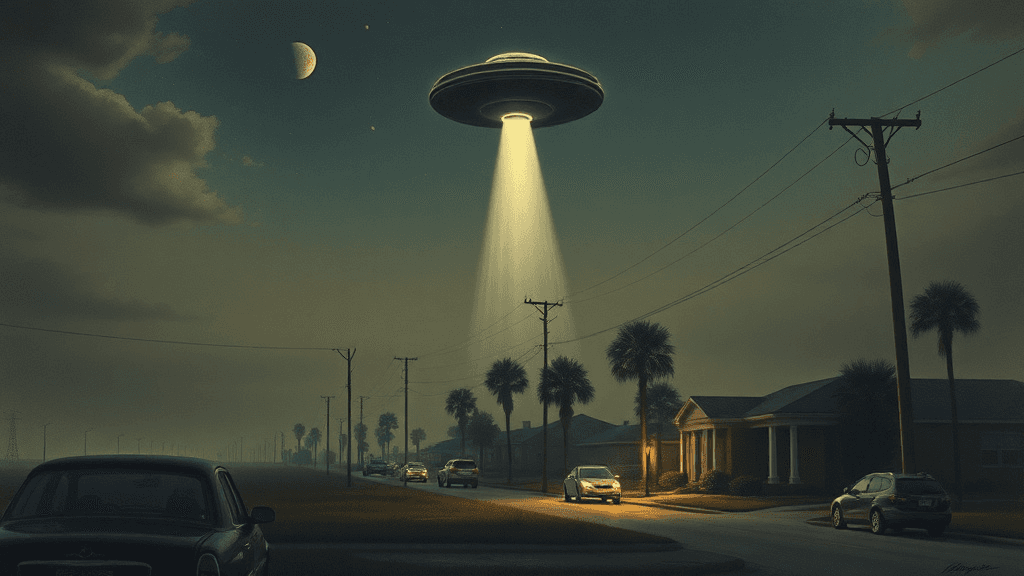
On the evening of November 11, 1987, Ed Walters, a 37-year-old building contractor and real estate developer known locally as a civic booster and amateur photographer, reported that a glowing disc hovered over his home on Jamestown Drive. He described being struck by a blue beam that briefly paralyzed him. In a state of panic, he grabbed his Polaroid OneStep camera — a manual model that he happened to have on hand — and fired off five photographs before the object moved away.
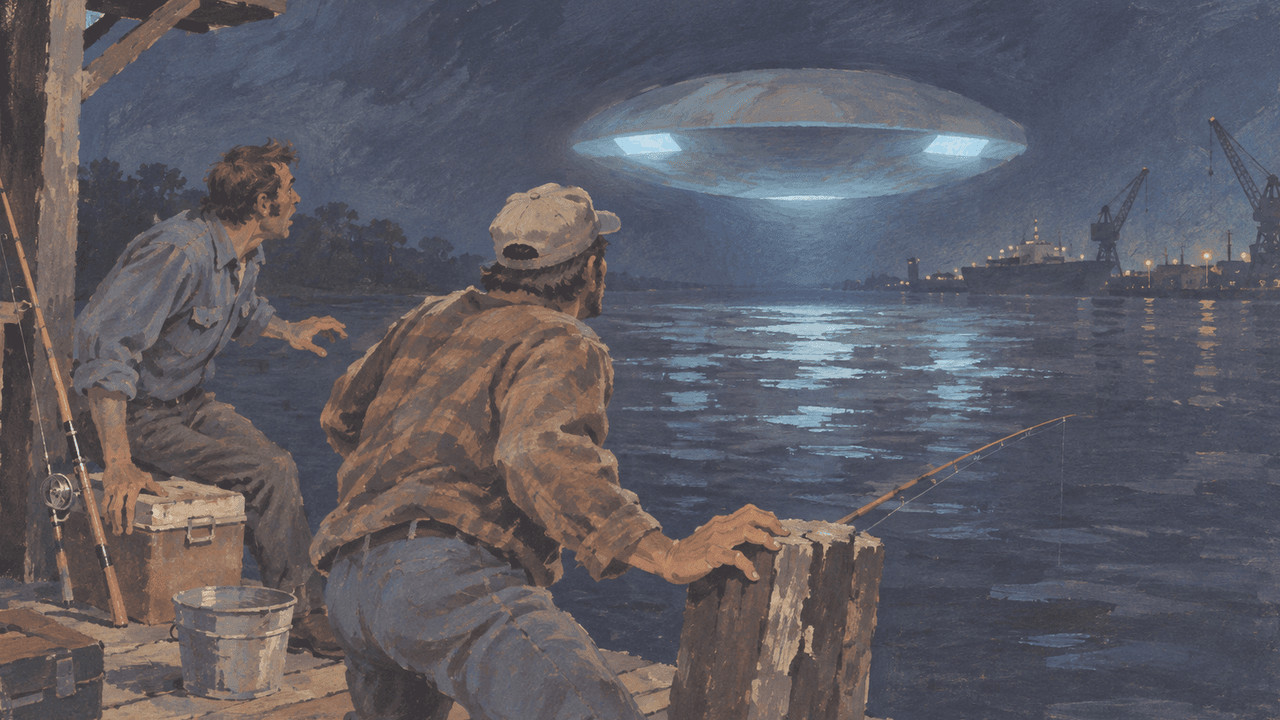
Walters did not immediately identify himself. Instead, he slipped an anonymous letter and the photographs to Duane Cook, editor of the small-circulation Gulf Breeze Sentinel newspaper, signed only "Mr. X." Cook published them. The community response was electric. Within days, Walters came forward under the alias "Mr. Ed," and over the following months he claimed 19 distinct encounters and produced a total of 32 photographs plus video recordings of the same disc-shaped craft — flat on the bottom, domed on top, rimmed with light ports, and emitting a glowing blue beam beneath.
As the months passed, Walters' narrative grew considerably more elaborate. He claimed the craft had landed on Soundside Drive and deposited five humanoid entities. He reported receiving telepathic messages in both English and Spanish from the beings, who at one point showed him a book filled with images of dogs. He described a persistent mental voice — he called it a "hum" — that preceded each appearance. In total he described being subjected to physical examinations and emotional terror across his encounters, which, combined with the Polaroid evidence, gave the case a rich texture of personal testimony layered over documentary images.
The Sentinel published photographs steadily from November 1987 through early 1988. As word spread, the Gulf Breeze area experienced a genuine mass sighting wave. Between late 1987 and mid-1988, over 135 residents — including a Florida Highway Patrol sergeant, schoolteachers, clergy, and retirees — independently reported seeing unusual aerial lights over the bay. These accounts came from people with no connection to Walters and pre-dated or ran concurrent with his reports. The Mutual UFO Network (MUFON) logged and catalogued the incoming reports, eventually holding their annual symposium in Pensacola in part because of the local excitement.
Investigation
The case attracted investigators from across the spectrum almost immediately.
Bruce Maccabee, an optical physicist employed by the U.S. Navy and a respected figure in civilian UFOlogy, subjected five of the early Polaroids to densitometric analysis and geometric triangulation. He concluded there was "a good chance it's the real thing," arguing that the images showed a solid, self-luminous object whose perspective geometry was consistent across frames — something he said a simple double-exposure hoax would struggle to replicate. Maccabee also advised Walters to adopt the Stereo Ring Sight (SRS) method, mounting two Polaroid cameras on a fixed beam to allow parallax-based distance triangulation for future photographs. The SRS images, taken in subsequent weeks, were likewise declared consistent with a genuine unknown object.
Meanwhile, MUFON director Walt Andrus threw the organisation's support behind Walters, facilitating his participation in conferences and helping coordinate investigation teams on the ground. UFO researcher and abduction specialist Budd Hopkins interviewed Walters repeatedly and cited his apparent reluctance for publicity — noting that Walters had initially turned down a reported $100,000 book deal — as a mark of sincerity. In February 1988, Walters underwent a polygraph examination; the examiner concluded that "Walters believes his photos are real" — a finding that satisfied some supporters but was quietly noted by critics as far short of confirming the photographs' authenticity.
Opposition was equally determined. Dr. Willy Smith, a physicist sympathetic to UFO research but unwilling to endorse sloppy evidence, published a 26-page technical report in September 1988 identifying what he called "telltale signs of double-exposure trickery" in the Walters photographs. Smith noted that Walters' particular Polaroid model was mechanically well-suited to double exposures, and that the depicted craft appeared asymmetrical in early images but more symmetrical in later ones — a discrepancy inconsistent with the same physical object being repeatedly photographed. The Center for UFO Studies (CUFOS), then regarded as the more scientifically rigorous of the major UFO organisations, published a Special Bulletin declaring the case an apparent hoax — an unusual step for an organisation ordinarily cautious about dismissing claims.
NASA analyst Robert Nathan of the Jet Propulsion Laboratory examined the images and concluded they showed signs of double-exposure and paste-up manipulation. Gulf Breeze Mayor Ed Gray separately concluded the photographs were fraudulent. MUFON investigators Rex and Carol Salisberry, working independently, reached the same double-exposure conclusion. Forensic imaging expert William G. Hyzer likewise confirmed the hoax hypothesis after technical examination of the originals. Skeptic Philip Klass, though he noted the Gulf Breeze case was not among the cases he found "genuinely impressive," eventually scrutinised the physical evidence found in 1990.
The Case For and Against
The case for authenticity rests on several pillars that supporters still cite. The mass sightings by 135-plus independent witnesses are difficult to explain away entirely — these people had no obvious motive to fabricate reports and no foreknowledge of Walters' specific claims. The Florida Highway Patrol sergeant among them adds a degree of official weight. Maccabee's technical analysis, for all its subsequent embarrassment, was conducted by a qualified physicist using legitimate methods. Walters' own polygraph result, while not conclusive, does suggest he was not consciously lying in the test setting. Supporters note that the model found in 1990 could theoretically have been planted — Gulf Breeze was a media circus by then, and Walters had made enemies.
The case against is substantially stronger. The Willy Smith double-exposure report predates the model discovery and represents an independent technical conclusion from a pro-UFO source. The Tommy Smith testimony is particularly damaging: Gulf Breeze attorney Tom Smith held a press conference under oath, stating that his son Tommy Jr. had been told by Walters more than two years before the first publication that he intended to stage a UFO hoax for profit. Tommy Jr. later appeared on camera confessing to personally assisting with the creation of double-exposure photographs. The model's architectural plans, found inside it when it was recovered from the attic, were traced by Klass to a home Walters had constructed in early 1987 — months before the alleged first encounter, suggesting the model was made by Walters himself well in advance. The claim that debunkers or the government planted the evidence was never supported by any evidence of a break-in at the property.
Bruce Maccabee's financial relationship with the case — reportedly receiving 10% of Walters' book advance in exchange for his endorsement — was revealed later and raised serious questions about the independence of his analysis. Walters and Frances Walters went on to publish The Gulf Breeze Sightings (1990, with William Morrow), collecting a commercial windfall from precisely the kind of public interest the original hoax had been designed to generate.
Cultural Impact
The Gulf Breeze case had an outsized influence on UFO culture throughout the late 1980s and 1990s. The Gulf Breeze Sentinel's willingness to publish the photographs — and the national and international press pickup that followed — demonstrated that a local newspaper, a Polaroid camera, and a compelling storyteller could generate months of global media attention. Producers for the syndicated TV special UFO Cover-Up? Live! (1988), hosted by Mike Farrell, featured the Gulf Breeze evidence prominently. The premiere episode of the revived Unsolved Mysteries (1988) devoted a segment to the sightings, reaching tens of millions of viewers.
Gulf Breeze itself became a UFO tourism destination. Regular skywatch gatherings formed along the waterfront, drawing enthusiasts from across the country. The MUFON annual symposium was held in Pensacola in 1990, cementing the region's place in the UFOlogy calendar. Walters gave lectures, appeared on talk shows, and became one of the most recognizable faces of the early 1990s UFO circuit. Even after the model discovery, a significant portion of the UFO community — particularly MUFON's leadership — maintained that the evidence against Walters was planted, and the case remained a touchstone of internecine argument within the field for years.
For skeptics, Gulf Breeze became an equally important reference case — evidence that motivated, media-savvy hoaxers could fool trained researchers, pass lie detector tests, and profit handsomely. The case features prominently in Joe Nickell's and Philip Klass's writings on UFO photography as a case study in the limitations of photographic analysis without chain-of-custody controls.
The disentanglement problem — that a genuine wave of unexplained sightings may have occurred in the Gulf Breeze area at roughly the same time as Walters' fabrication — remains genuinely interesting. The mass sightings that preceded and ran parallel to his claims were not manufactured by Walters and have never been fully explained. Some researchers argue this explains why so many credible people found the overall case compelling: they were responding to real phenomena, and Walters simply exploited that real phenomena for personal gain.
Current Status
Ed Walters continues to maintain that his photographs are genuine and that the foam model was planted by those seeking to discredit him. He has never been charged with fraud. Frances Walters has corroborated his account throughout. MUFON's official position remains one of support for the case, though mainstream UFO researchers have largely moved on.
In UFO scholarship, Gulf Breeze is now most often cited as a cautionary tale about investigative standards — particularly regarding chain-of-custody for photographic evidence, the risks of financial entanglement between researchers and witnesses, and the challenge of separating a possible genuine anomalous wave from deliberate fabrication built on top of it. The case also anticipated later debates about the role of commercial incentives in shaping UFO testimony: Walters' book advance, lecture fees, and media appearances demonstrated that UFO celebrity could be a viable income stream, a lesson not lost on subsequent claimants.
The independent sightings by over 135 Gulf Breeze residents between 1987 and 1988 remain unexplained by any official body. Pensacola NAS never issued a statement accounting for them. Whether they reflect misidentification of conventional aircraft and natural phenomena, classified military testing, or something else entirely, the record does not say.
Witnesses
Over 135 independent Gulf Breeze residents reported sightings during the 1987–1988 wave, including a Florida Highway Patrol sergeant, schoolteachers, clergy, and retirees with no connection to Walters. Community members reported glowing discs, beams of light, and low-flying objects over Pensacola Bay.
Evidence
32 Polaroid photographs and video footage claimed by Ed Walters (technical analysis by multiple experts indicates double-exposure fabrication); Stereo Ring Sight (SRS) photographs taken with dual-camera rig; styrofoam/foam model UFO found in Walters' attic by new homeowners on June 10, 1990 (architectural plans inside dated to early 1987); 26-page technical report by Dr. Willy Smith (September 1988) identifying double-exposure anomalies; analyses by Robert Nathan (NASA JPL), Rex and Carol Salisberry (MUFON), William G. Hyzer (forensic imaging), and Bruce Maccabee (initially supportive, later embarrassed); on-camera confession by Tommy Smith Jr. to co-creating the hoax; press conference testimony under oath by attorney Tom Smith.
Filed under
Watch
Video captures flying objects that officials can't explain (2020)
4th UFO shot down by US military in 9 days
Revisiting The Gulf Breeze UFO Sightings || A YouTube Documentary
CREEPS & MONSTERS Ep. 1 / The Gulf Breeze UFO Sightings
1952 UFO Sighting is Oldest Caught on Camera | The Proof Is Out There (Season 4) | History
Where this entry came from
ProvenanceAgent indexedUpdated 5mo ago8 sources
Drafted by the archive's AI research agent from the sources below; corrections from readers are reviewed and folded in.
- First indexed
- 02 JUN 26 // 02:18Z
- Last updated
- 05 JUN 26 // 04:46Z
- Gulf Breeze UFO incident, Wikipedia contributors, Wikipedia
- Gulf Breeze UFO Hoax, Gary P. Posner, GP Posner — Skeptical Analysis
- Gulf Breeze UFO Wave (1987), Project: Unredacted, Project: Unredacted
- The Gulf Breeze UFO Incident, UFO Pensacola Beach, UFO Pensacola Beach
- The Gulf Breeze UFO Incident, PensacolaBeach.com, PensacolaBeach.com
- Gulf Breeze UFO, Unsolved Mysteries Wiki contributors, Unsolved Mysteries Wiki
- UFO Cover-Up? Live! (1988 TV Special), Martin Pasetta (dir.), Internet Archive
- The Gulf Breeze, Florida UFOs (Ed Walters), B.J. Booth, UFO Casebook
Notes
- Gulf Breeze UFO incident, Wikipedia contributors, Wikipedia
- Gulf Breeze UFO Hoax, Gary P. Posner, GP Posner — Skeptical Analysis
- Gulf Breeze UFO Wave (1987), Project: Unredacted, Project: Unredacted
- The Gulf Breeze UFO Incident, UFO Pensacola Beach, UFO Pensacola Beach
- The Gulf Breeze UFO Incident, PensacolaBeach.com, PensacolaBeach.com
- Gulf Breeze UFO, Unsolved Mysteries Wiki contributors, Unsolved Mysteries Wiki
- UFO Cover-Up? Live! (1988 TV Special), Martin Pasetta (dir.), Internet Archive
- The Gulf Breeze, Florida UFOs (Ed Walters), B.J. Booth, UFO Casebook
Also available
UFO Cover-Up? Live!
A two-hour television special hosted by Mike Farrell featuring the Gulf Breeze UFO case alongside government documentation on UFO suppression and evidence of alien contact.
Creeps & Monsters: The Gulf Breeze UFO Sightings
An investigative documentary by filmmaker Dan Bell examining the 1987 Gulf Breeze UFO photographs and Ed Walters' claims, analyzing the evidence and controversy surrounding the incident.
Unsolved Mysteries: Episode 1
The premiere episode of the iconic documentary series features a segment on the Gulf Breeze UFO sightings of November 1987, including eyewitness accounts and photographs taken by Ed Walters.
UFO Hunters: Season 3, Episode 4 - Underwater Alien Bases
History Channel investigators Bill Birnes, Patrick Uskert, and Kevin Cook examine the Gulf Breeze UFO sightings and their potential connection to underwater alien bases near Guantanamo Bay, Cuba.
Strange But True?: Gulf Breeze UFO Incident
This ITV documentary episode investigates the famous Gulf Breeze UFO photographs from 1987, featuring interviews with Ed Walters and UFO researcher Bruce Maccabee analyzing the controversial evidence.
Buying through these links supports the library. We may earn a commission.