The UFO Library: Mass sighting
Canary Islands UFO Incident
Over 40 minutes on June 22, 1976, hundreds of military and civilian witnesses across the Canary Islands observed a massive luminous phenomenon estimated to have been seen by over one million people.
The Phenomenon
On the evening of June 22, 1976, residents across the Canary Islands witnessed an extraordinary aerial display. Beginning around 21:16 local time and lasting approximately 40 minutes, a massive luminous object appeared over the Atlantic, visible across multiple islands: Tenerife, La Palma, La Gomera, Gran Canaria, and even from sea observers. Witnesses variously described the phenomenon as a "gigantic explosion of light," a "massive ball of fire," and an expanding semicircular halo of brilliance with striking color shifts from bluish-white to intense red. The scale was remarkable—authorities later estimated the phenomenon was observed by over one million residents across all seven Canary Islands, making it one of the most widely witnessed UFO incidents of the 20th century.
The phenomenon's progression was notable: it began as a single bright point, gradually expanding into a massive glowing sphere that dimmed and brightened, shifting colors throughout its duration, before gradually fading into darkness after roughly 40 minutes. The display was visible across an enormous geographic area, suggesting an object of extraordinary size or an atmospheric phenomenon affecting a vast region.
Witness Accounts
Among the most detailed accounts came from military sources. The Spanish Navy corvette Atrevida, positioned off the coast of Fuerteventura, provided one of the most credible official observations. Naval personnel documented the event systematically, offering technical descriptions that added weight to civilian reports.
One of the most extraordinary civilian accounts involved a medical doctor and a taxi driver who reported observing a transparent sphere from which two tall, humanoid entities were visible. This account received significant attention despite being considered problematic by military investigators; military judge Antonio Munaiz, who conducted the Spanish Air Force's formal investigation, noted skepticism about the occupant claim, though he documented it thoroughly. The account nonetheless exemplifies the range of witness testimony gathered—from standard light sightings to claims of observed craft and occupants.
Civilian reports consistently emphasized the phenomenon's visual intensity and the emotional impact of witnessing something so extraordinary. Many observers expressed confusion and concern, with some believing they were witnessing a catastrophic event or military activity. The scale of civilian engagement—with hundreds of spontaneous reports flooding authorities—underscored the event's genuine impact on the population.
Official Investigation
The Spanish Air Force took the sighting seriously and officially commissioned an investigation. On June 25, 1976, just three days after the incident, the commanding general of the Spanish Air Force's Canary Islands Air Zone assigned an investigative adjutant to conduct depositions and gather evidence. At least fourteen key witnesses were formally interviewed, and their accounts were compiled into an official report.
The report was declassified in June 1994, though much of its content had entered the public domain earlier. In 1977, journalist and paranormal investigator J. J. Benítez obtained a copy of the official Spanish Air Force report and used it as the basis for a published work on UFO cases, bringing the incident to wider attention. The existence of a formal, declassified military investigation lent credibility to the incident—this was not merely a collection of anecdotal reports, but a documented military investigation of a significant aerial phenomenon.
The Missile Explanation
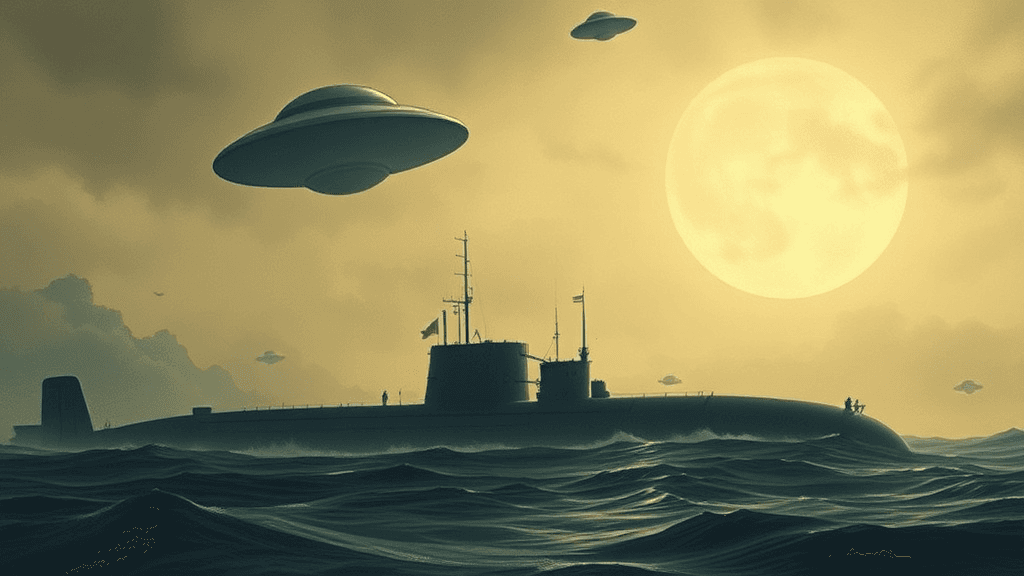
Decades later, in 2001, researchers Vicente-Juan Ballester Olmos and Ricardo Campo Pérez published a paper in the Revista de Aeronáutica y Astronáutica (the official journal of the Spanish Air Force) proposing an alternative explanation: the USS Von Steuben, a U.S. Navy ballistic missile submarine, had conducted a Poseidon C-3 missile test on June 22, 1976, at 20:16–20:17 GMT (21:16–21:17 local Canary Islands time), positioned approximately 762 kilometers west of the islands.
According to their analysis, the missile detonated at an altitude of roughly 90 kilometers, well above the thermosphere, where it would remain in direct sunlight while the Canary Islands had descended into evening twilight. This created an optical illusion known as the "twilight phenomenon" or "space jellyfish" effect—expanding rocket gases illuminated by the sun, creating an extraordinarily large and luminous expanding sphere visible across a vast area. The mechanism is plausible: rockets launched from twilight zones do produce striking optical effects visible across hundreds of kilometers, and the Canary Islands' location and local time would have created precisely the conditions for such an effect to be maximally visible.
This explanation has gained acceptance among skeptical researchers, though it remains contested by ufologists who argue the timing or other details do not align perfectly with the observed phenomenon.
Witnesses
- Spanish Navy corvette Atrevida crew (military observers)
- Medical doctor and taxi driver (claimed observation of transparent sphere with occupants)
- Hundreds of civilian witnesses across Tenerife, La Palma, La Gomera, Gran Canaria
- Estimated 1+ million residents across the Canary Islands
- 14+ formally interviewed in Spanish Air Force investigation
Evidence
- Declassified Spanish Air Force official investigation report (released 1977, formally declassified 1994)
- Military corvette Atrevida logs
- Civilian witness depositions
- Multiple contemporary news accounts
- 2001 technical analysis of Poseidon missile test hypothesis by Ballester Olmos and Campo Pérez
Filed under
Watch
Ep. 10 | The Basement Office | UFO sightings with aliens | Close Encounters | New York Post
UFO Sighting Over the Canary Islands is Next Level Strange
Tenerife’s Strangest Valley – UFOs, Lost Time & The Girl with the Pears
Curiosidades científicas: Un OVNI en las Islas Canarias - Órbita Laika - La 2
Where this entry came from
ProvenanceAgent indexedUpdated 2mo ago4 sources
Drafted by the archive's AI research agent from the sources below; corrections from readers are reviewed and folded in.
- First indexed
- 31 AUG 26 // 15:19Z
- Last updated
- 31 AUG 26 // 15:19Z
- The 1976 Canary Islands Sphere Incident, UFO Insight, UFO Insight
- Canary Islands 1976: The UFO Seen by a Million Witnesses, The Exclusion Zone, The Exclusion Zone
- Canary Islands 1976, Metabunk, Metabunk
- ¡Identificados! Los OVNIS de Canarias fueron misíles Poseidón, Vicente-Juan Ballester Olmos, Ricardo Campo Pérez, Academia.edu / Revista de Aeronáutica y Astronáutica
Notes
- The 1976 Canary Islands Sphere Incident, UFO Insight, UFO Insight
- Canary Islands 1976: The UFO Seen by a Million Witnesses, The Exclusion Zone, The Exclusion Zone
- Canary Islands 1976, Metabunk, Metabunk
- ¡Identificados! Los OVNIS de Canarias fueron misíles Poseidón, Vicente-Juan Ballester Olmos, Ricardo Campo Pérez, Academia.edu / Revista de Aeronáutica y Astronáutica
Also available

The Phenomenon
Comprehensive documentary covering UFO history from WWII to the present, featuring declassified Pentagon footage and interviews with military officials, former government insiders, and key witnesses. Explores multiple UFO incidents including government cover-ups and scientific evidence.

Unidentified: Inside America's UFO Investigation
Two-season documentary series featuring former Defense Intelligence Agency official Luis Elizondo investigating classified UFO incidents and Pentagon programs. Combines declassified footage, military testimonies, and government analysis of unidentified aerial phenomena.
UFOs: Investigating the Unknown
Multi-season National Geographic series examining UFO incidents from around the world through scientific investigation and expert analysis. Covers military encounters, declassified cases, and contemporary UAP sightings with structured investigative methodology.
Overlords of the U.F.O.
1970s documentary examining UFO sightings and putting forth theories about UFO origins and nature. Features analysis of multiple incidents, historical UFO photographs, and investigative examination of alleged alien encounters.
Buying through these links supports the library. We may earn a commission.