The UFO Library: Mass sighting
The Battle of Los Angeles
In the predawn hours of February 25, 1942, U.S. anti-aircraft batteries fired over 1,400 rounds into the sky above Los Angeles at unidentified targets that were never conclusively explained.
Background
The United States in early 1942 was a nation gripped by fear. Barely eleven weeks had passed since the Imperial Japanese Navy's devastating surprise attack on Pearl Harbor on December 7, 1941, which killed over 2,400 Americans and drew the country into the Second World War. Along the Pacific Coast, anxiety ran especially high. Japanese submarines had been spotted operating in coastal waters, attacking merchant shipping from Washington State to Southern California. Rumors of imminent invasion were rampant, and civil defense preparations — blackout drills, air raid warden recruitment, coastal watchtowers — became part of daily life in cities like Los Angeles, San Francisco, and San Diego.
The tension escalated dramatically on the evening of February 23, 1942, when the Japanese submarine I-17 surfaced off the coast near Santa Barbara and shelled the Ellwood Oil Field in Goleta. Though the bombardment caused only minor damage — a few oil derricks and a pump house were hit — it represented the first enemy attack on the continental United States since the War of 1812. The psychological impact was enormous. If Japan could shell an oil field twenty miles from a major American city, what else might be possible? Radio stations broadcast warnings. Military units along the coast were placed on high alert. Southern California held its breath.
It was into this atmosphere of genuine and well-founded dread that the events of February 25 would unfold — an episode so strange, so chaotic, and so poorly explained that it would eventually become one of the most celebrated mysteries in both military history and UFO lore.
Events
At approximately 2:15 a.m. on February 25, 1942, U.S. Army radar stations picked up an unidentified contact roughly 120 miles west of Los Angeles, moving south toward San Diego. Given the previous night's shelling at Ellwood, the operators understandably treated the contact as a potential hostile. At 2:25 a.m., air raid sirens wailed across Los Angeles County. A total blackout was ordered across the metropolitan area — streetlights extinguished, neon signs killed, automobile headlights forbidden. Thousands of civilian air raid wardens rushed to their posts throughout the sprawling city.
For nearly an hour, tension mounted as anti-aircraft batteries tracked reported movements in the sky. Then, at 3:16 a.m., the 37th Coast Artillery Brigade opened fire. The night exploded. Batteries of .50-caliber machine guns and 12.8-pound anti-aircraft shells poured upward into the darkness, their tracers and detonations lighting the sky in a spectacular, terrifying display. Powerful searchlight beams swept the heavens, converging on what gunners believed to be targets above the city.
Over the next hour, approximately 1,400 anti-aircraft rounds were fired. The barrage was not continuous but came in waves, with batteries across a wide swath of Los Angeles County — from Santa Monica to Long Beach — joining in at different times. The firing continued sporadically until roughly 4:14 a.m., though scattered reports of unidentified objects persisted. The all-clear was not sounded until 7:21 a.m., five hours after the initial alarm.
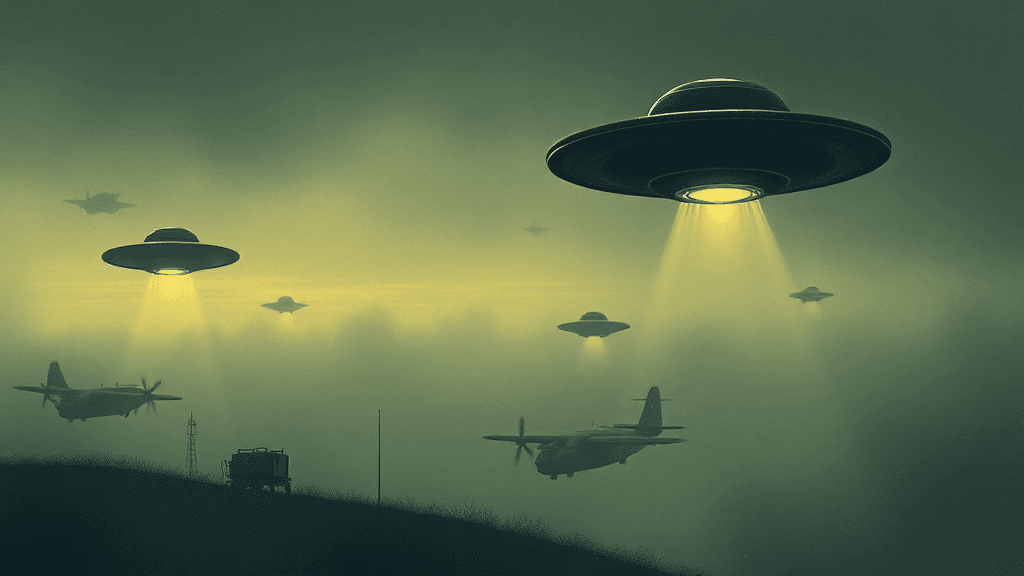
What was actually in the sky that night remains the central mystery. Eyewitness accounts were wildly inconsistent, as might be expected from thousands of frightened civilians and tense military personnel peering upward through smoke, searchlight glare, and bursting shells. Some residents reported seeing planes — anywhere from a handful to two dozen. A few claimed to see aircraft hit and falling in flames, though no wreckage was ever recovered. Others described a single large object, variously characterized as bell-shaped, oblong, or round, estimated at anywhere from 16 to 80 feet across, moving slowly at altitudes between 9,000 and 18,000 feet. Some witnesses, including military observers, saw nothing at all and believed the gunners were firing at phantoms created by searchlight reflections off smoke and shell bursts.
The consequences on the ground were entirely real. Five people died as a direct result of the incident: three were killed in automobile accidents on the blacked-out streets, and two suffered fatal heart attacks attributed to the stress of the bombardment. Numerous others were injured. Falling shell fragments — the inevitable debris of 1,400 rounds fired nearly straight up — rained down across the city, damaging homes, automobiles, and buildings. The irony was inescapable: whatever had been in the sky dropped not a single bomb, while American guns inflicted all of the night's casualties and property destruction.
Investigation
The official response to the Battle of Los Angeles was swift, confused, and contradictory — a pattern that would fuel conspiracy theories for decades.
On February 25, just hours after the all-clear, Secretary of the Navy Frank Knox held a press conference in which he flatly declared the entire episode a "false alarm" attributable to "war nerves." Knox's dismissal enraged the Army, which had been responsible for the anti-aircraft response. The following day, Secretary of War Henry Stimson publicly contradicted Knox, insisting that as many as fifteen unidentified aircraft had been over the city. Stimson floated the theory that enemy agents might have launched commercial aircraft from clandestine airfields in Mexico as part of a psychological warfare operation designed to provoke panic — a claim he later quietly retracted.
Behind the scenes, General George C. Marshall, the Army Chief of Staff, sent a memorandum to President Roosevelt in which he suggested the objects might have been commercial aircraft operated by enemy agents, intended either for reconnaissance or to trigger a panicked response that would disrupt West Coast war production. Marshall acknowledged, however, that no definitive identification of the targets had been made.
The public spectacle of the Navy and War Department openly disagreeing — one saying nothing happened, the other claiming an aerial incursion by up to fifteen aircraft — did little to reassure an already anxious public. Newspapers, particularly the Los Angeles press, reacted with outrage. Some editorials accused the government of concealing an actual enemy attack to avoid panic; others mocked the military for wasting ammunition on imaginary targets. The incident became a political embarrassment.
The 14th Air Interceptor Command officially stated that no American fighter planes had been scrambled during the incident — a curious detail given the apparent seriousness of the air raid alert. The United States Coast Artillery Association later attributed the firing to a weather balloon that had been released and drifted over the city. A 1944 Army Inspector General's confidential memo concluded that the event was caused by a combination of "war nerves" and the misidentification of friendly aircraft and balloons.
The most authoritative retrospective analysis came in 1983, when the Office of Air Force History reviewed the case. Their conclusion was that meteorological balloons, most likely released by the Army itself for weather observations, had triggered the initial alarm. Once the first nervous gunner opened fire, the barrage became self-sustaining: anti-aircraft shell bursts, caught in searchlight beams, were mistaken for additional targets, prompting more firing, which created more apparent targets. The cascade of confusion was compounded by primitive radar technology incapable of distinguishing a balloon from a bomber.
The case for
Despite the official weather-balloon explanation, elements of the Battle of Los Angeles continue to resist tidy resolution, and proponents of more exotic interpretations point to several nagging details.
First, there is the matter of the famous photograph. On February 26, 1942, the Los Angeles Times published what would become one of the most iconic images of the 20th century: a dramatic nighttime shot showing multiple searchlight beams converging on a bright point in the sky above Los Angeles, with the flashes of anti-aircraft bursts visible around it. To UFO researchers, the image appears to show searchlights illuminating a solid, structured object — possibly disc- or bell-shaped — hovering above the city while absorbing tremendous punishment from anti-aircraft fire without effect. The object, they note, was apparently tracked by searchlights for an extended period, suggesting something tangible rather than smoke or cloud reflections.
Second, despite 1,400 rounds being fired, nothing was shot down. If the targets were weather balloons, proponents argue, at least some should have been destroyed by the barrage. A balloon caught in converging searchlight beams and pelted with exploding shells would not plausibly survive for an hour of sustained fire.
Third, the radar contact that initiated the alert was plotted 120 miles west of the city, a location well out to sea. Weather balloons released locally would not have been detected at that range, suggesting the radar operators were tracking something else — something approaching from the Pacific.
Finally, eyewitness descriptions of a large, slow-moving, luminous object that appeared impervious to anti-aircraft fire bear a striking resemblance to accounts that would later become staples of UFO literature. Some researchers, notably Frank Edwards in his 1966 book Flying Saucers — Serious Business, have argued that the Battle of Los Angeles represents one of the earliest well-documented encounters with an unknown aerial phenomenon.
The case against
The prosaic explanation — war jitters combined with weather balloons and a self-reinforcing cascade of confused gunfire — accounts for most of the evidence without invoking extraordinary causes.
The famous Los Angeles Times photograph, frequently cited as the strongest evidence for a solid object, was significantly retouched before publication. Photo enhancement for newsprint reproduction was standard practice in 1940s journalism. Examination of the original negative reveals only faint, indistinct lights — far from the crisp, structured object that appears in the published version. The retouching artists widened and brightened searchlight beams, eliminated others, and increased contrast throughout. The apparently solid convergence point in the retouched image is an artifact of the enhancement process, not a faithful representation of what the camera captured.
The failure to shoot anything down is easily explained if the targets were shell bursts and searchlight reflections rather than physical objects. Gunners were firing at phenomena created by their own weapons, a feedback loop that could sustain itself indefinitely. The 1983 Air Force review specifically identified this mechanism as the most likely driver of the extended barrage.
The initial radar contact 120 miles offshore was never corroborated and may itself have been a false return — early SCR-270 radar sets were notoriously unreliable and prone to ghost returns from weather phenomena, flocks of birds, and atmospheric anomalies. The contact was tracked moving south and never approached Los Angeles directly, suggesting it may have been unrelated to whatever triggered the subsequent visual reports over the city.
Moreover, no physical evidence of any kind was recovered — no wreckage, no foreign ordnance fragments, no residue inconsistent with American anti-aircraft ammunition. Japan confirmed after the war that it had flown no aircraft over Los Angeles that night. No other nation has ever claimed responsibility. The simplest and best-supported explanation remains the one offered by the 1983 Air Force review: balloons plus panic.
Cultural impact
The Battle of Los Angeles occupies a unique place in the cultural landscape. It is simultaneously a footnote in World War II military history and a landmark in UFO mythology — and the two narratives have coexisted, sometimes uneasily, since the 1950s.
For decades after the event, it was remembered primarily as a wartime embarrassment: the night Los Angeles shot at nothing. Wartime censorship suppressed much of the initial coverage, and the incident faded from public consciousness as the far larger dramas of the Pacific and European theaters unfolded. It resurfaced in UFO literature beginning in the early 1950s, when writers like Donald Keyhoe and later Frank Edwards began retrospectively cataloging unexplained aerial events that predated the 1947 Kenneth Arnold sighting, widely considered the birth of the modern UFO era. The Battle of Los Angeles, with its dramatic photographs, mass witnesses, military involvement, and contradictory official explanations, was a natural candidate for reinterpretation.
The retouched LA Times photograph has become one of the most reproduced images in UFO literature, appearing in countless books, documentaries, and websites. It featured prominently on promotional materials for the 2011 science fiction film Battle: Los Angeles, which used the 1942 incident as a springboard for a fictional alien invasion narrative. The event has been explored in television programs including the History Channel's UFO Hunters and Discovery Channel documentaries.
Beyond its UFO associations, the incident holds genuine historical significance as an illustration of the fog of war, the power of collective fear, and the consequences of imperfect technology under stress. Military historians study it as an early example of how cascading errors in signal interpretation can escalate into large-scale responses to nonexistent threats — a concern that remains urgently relevant in the age of automated defense systems and nuclear weapons.
Current status
The Battle of Los Angeles remains officially classified as a false alarm triggered by war nerves and meteorological balloons, per the 1983 Office of Air Force History review. No government agency has revisited the case since.
Among UFO researchers, the incident continues to attract attention, though it is generally considered more intriguing than conclusive. The heavily retouched nature of the key photographic evidence weakens the strongest pillar of the UFO interpretation, and the wartime context provides a compelling conventional explanation. Nevertheless, the sheer scale of the event — a major American city subjected to a sustained anti-aircraft barrage against an unidentified target — ensures its place in any serious catalog of unexplained aerial phenomena.
The site of the incident is commemorated informally. In 2011, the city of Los Angeles issued a proclamation recognizing the 69th anniversary of the event, and the Fort MacArthur Museum in San Pedro has hosted anniversary events and exhibits related to the incident. The original, unretouched LA Times negative remains in the newspaper's archives and has been the subject of periodic reanalysis as photographic forensic techniques have improved, though no analysis has overturned the conclusion that the retouching created the appearance of a solid object where none was clearly visible in the original exposure.
Witnesses
Thousands of Los Angeles residents witnessed the anti-aircraft barrage. Military personnel of the 37th Coast Artillery Brigade and radar operators were direct participants. Air raid wardens across Los Angeles County reported observations. Specific named witnesses include Lillie Haddon of Culver City, who described seeing a plane directly overhead amid explosions and flares. Eyewitness descriptions ranged wildly — from 5 to 25 aircraft, to a single large bell-shaped or oblong object measuring 16 to 80 feet across. The 14th Air Interceptor Command officially stated no American fighter planes were scrambled.
Evidence
Radar contact: An unidentified object was detected approximately 120 miles west of Los Angeles, moving south toward San Diego, triggering the initial alert.
Anti-aircraft barrage: Over 1,400 rounds of anti-aircraft ammunition were expended by the 37th Coast Artillery Brigade between 3:16 a.m. and approximately 4:14 a.m.
The LA Times photograph: Published February 26, 1942, showing searchlight beams converging on a bright point in the sky. The image was significantly retouched for newsprint reproduction — a standard practice of the era — and the original negative shows only faint, indistinct lights.
No physical remains: No wreckage, bomb fragments, or foreign debris was recovered. No aircraft — enemy or otherwise — was confirmed shot down.
Casualties: Five deaths (three from traffic accidents, two from heart attacks) and numerous injuries from shell fragments, all caused by the American response rather than any external attack.
Official documents: Secretary Knox's press conference statement; Secretary Stimson's contradictory claims; General Marshall's memo to Roosevelt; 1944 Army Inspector General confidential report; 1983 Office of Air Force History review.
Filed under
Watch
The Battle of Los Angeles
Battle Los Angeles | Aliens Invade Los Angeles | Full Scene | Sci-Fi Central
Battle: Los Angeles - Destroying the Alien Drone Scene (3/10) | Movieclips
The Phantom Air Raid That Plunged LA into Darkness • Mystery Files
How a UFO Caused the Battle of Los Angeles
Where this entry came from
ProvenanceAgent indexedUpdated 6mo ago8 sources
Drafted by the archive's AI research agent from the sources below; corrections from readers are reviewed and folded in.
- First indexed
- 27 APR 26 // 13:21Z
- Last updated
- 27 APR 26 // 13:21Z
- The WWII Mystery Behind the 1942 Battle of Los Angeles, Military.com
- WWII Battles: The Battle of Los Angeles, Warfare History Network
- UFOs or no, 'Battle of Los Angeles' nears 75th anniversary, Military Times
- The Mysterious Battle of Los Angeles, 1942, LA Almanac
- New light on the Battle of Los Angeles, Airminded
- WW2 Raid or Alien Incursion? The Battle of Los Angeles Examined, Discovery UK
- Revisiting The Mysterious Battle Of Los Angeles 1942, Los Angeleno
- Battle of Los Angeles, EBSCO Research Starters
Notes
- The WWII Mystery Behind the 1942 Battle of Los Angeles, Military.com
- WWII Battles: The Battle of Los Angeles, Warfare History Network
- UFOs or no, 'Battle of Los Angeles' nears 75th anniversary, Military Times
- The Mysterious Battle of Los Angeles, 1942, LA Almanac
- New light on the Battle of Los Angeles, Airminded
- WW2 Raid or Alien Incursion? The Battle of Los Angeles Examined, Discovery UK
- Revisiting The Mysterious Battle Of Los Angeles 1942, Los Angeleno
- Battle of Los Angeles, EBSCO Research Starters
Also available
The UFO Battle of Los Angeles
A comprehensive examination of the mysterious aerial event on February 24-25, 1942, when unidentified objects appeared over Los Angeles, prompting military forces to fire over 1,400 rounds of anti-aircraft artillery. Explores the night's events, military response, and the enduring mystery of what actually occurred.
Ancient Aliens
Season 1, Episode 5: 'The Return'. This episode explores the 1942 Battle of Los Angeles from an extraterrestrial perspective, examining the military's response to unidentified objects and questioning whether the incident involved an alien encounter during wartime tensions.
UFOs Declassified
An investigation into the 1942 Battle of Los Angeles using declassified documents and historical evidence. The episode explores what flew over LA that night, how it evaded anti-aircraft defenses, and analyzes the famous UFO photograph from the Los Angeles Times.
History's Greatest Mysteries
Season 5, Episode 7. Hosted by Laurence Fishburne. On February 24, 1942, military radar detected what appeared to be enemy aircraft over Los Angeles, triggering air raid sirens and a massive anti-aircraft barrage. This episode explores the enduring mystery of what actually occurred that night.
Buying through these links supports the library. We may earn a commission.